
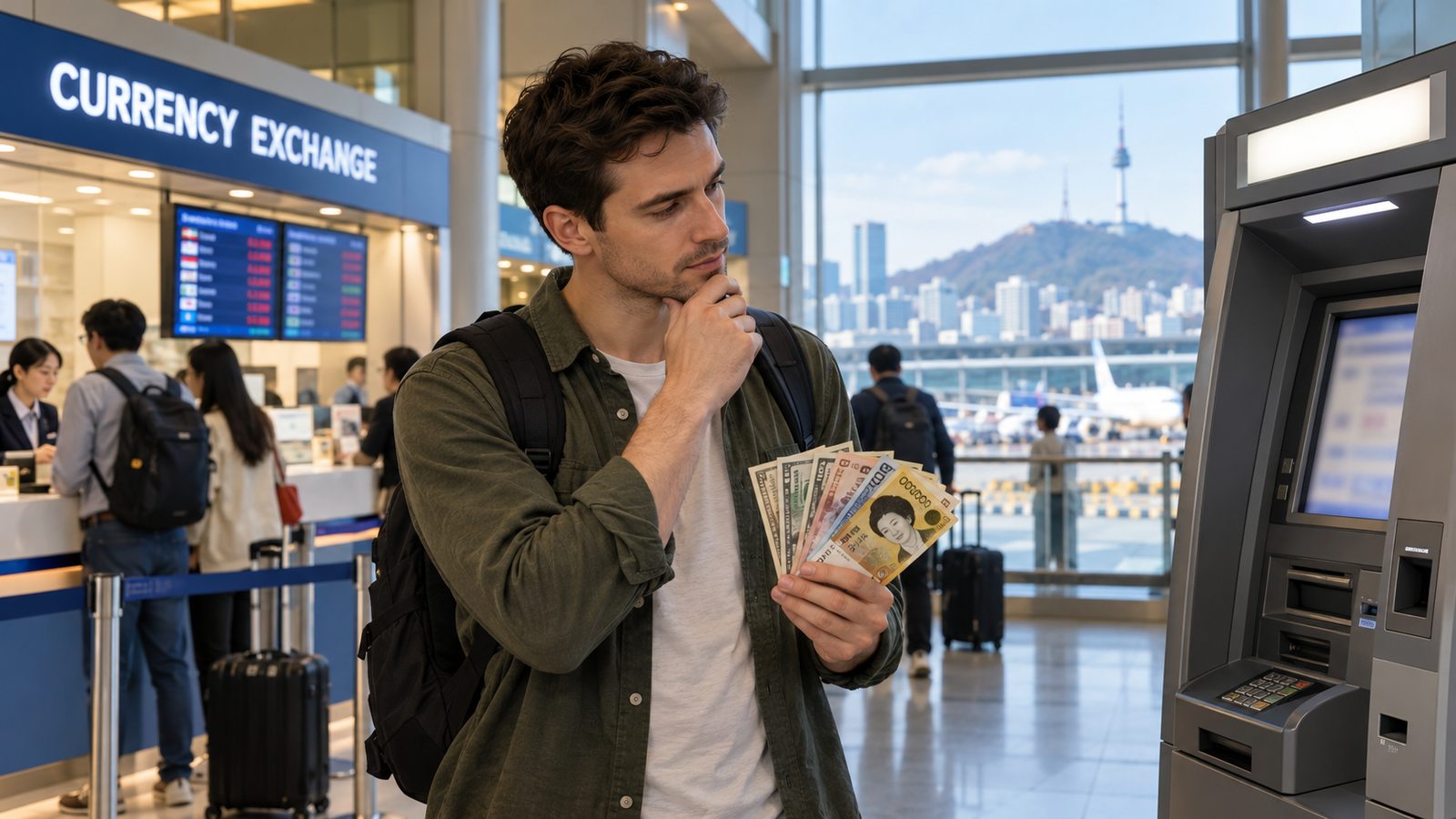
Getting Korean won is easy. Deciding where to get it without paying unnecessary conversion costs is more complicated.
International travelers arriving in South Korea generally have three practical choices: exchange foreign cash at the airport, withdraw won from an ATM with a foreign card, or exchange cash later at a bank or authorized exchange service in Seoul.
There is no single option that is cheapest for every traveler.
Your best choice depends on whether you already carry foreign cash, what your bank charges for international ATM withdrawals, how much Korean won you need, and whether an ATM offers Dynamic Currency Conversion (DCC).
This guide compares the three options so you can decide based on total cost and convenience, not simply the advertised exchange rate.
Quick Answer: Where Should You Exchange Money in Korea?
For many travelers, the most practical strategy is:
- Do not exchange a large amount automatically at the airport.
- If you need cash immediately, get enough Korean won for your first day.
- If your debit card has favorable international withdrawal terms, compare an ATM withdrawal with cash exchange.
- If you brought foreign cash, compare rates at an authorized exchange service in Seoul before exchanging a larger amount.
- Keep paying by card when it is convenient instead of converting your entire travel budget into cash.
The important point is that the best displayed exchange rate is not necessarily the lowest total cost.
An ATM may use a competitive currency-conversion process but still involve ATM and card-issuer fees.
A cash exchange booth may advertise an attractive rate but require you to travel there.
Airport exchange counters prioritize convenience, particularly when you need won immediately after arrival.
Your decision should therefore be based on the final amount of Korean won you receive for the total cost you pay.
Do Tourists Still Need Cash in South Korea?
South Korea is highly card-oriented.
Credit and debit cards are widely accepted at hotels, department stores, restaurants and many other businesses.
However, carrying some Korean won is still useful.
You may encounter situations where cash is convenient or required, including certain transportation-card transactions, traditional-market purchases, small businesses or situations where a foreign card does not work as expected.
The goal should not necessarily be to convert your entire travel budget into cash.
Instead, ask:
How much Korean won will I realistically need before I can use cards for most of my spending?
That question changes the exchange decision significantly.
If you only need a modest cash reserve, spending an hour searching for a marginally better exchange rate may save less money than you expect.
Your Three Main Ways to Get Korean Won
For most international visitors, the practical choices are:
| Option | Best For | Main Advantage | Main Risk |
|---|---|---|---|
| Airport exchange counter | Travelers who need cash immediately | Maximum convenience | Rate may not be the most competitive available |
| Foreign-card ATM withdrawal | Travelers with favorable debit-card terms | No need to carry large foreign-currency cash | ATM, issuer and conversion fees can apply |
| Seoul exchange service | Travelers already carrying foreign cash | Ability to compare displayed cash rates | Requires time, travel and an authorized provider |
None of these should automatically be labeled “best.”
The answer depends on your situation.
Option 1: Exchanging Money at Incheon Airport
Incheon International Airport has bank branches and currency-exchange counters where arriving travelers can obtain Korean won.
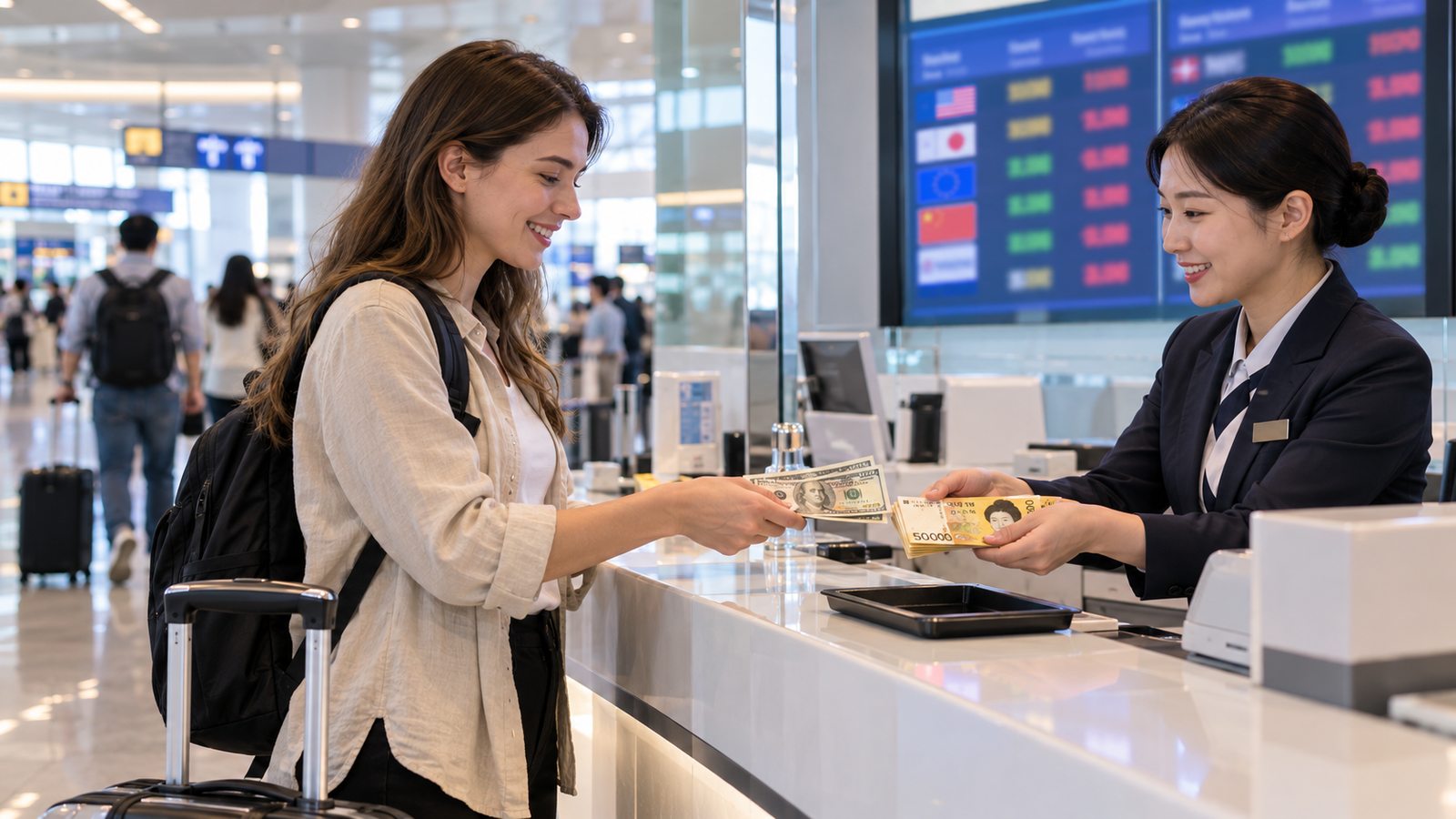
This is the easiest option when you need cash immediately.
That convenience matters.
Imagine arriving after a long flight with luggage and needing Korean won before reaching your hotel. Saving a small amount on exchange costs may not justify adding another task to your first evening.
Advantages of Airport Exchange
Airport exchange is useful because:
- you can obtain won immediately after arrival;
- you do not need to find an ATM compatible with your card;
- you do not need to travel into Seoul before exchanging cash;
- bank-operated exchange services are easy to identify;
- it can provide an emergency cash reserve if your foreign card later fails.
According to Korea Tourism Organization information, travelers can exchange currency at airport bank branches and exchange counters, although operating hours vary by location.
Disadvantages of Airport Exchange
The main disadvantage is that convenience and the best available cash-exchange rate are not the same thing.
Rather than assuming every airport counter is expensive or every Seoul exchange booth is cheaper, compare the amount of won you would actually receive.
For a small first-day exchange, even a less favorable rate may represent a relatively small absolute difference.
For a much larger exchange, the rate difference becomes more important.
When Airport Exchange Makes Sense
Airport exchange becomes particularly reasonable when:
- you arrive with foreign cash but no usable debit card;
- you need Korean won immediately;
- you are uncomfortable using an overseas ATM;
- your card issuer charges high international ATM fees;
- you only need a small amount before reaching your accommodation.
A useful strategy is to exchange only the amount you need immediately, then make the larger decision after you reach the city.
Option 2: Withdrawing Korean Won From an ATM
An ATM can be an efficient way to obtain Korean won because you do not need to bring a large amount of foreign cash into Korea.
But comparing ATM withdrawals with cash exchange requires more than looking at an exchange rate.
Your total ATM cost can include several separate charges.
The Real Cost of an ATM Withdrawal
Think of the cost as:
- ATM operator fee
- card issuer withdrawal fee
- foreign transaction or currency-conversion cost
- possible DCC cost
Not every traveler pays every fee.
That is exactly why there is no universal answer to whether an ATM is cheaper than a currency-exchange booth.
A traveler whose bank reimburses ATM fees and charges favorable international conversion terms may have a very different result from someone whose bank charges both a withdrawal fee and a foreign-transaction fee.
Before traveling, check your card issuer’s terms.
Watch for Dynamic Currency Conversion
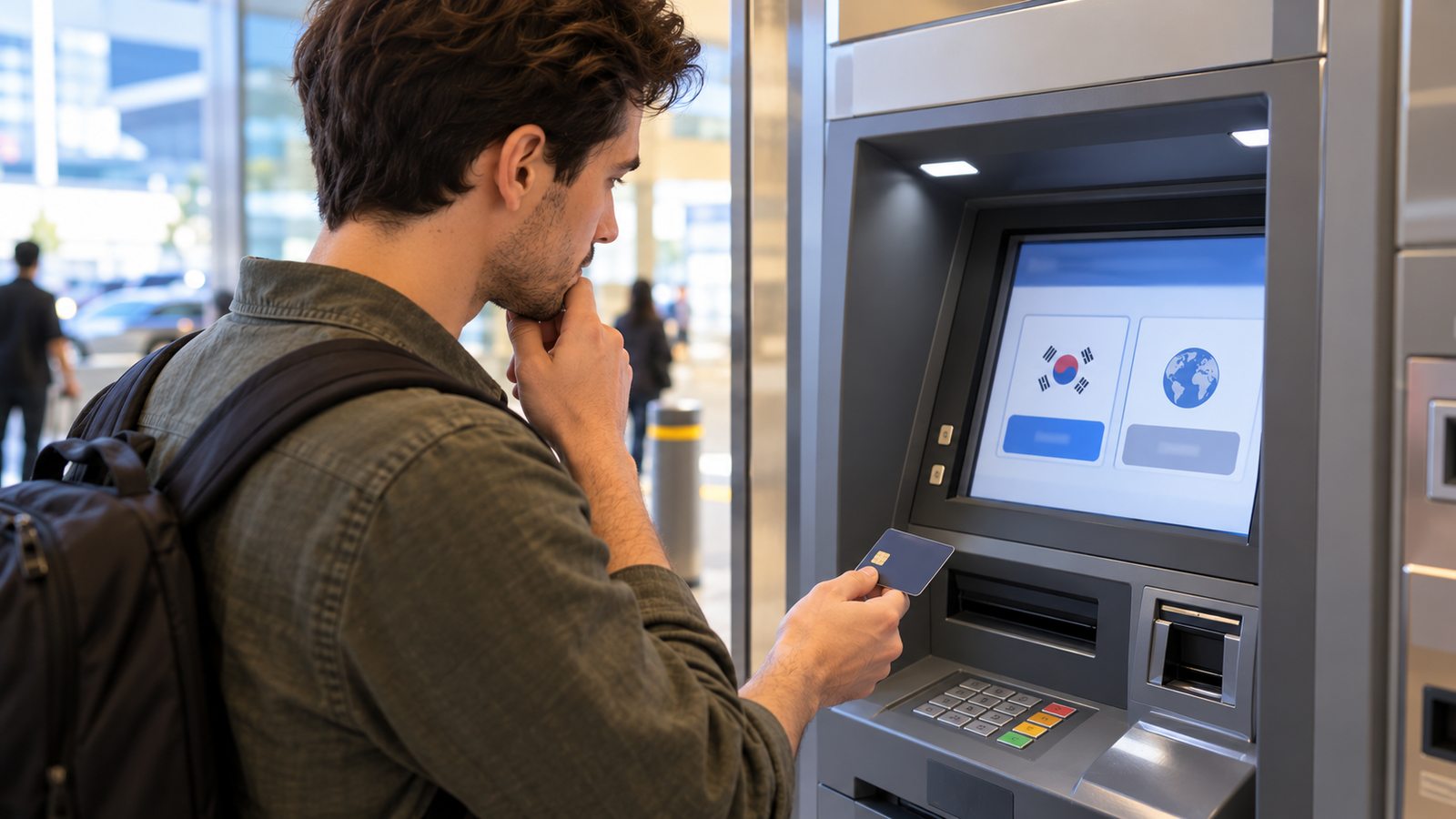
An ATM may offer to convert your withdrawal into your home currency.
This is known as Dynamic Currency Conversion, or DCC.
For example, rather than simply processing a withdrawal in Korean won, the ATM may show how much the transaction will cost in dollars, pounds, euros or another billing currency.
Visa explains that when DCC is offered, the screen should disclose information including the local-currency amount, cardholder-currency amount, exchange rate and applicable additional fees or markup.
You should be allowed to accept or decline that conversion.
The important distinction is:
ATM withdrawal in KRW: the transaction remains denominated in Korean won and conversion is handled according to your card network and issuer terms.
ATM DCC: the ATM or its conversion provider converts the transaction into your billing currency using the displayed conversion terms.
Do not assume that seeing your home currency makes the transaction cheaper.
Read the conversion information before confirming.
For a more detailed explanation of foreign-card ATM fees, compatibility and DCC, see our Korea ATM guide for foreign cards.
Why Withdrawal Frequency Matters
Suppose two travelers need the same total amount of Korean won.
Traveler A makes several small ATM withdrawals.
Traveler B makes one larger withdrawal.
If a fixed ATM fee or issuer withdrawal fee applies each time, Traveler A can end up paying considerably more even though both travelers withdraw the same total amount.
For example, imagine an ATM-related fixed cost of ₩4,000 per transaction purely as a hypothetical illustration.
Four withdrawals would create:
₩4,000 × 4 = ₩16,000
One withdrawal would create:
₩4,000 × 1 = ₩4,000
That does not mean one large withdrawal is always the correct choice. Withdrawal limits, security, cash needs and your bank’s terms still matter.
It simply demonstrates why you should compare total trip cost, not one transaction in isolation.
Option 3: Exchanging Foreign Cash in Seoul
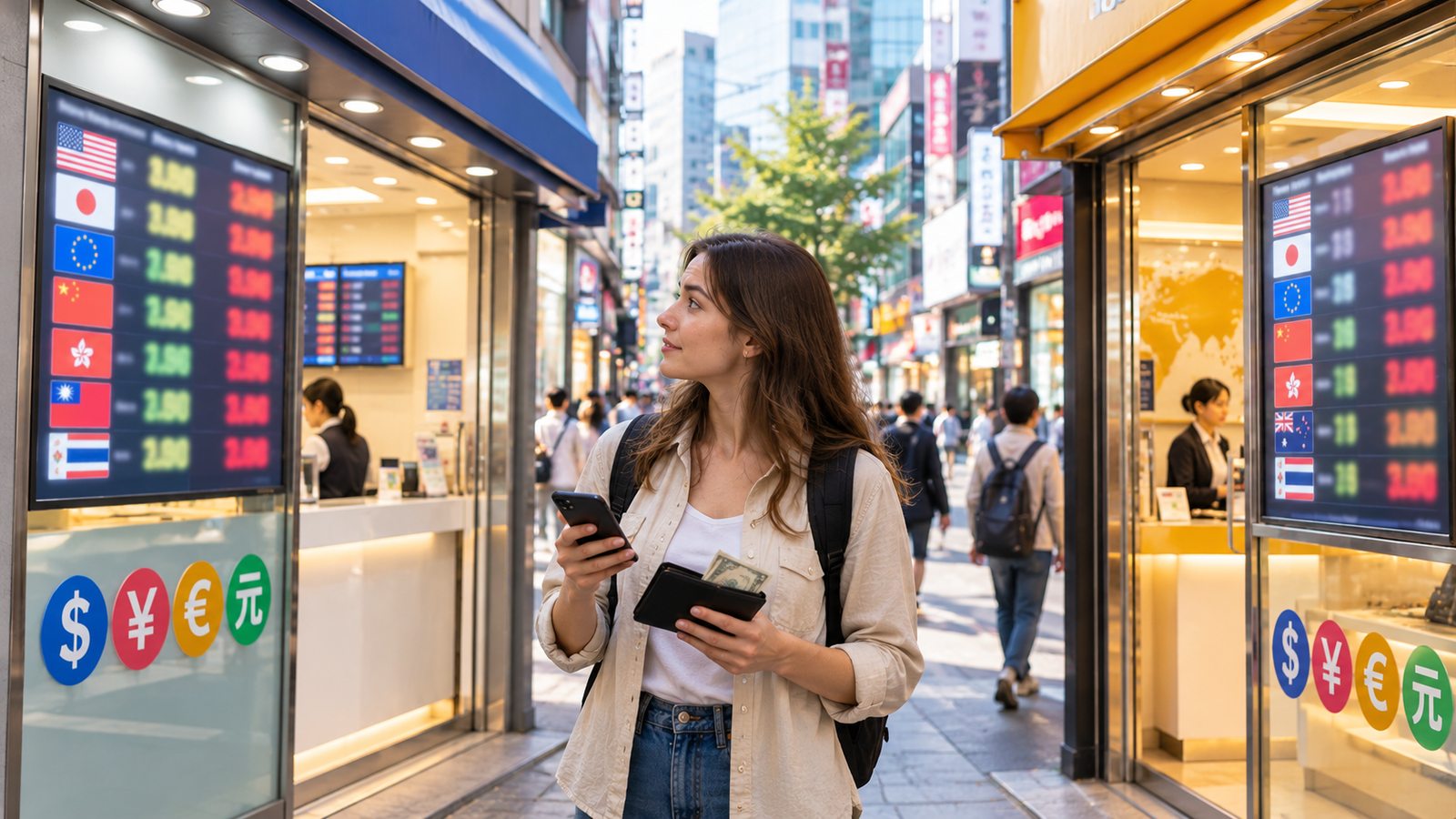
If you arrive with foreign currency, you can also exchange it at banks or authorized exchange services after reaching Seoul.
Korea Tourism Organization advises travelers who need to exchange foreign currency to use a bank or authorized exchange service center.
This option can be attractive because you can compare displayed rates before handing over your money.
Tourist areas such as Myeongdong are well known among international travelers for having multiple currency-exchange businesses within a relatively small area.
However, “Myeongdong is always cheapest” is too broad to use as a rule.
Rates vary by provider, currency and time.
What to Compare at an Exchange Booth
Do not look only for a sign saying:
“No Commission.”
Instead ask:
How much KRW will I receive for my exact amount of foreign currency?
Two exchange services can both advertise no separate commission while offering different exchange rates.
The number that matters is the final Korean won you receive.
For example:
If I exchange USD 300, how many Korean won will I receive?
That question makes different providers easier to compare.
Airport vs ATM vs Seoul Exchange: What Actually Matters?
The correct comparison is not:
Which place has the best exchange rate?
It is:
Which option gives me the most useful Korean won after all costs, inconvenience and risks are considered?
Use this framework:
Airport Cash Exchange
Effective KRW received = foreign cash × offered cash-buying rate
Then consider the value of immediate convenience.
Seoul Cash Exchange
Effective KRW received = foreign cash × offered cash-buying rate − any applicable charges
Also consider transportation and time required to reach the exchange location.
ATM Withdrawal
Effective cost = amount withdrawn + ATM operator fee + issuer withdrawal fee + issuer FX costs + optional DCC-related cost
The structure is more complicated because some fees may appear on the ATM screen while others come from your bank later.
Example: You Need ₩100,000 Soon After Landing
This is primarily a convenience decision.
If you need only enough cash to cover initial expenses, spending substantial time traveling around Seoul for a slightly better exchange rate may not be worthwhile.
Practical options include:
- exchange a small amount at the airport;
- use a compatible foreign-card ATM;
- use cards where possible and exchange later.
For a small amount, convenience can matter more than optimizing every fraction of the exchange rate.
Example: You Need ₩500,000 During Your Trip
Now the decision becomes more meaningful.
If you brought foreign cash, compare the actual won amount available from an authorized Seoul exchange provider.
If you plan to use a debit card, calculate:
- local ATM fee;
- your bank’s ATM fee;
- foreign-transaction or FX fee;
- possible DCC;
- number of withdrawals required.
A card with favorable international terms may make an ATM competitive.
A card with high fixed and percentage-based fees may produce a very different result.
Example: You Need a Large Amount of Cash
The larger the cash requirement, the more carefully you should compare the options.
Check:
- ATM withdrawal limits;
- daily limits imposed by your bank;
- repeated transaction fees;
- the cash-exchange rate;
- whether your currency is readily accepted;
- security considerations around carrying a large amount of cash.
Travelers who need significant cash should avoid making the decision based on a single headline exchange rate. If you are still deciding how much spending money to prepare overall, use our South Korea trip cost calculator to estimate your broader travel budget before deciding how much of it needs to be held in cash.
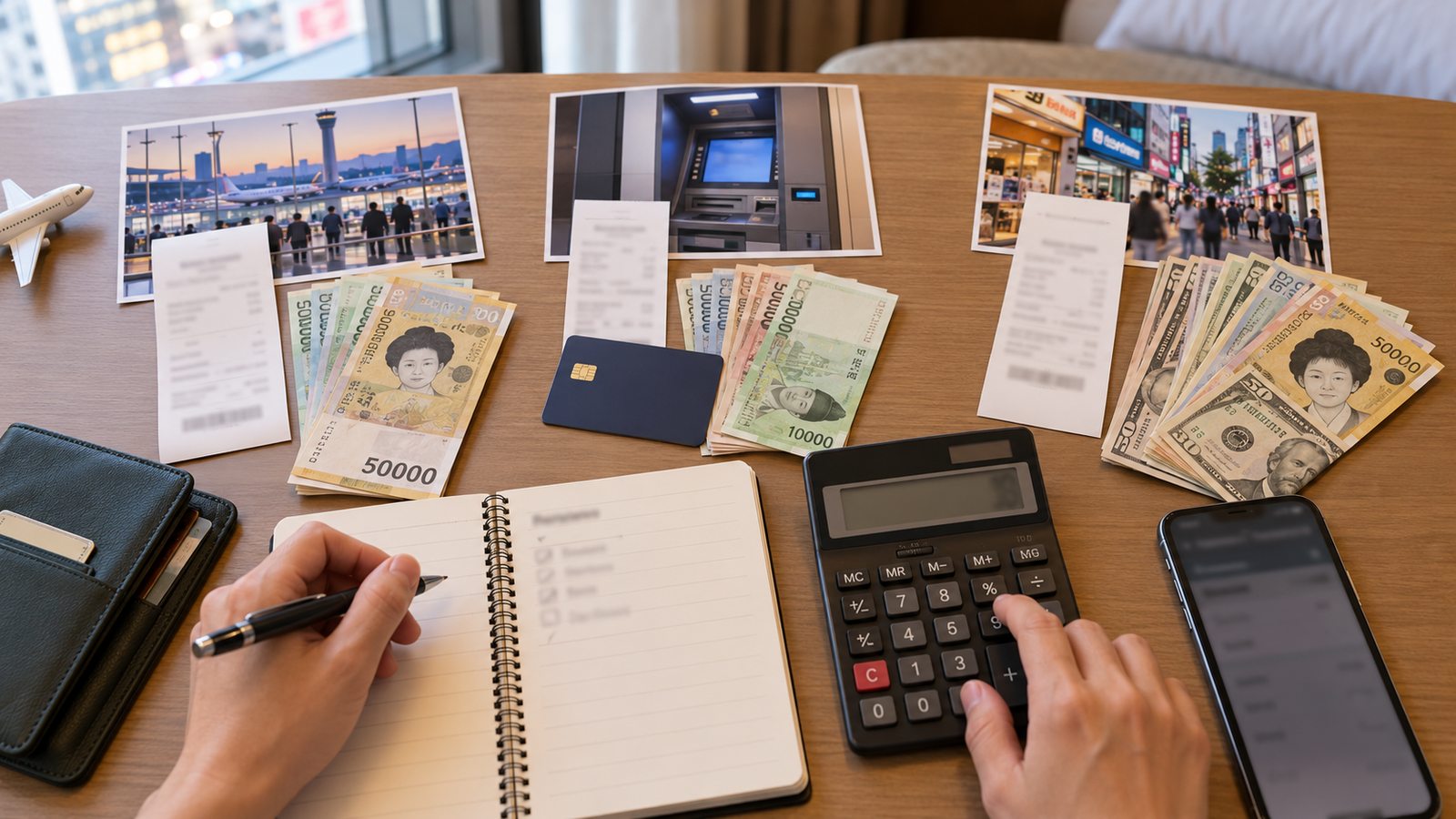
The KFR Currency Exchange Decision Framework
Use these four questions.
1. Do You Already Have Foreign Cash?
Yes: Compare airport and authorized Seoul exchange rates.
No: ATM withdrawal becomes the more relevant cash-acquisition option.
2. Does Your Debit Card Charge International ATM Fees?
Low or no fees: ATM withdrawal deserves serious consideration.
High fees: Cash exchange may become more competitive if you already have suitable foreign currency.
3. Do You Need Won Immediately?
Yes: Airport exchange or an airport ATM may be worth the convenience.
No: You have more flexibility to compare your options after reaching Seoul.
4. How Much Cash Do You Actually Need?
Small emergency amount: prioritize convenience.
Moderate amount: compare total costs.
Large amount: compare rates, fees, withdrawal limits and security carefully.
That produces a much better answer than simply asking where tourists get the “best rate.”
Should You Exchange All Your Travel Money Into Won?
Usually, there is no reason to assume that you must convert your entire Korea travel budget into physical cash.
Cards are widely accepted across South Korea.
Instead, consider dividing your travel spending into:
Card spending + transportation/payment-card needs + Korean-won cash reserve
This reduces the amount of physical cash you carry and lets you make currency decisions as your trip develops.
Our guide to paying in Korea explains where cards, cash and transportation cards fit into a typical trip.
A Simple Currency Exchange Comparison You Can Do Yourself
Before choosing an option, write down three numbers.
Cash Exchange
Foreign currency given: ______
KRW received: ______
ATM
KRW withdrawn: ______
ATM fee: ______
Issuer fee: ______
FX/foreign transaction cost: ______
DCC accepted? Yes / No
Then calculate:
Effective cost per ₩100,000 received
This is much more useful than comparing exchange-rate numbers that use different fee structures.
What About Exchanging Money Before Flying to Korea?
This can be convenient, but it should be treated as another price comparison rather than automatically better or worse.
Ask your home bank or currency provider:
Exactly how much Korean won will I receive for my money after all charges?
Then compare that with your Korean options.
Also confirm that your provider actually stocks Korean won and whether advance ordering is required.
The advantage is certainty: you arrive with usable cash.
The disadvantage is that the offered rate may not be competitive compared with options available after arrival.
What Should You Do Before Your Flight?
A few checks can prevent expensive surprises:
- check your debit card’s foreign ATM fee;
- check its foreign-transaction or currency-conversion fee;
- confirm your daily withdrawal limit;
- bring a backup payment method;
- avoid carrying more cash than necessary;
- understand what DCC looks like before using an ATM;
- check current airport bank and exchange-counter operating hours if you arrive very early or late.
Do this before comparing individual exchange booths.
Your own card terms can change the result more than a small difference between two Korean exchange rates.
Best Strategy by Traveler Type
| Traveler | Practical Starting Strategy |
|---|---|
| First-time visitor who wants immediate cash | Small airport exchange or compatible ATM |
| Traveler with a low-fee international debit card | Compare ATM total cost |
| Traveler carrying USD, JPY, EUR or another accepted currency | Compare authorized cash-exchange rates |
| Traveler arriving late at night | Check airport ATM/exchange availability before arrival |
| Mostly card-paying traveler | Keep only a modest cash reserve |
| Traveler needing a large amount of cash | Compare total costs, limits and security before exchanging |
This is a decision framework, not a guarantee that one method will always be cheaper.
Korea Currency Exchange Checklist
Before exchanging or withdrawing money:
- Decide how much cash you actually need.
- Check your card issuer’s overseas ATM fees.
- Check foreign-transaction and FX fees.
- Confirm your ATM withdrawal limit.
- Compare the final KRW received, not just the advertised rate.
- Read any DCC screen before accepting conversion.
- Use banks or authorized exchange services for cash exchange.
- Keep a backup card or emergency cash source.
- Avoid repeatedly withdrawing small amounts when fixed fees apply.
- Recheck current airport exchange-counter hours before your trip.
FAQ
Is it better to exchange money at Incheon Airport or in Seoul?
It depends on the amount and your priorities. Airport exchange is highly convenient when you need Korean won immediately, while waiting until Seoul gives you more opportunities to compare cash-exchange rates. For a small amount, convenience may outweigh a modest rate difference.
Is using an ATM cheaper than exchanging cash in Korea?
It can be, but not for everyone. The result depends on the Korean ATM fee, your card issuer’s withdrawal fee, foreign-exchange terms and whether DCC is involved. Compare the total cost of receiving the same amount of Korean won.
Should I exchange money in Myeongdong?
Myeongdong has many currency-exchange businesses, making it convenient to compare displayed rates if you already carry foreign cash. Do not assume every Myeongdong exchange service offers the same rate, and use an authorized provider.
Should I accept USD or my home currency when a Korean ATM offers conversion?
That screen is generally related to Dynamic Currency Conversion. Review the displayed exchange rate, markup and fees carefully. Processing the withdrawal in KRW avoids accepting the ATM provider’s DCC conversion, but your own card issuer’s currency-conversion terms still apply.
How much Korean cash should I get when I arrive?
There is no universal amount. Korea is highly card-friendly, so many travelers need cash mainly as a reserve or for specific cash-dependent situations. Estimate your actual cash needs rather than automatically converting your entire travel budget.
Can I exchange foreign currency at a Korean bank?
Yes. Korea Tourism Organization states that travelers can exchange foreign currency at banks or authorized exchange service centers. Bank operating hours and the currencies accepted can vary, so check the location before visiting.
Final Takeaway
There is no universal “best place” to exchange money in Korea.
Airport exchange wins on convenience.
ATMs can work well when your card has favorable international withdrawal terms.
Authorized Seoul exchange services can be useful when you already carry foreign cash and want to compare rates.
The smartest strategy is to compare the final cost of obtaining the amount of Korean won you actually need.
For many travelers, that means getting only enough cash for immediate needs, using cards for much of their spending, and avoiding unnecessary conversions or repeated withdrawal fees.
The question is not simply:
“Where is the best exchange rate in Korea?”
A better question is:
“Which method gives me the Korean won I need at the lowest total cost for my situation?”
Sources & Further Reading
- Korea Tourism Organization — Korean Currency & Exchange Info
- Korea Tourism Organization — Foreign Exchange Banks in Airports
- Incheon International Airport — Information & Services / Bank and Currency Exchange Locations
- Visa — What You Should Know About Dynamic Currency Conversion
- Mastercard — Dynamic Currency Conversion guidance