
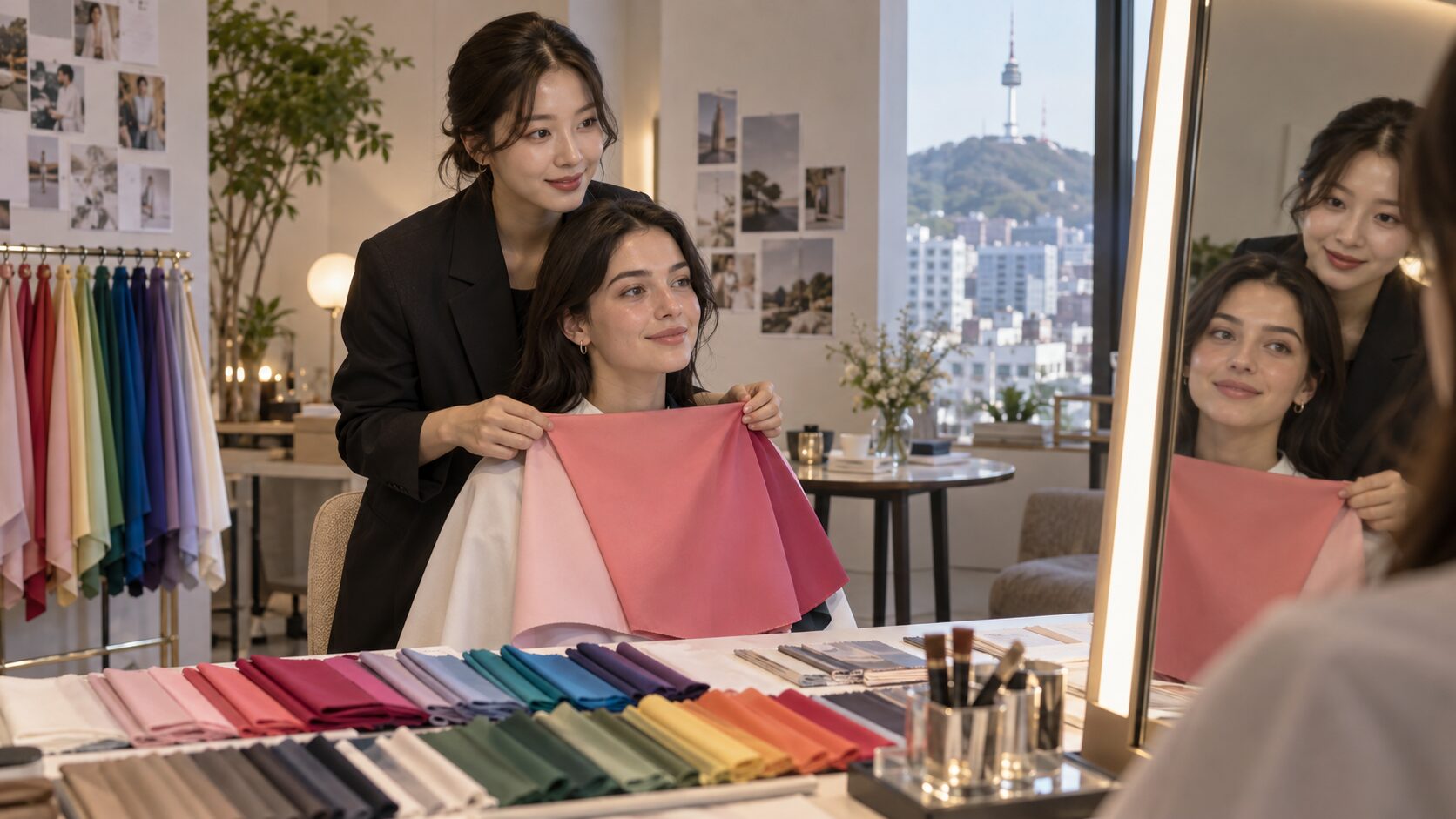
If you have watched Korean beauty or travel content on social media, you may have seen the scene: a client sits in front of a mirror while a consultant places dozens of colored fabrics beneath their face.
One shade seems to make the complexion look brighter. Another suddenly emphasizes shadows. After comparing warm and cool tones, light and dark colors, and different levels of saturation, the consultant eventually recommends a personal palette.
This is Korean personal color analysis, and it has become more than a local beauty trend.
For travelers interested in K-beauty, fashion and styling, booking a personal color session has become one of the experiences to consider adding to a Seoul itinerary. In 2026, Korea’s official tourism promotion has continued to feature personal color consultations as part of the country’s growing beauty tourism scene.
But what actually happens during a session? And how seriously should you take the result?
Here is what to know before booking a personal color analysis in Seoul.
What Is Korean Personal Color Analysis?
Personal color analysis is a styling method designed to identify colors that appear harmonious with a person’s natural coloring.
Rather than asking which colors you simply like, a consultant usually looks at how different colors interact visually with your face. Skin appearance, hair and eye coloring, contrast, brightness and the effect of different fabric colors can all play a role.
In Korea, one of the most recognizable approaches is the seasonal color system.
You may hear categories such as:
- Spring
- Summer
- Autumn
- Winter
These are often divided further into more specific subtypes depending on the studio and system being used.
The basic idea is straightforward: two people may look very different in exactly the same lipstick, shirt or hair color, even if both personally like the shade.
A personal color consultation attempts to turn those differences into a practical palette for makeup, clothing, accessories and sometimes hair color.
How Does a Personal Color Analysis Work in Korea?
The exact process varies between studios, but a typical session starts with the consultant trying to see your natural coloring as clearly as possible.
That is important because heavy foundation, colored contact lenses or strongly colored lighting can affect how colors appear around the face.
Some studios may therefore ask clients to arrive with little or no makeup, or remove some makeup before the analysis.
Then comes the part most people recognize from social media: color draping.
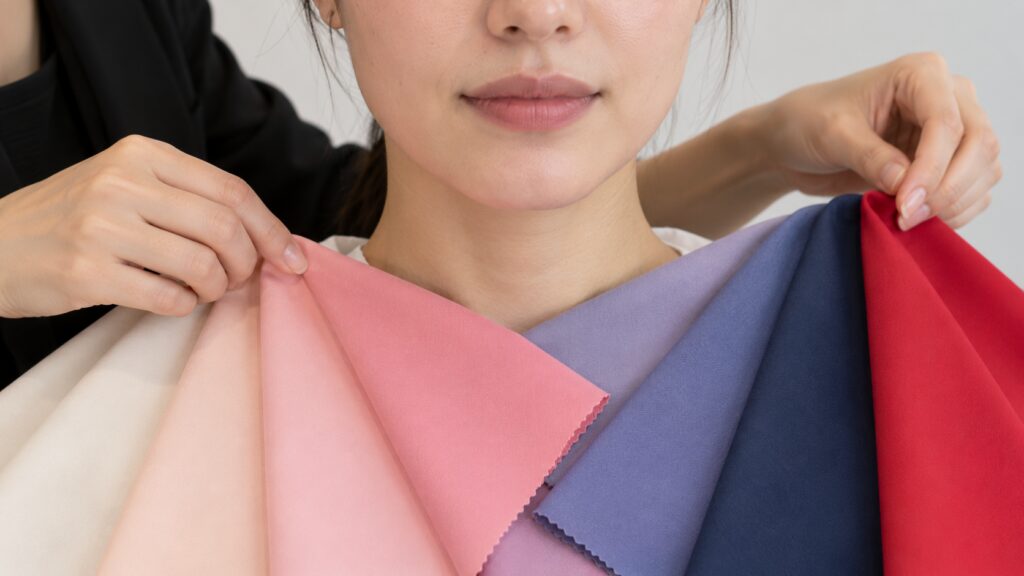
The consultant places different colored fabrics near your face and compares how each one affects your overall appearance.
The goal may be to see whether a color appears to make the complexion look clearer or duller, whether facial shadows seem more or less noticeable, and whether the color overwhelms the face or works naturally with it.
The comparison can include several dimensions.
Warm vs. Cool
One of the first distinctions is often whether warmer or cooler colors appear more harmonious.
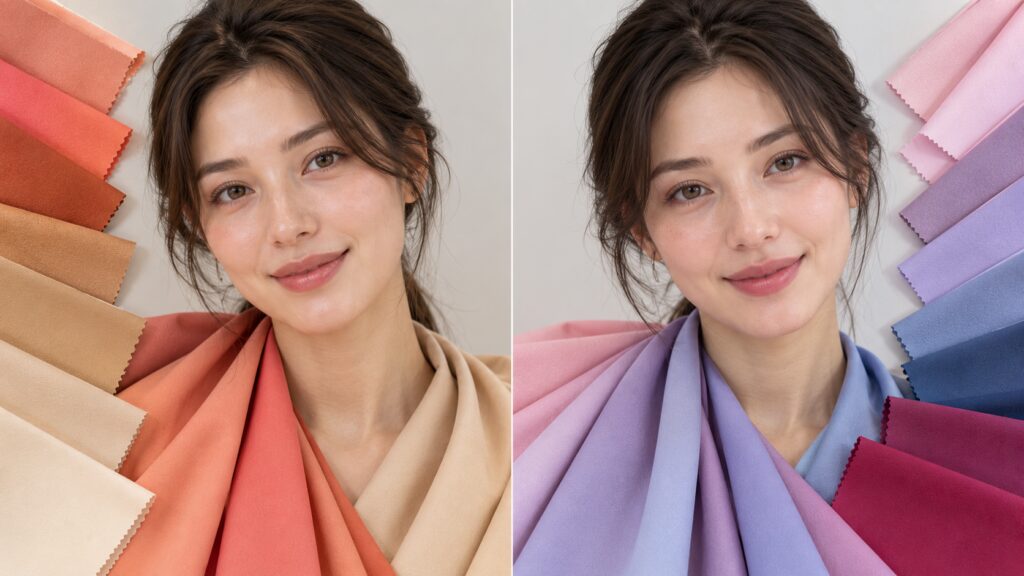
Warm palettes may lean toward peach, coral, warm beige, camel or earthy shades, while cooler palettes may include blue-based pinks, cooler reds, lavender, gray or crisp blue tones.
But personal color analysis is usually more complicated than simply deciding whether your skin is “warm” or “cool.”
Light vs. Deep
The consultant may also compare lighter colors with deeper shades.
Someone may respond well to soft, pale colors while another person’s features may work better with richer or darker tones.
Clear vs. Muted
Saturation can matter too.
Bright, clear colors can look striking on some people but overpowering on others. Muted or softened colors can have the opposite effect.
By comparing these characteristics, the consultant gradually narrows down a palette and, in many Korean systems, a seasonal type or subtype.
Spring, Summer, Autumn or Winter: What Do the Results Mean?
The four-season terminology is easy to remember, which is one reason it has become so recognizable.
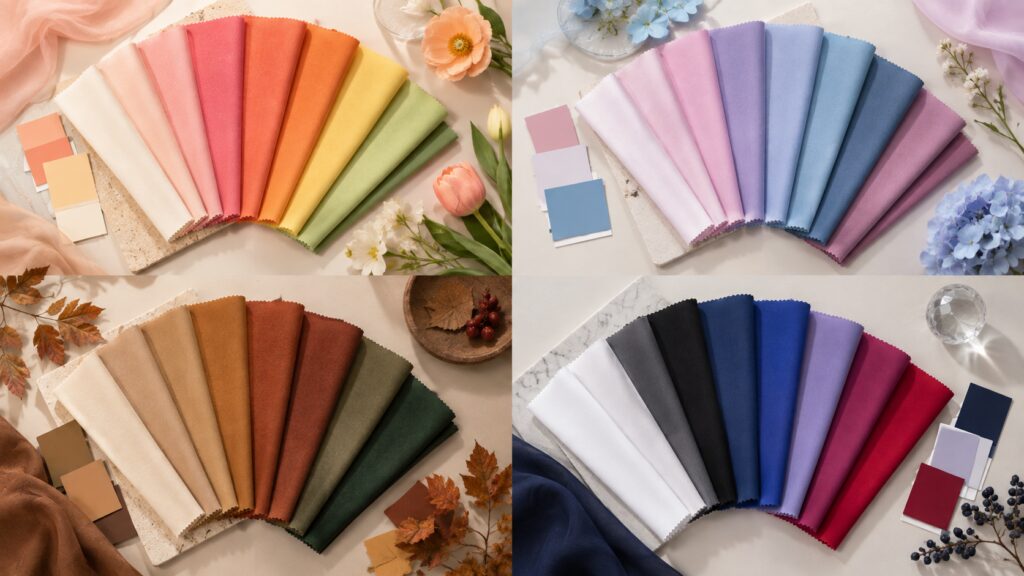
In simplified form, Spring palettes are often associated with warm, fresh and relatively bright colors. Summer commonly refers to cooler, softer or lighter colors. Autumn tends to emphasize warmer, muted and earthy shades, while Winter is often associated with cooler, clearer and higher-contrast colors.
But there is an important caveat.
Not every Korean studio uses exactly the same classification system.
Some use four seasons, while others divide those categories into more detailed subtypes. Different systems can also emphasize different characteristics such as temperature, brightness, saturation or contrast.
Korean academic research comparing personal color systems has found differences in how different systems classify seasonal types. That is a useful reminder that your result should not be treated like a universal biological category.
Think of it as a styling framework rather than a permanent label.
Why Is Personal Color Analysis So Popular in Korea?
To understand its popularity, it helps to look beyond the color fabrics.
Korean beauty culture is highly specific about color.
Walk through a large beauty store in Seoul and a single lip product may come in numerous shades that look surprisingly similar at first glance. Foundations and cushions are discussed by undertone. Blushes range from warm peach to muted mauve. Hair colors, nail colors and clothing palettes are often described with similar attention to tone.
Personal color analysis gives consumers a vocabulary for navigating all those choices.
Instead of asking:
“What lipstick looks good?”
the question becomes:
“Which lipstick works with my tone?”
That fits naturally into a beauty market built around customization and detailed product selection.
K-pop and Korean entertainment culture have also helped make personal color terminology familiar to international audiences, while social media turned the visually satisfying draping process into highly shareable content.
By 2023, international reporting was already documenting travelers who booked personal color consultations as part of their Seoul trips after discovering the experience online.
What is more interesting is that the trend did not disappear.
In 2026, personal color analysis remains visible within Korea’s official beauty tourism promotion.
Why Travelers Are Booking Personal Color Analysis in Seoul
For international visitors, the appeal is slightly different from simply getting styling advice at home.
It can become part of the travel experience itself.
A session combines several things Korea is currently known for internationally: beauty, fashion, customization and highly specialized services.
That combination is increasingly part of K-beauty tourism in Korea, where travelers build beauty, styling and wellness experiences into their itineraries instead of limiting K-beauty travel to shopping for products.
At the 2026 Korea Beauty Festival, organized as a global beauty tourism event, international visitors were offered one-on-one beauty experiences including personal color consultation. Korea’s official tourism platform also promoted hundreds of bookable beauty experiences across makeup, hair, skincare and wellness.
Seoul’s official tourism website now lists personal color services specifically aimed at international travelers as well.
Some offer consultations in English and other languages, making the experience considerably easier for visitors than it was during the early stages of the trend.
That tells us something important: personal color analysis is no longer simply a Korean social-media curiosity. It has become part of the infrastructure surrounding K-beauty travel.
What Happens After Your Personal Color Analysis?
This may be the most practical part of the experience.
You do not necessarily leave with only a label such as “Summer” or “Autumn.”
Depending on the program, a consultation may include recommendations for makeup, hair color, clothing or accessories. Some studios provide color cards or palette references that clients can keep.
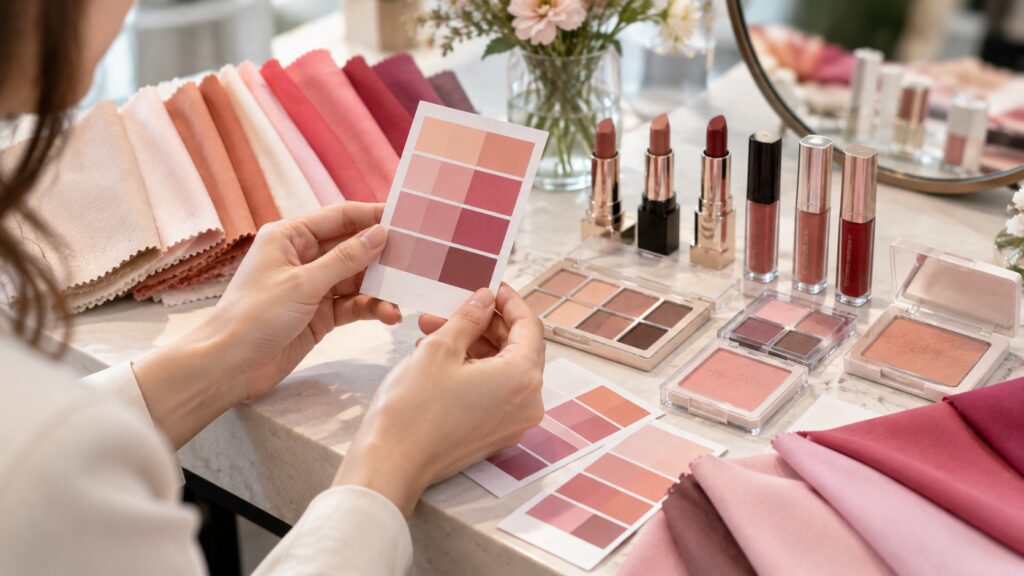
That can be useful if you are planning to shop for beauty products while in Korea.
Imagine walking into a Seoul beauty store and facing dozens of lipstick shades.
Without a reference point, it is easy to choose by packaging, popularity or whatever looks attractive on the display.
After a color consultation, you may have a clearer idea of whether you want to start with cooler pinks, warm corals, muted shades or clearer colors.
It does not mean you are forbidden from wearing anything outside your recommended palette.
Personal color should make shopping easier—not turn your makeup bag into a rulebook.
When Should You Book It During a Seoul Trip?
If personal color analysis is high on your list, there is a practical argument for booking it relatively early in your trip.
Because the recommendations can then inform the beauty and fashion shopping you do afterward.
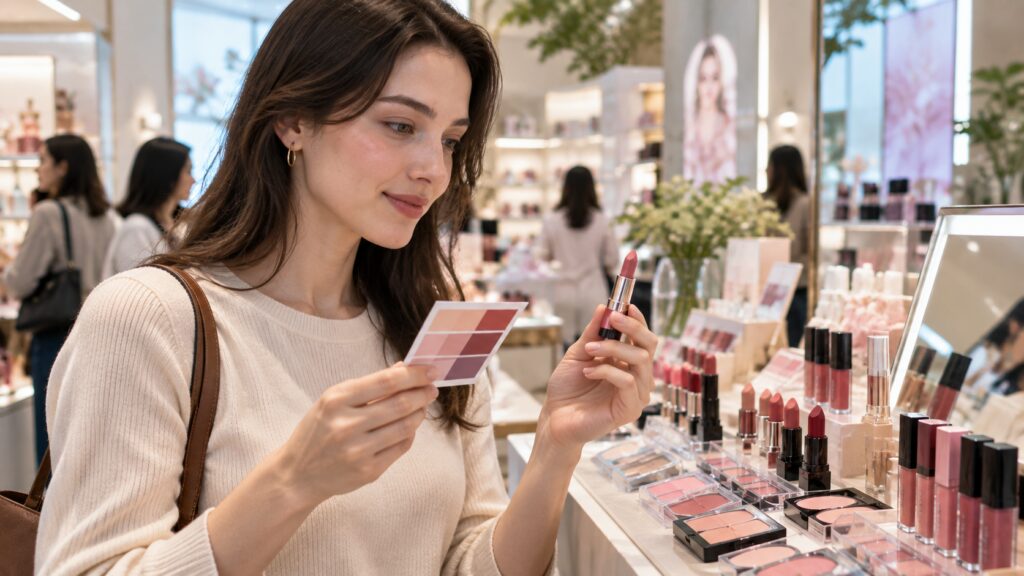
A traveler interested in K-beauty could, for example, schedule a personal color consultation before visiting major shopping areas and then use the resulting palette as a reference while looking at lip colors, blush, eye makeup or clothing.
This makes the experience more connected to the rest of the trip rather than treating it as an isolated appointment.
Just avoid packing your schedule too tightly. A beauty consultation is more enjoyable when you are not checking the clock every five minutes before your next reservation.
How Long Does Korean Personal Color Analysis Take?
There is no universal session length.
A quick basic consultation and a detailed one-on-one analysis are very different products.
Some consultations can take around an hour, while more detailed programs may run longer depending on the number of tests and whether makeup, body-type analysis or additional styling advice is included.
The safest approach is to check the duration of the exact program before booking rather than assuming every “personal color analysis” offers the same experience.
This is especially important when planning it between other activities in Seoul.
What Should Travelers Check Before Booking?
Start with language.
A highly detailed color consultation is less useful if you cannot understand why the consultant is recommending particular shades.
Fortunately, some Seoul studios now explicitly advertise services in English and other languages for international visitors.
Next, look carefully at what the booking actually includes.
Does the session provide only a seasonal color result, or does it include makeup recommendations? Will you receive a palette card? Is hair color discussed? Is it a private consultation or a group session?
Also check the cancellation policy and whether reservations are required.
Popular studios can become busy, so a personal color session is one of those Seoul activities that may be worth arranging before you arrive rather than leaving entirely to chance.
Should You Wear Makeup to a Personal Color Analysis?
Follow the instructions from the studio you book.
In general, consultants want to evaluate how colors interact with your natural appearance, so heavy makeup can make that more difficult.
Some services may ask you to arrive without makeup. Others may provide an opportunity to remove it before the analysis.
Colored contact lenses can also change the visual balance of the face, so check whether the studio recommends removing them.
If you are unsure, ask the studio before your appointment rather than trying to guess.
Is Korean Personal Color Analysis Scientifically Accurate?
This question deserves a careful answer.
There is academic research in Korea examining personal color systems, color harmony, skin color characteristics and methods for making color classification more quantitative.
However, that does not mean a personal color consultation should be treated as a medical or scientific diagnosis.
Research comparing different personal color systems has found that classification results and criteria can vary between systems. More recent Korean research has also discussed inconsistency in conventional seasonal or warm-versus-cool classifications and explored other ways of interpreting color harmony.
In practical consultations, the method used by the studio and the judgment of the consultant can influence the result.
So if two consultants give you slightly different subtypes, it does not necessarily mean one has discovered a hidden truth and the other has failed.
The most useful question is probably not:
“Is this objectively my one true color type?”
It is:
“Do these recommendations help me understand which colors I enjoy wearing and how different colors change my overall appearance?”
Used that way, personal color analysis can be a useful styling tool.
It is not a medical diagnosis, and it should not be presented as one.
Is Personal Color Analysis Worth Adding to a Seoul Trip?
For every traveler? Probably not.
If your ideal Seoul itinerary is entirely about palaces, hiking and food, there is no reason to book a beauty consultation simply because it is trending.
But if you are already interested in Korean makeup, fashion or beauty shopping, personal color analysis can make sense.
It offers something that buying another product cannot: a personalized experience.
And it can change how you approach the shopping you do afterward.
That is also why the trend fits into a larger shift in Korean tourism.
For years, international interest in K-beauty largely meant purchasing Korean products. Increasingly, visitors are also looking for experiences—makeup sessions, styling consultations, skincare services, fragrance workshops and other activities they can participate in while they are actually in Korea.
Personal color can also connect naturally with a Korean makeup experience, where the results may help guide choices such as lip, blush and eye colors during a professional session or lesson.
Another increasingly visible Seoul beauty experience is the Korean head spa, where scalp and hair care are combined with the relaxation-focused side of Korea’s beauty culture.
Personal color analysis sits neatly at the intersection of those trends.
You arrive curious about Korean beauty.
You sit down in front of a mirror.
Dozens of colors pass beneath your face.
And you may leave Seoul seeing your makeup drawer—and perhaps that beige shirt you have owned for five years—a little differently.
That is what makes Korean personal color analysis more than another item on a beauty shopping list. For the right traveler, it is a small but distinctly contemporary way to experience how beauty and personal styling are being explored in Korea today.
Frequently Asked Questions
What is Korean personal color analysis?
Korean personal color analysis is a styling consultation that compares different colors around your face to identify shades that appear harmonious with your natural coloring. Many Korean systems organize the results into seasonal categories such as Spring, Summer, Autumn and Winter, sometimes with additional subtypes.
How long does a personal color analysis take in Seoul?
Session length varies by studio and program. A basic consultation may take around an hour, while more detailed sessions can take longer if they include makeup recommendations, body-type analysis or additional styling advice. Always check the duration of the specific program before booking.
Should I wear makeup to a personal color analysis?
Follow your studio’s instructions. Because makeup can affect how colors appear against your face, some consultants recommend arriving with little or no makeup or removing it before the analysis. You may also be asked about colored contact lenses.
Can foreigners get personal color analysis in Seoul in English?
Yes. Some Seoul studios specifically offer personal color consultations for international visitors, including services in English. Seoul’s official tourism website lists facilities offering consultations in English and, at some locations, additional languages. Language availability should still be confirmed when booking.
Is Korean personal color analysis scientifically proven?
Personal color and color harmony have been studied academically, including in Korea, but a commercial personal color consultation should not be treated as a medical or scientific diagnosis. Different systems and consultants can produce different classifications. It is more useful to view the result as a styling framework for exploring colors that work well for you.
Is personal color analysis worth doing in Seoul?
It can be especially worthwhile for travelers interested in K-beauty, makeup, fashion or shopping. Receiving the analysis early in your trip can also give you a useful reference when choosing makeup or clothing later. Travelers with little interest in beauty or styling may prefer to spend their time on other Seoul experiences.
Sources & Further Reading
1. VISITKOREA — 2026 Korea Beauty Festival: From Makeover to Personal Color Tests!
2. Visit Seoul — Color Signal Personal Color Analysis in Gangnam
3. Visit Seoul — Myeongdong Personal Color & Makeup Colorholic
4. TIME — ‘Personal Color Analysis’ Has Gone Viral—Fueling a Tourism Boom for South Korea