
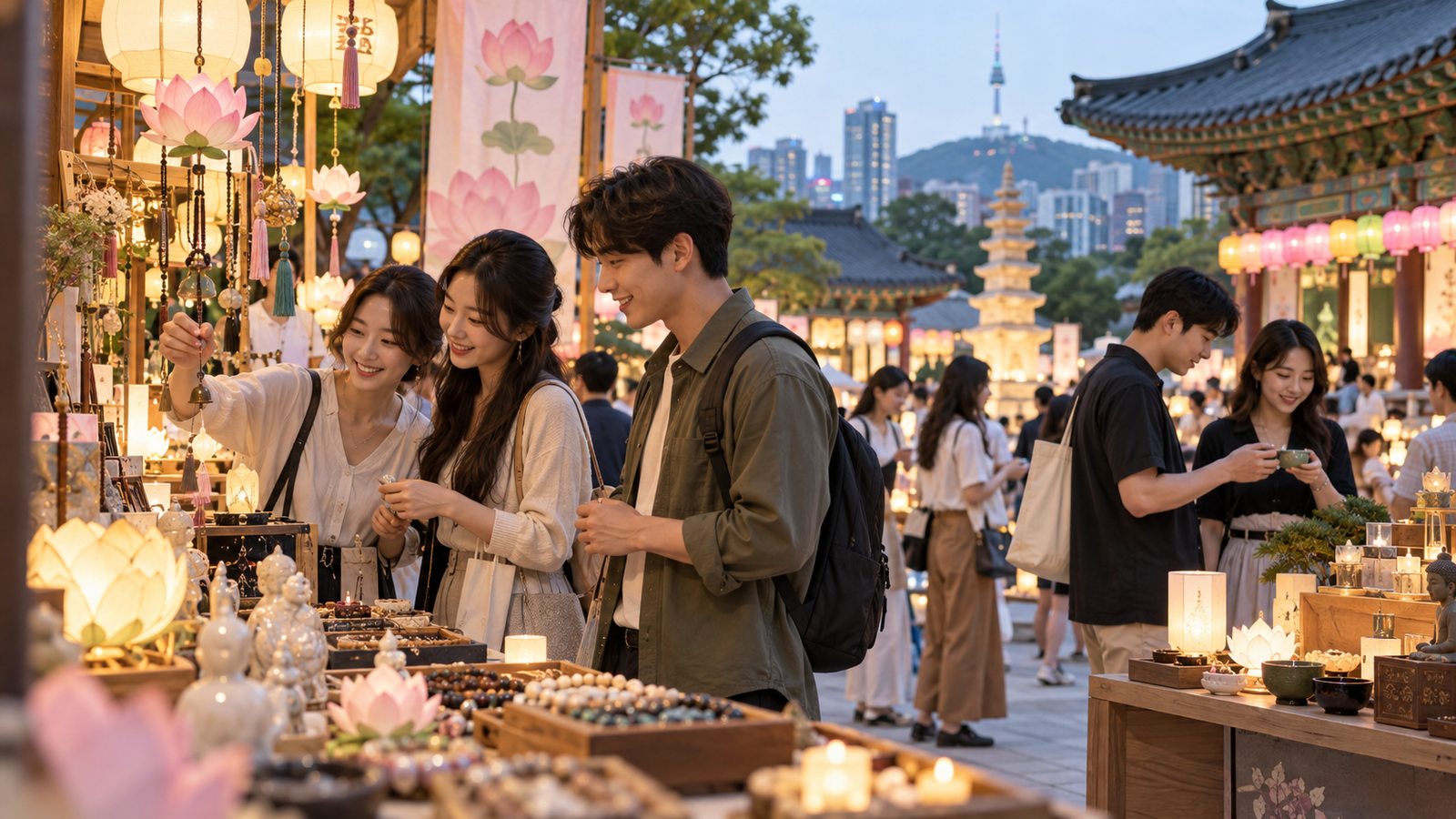
Buddhism may be one of Korea’s oldest religious traditions, but some of its newest fans are discovering it through surprisingly modern channels: meme-covered T-shirts, meditation classes, pop-up stores, electronic music, temple merchandise and even viral keyrings that make the sound of a moktak, a wooden percussion instrument used in Buddhist practice.
In Korea, this cultural shift is often described as “Hip Buddhism” — a younger, more approachable way of engaging with Buddhist ideas and imagery.
The numbers suggest there is more happening than a short-lived social-media joke. According to the Jogye Order of Korean Buddhism, the 2026 Seoul International Buddhism Expo attracted about 250,000 visitors. Millennials and Gen Z accounted for 81.7% of visitors, while roughly 40% reported having no religious affiliation.
So are young Koreans suddenly becoming Buddhist?
Not exactly.
The more interesting story is how Buddhism is moving beyond formal religious identity and entering Korean youth culture through humor, design, mindfulness, merchandise and the search for a slower, less competitive way of thinking about life.
What Does “Hip Buddhism” Mean in Korea?
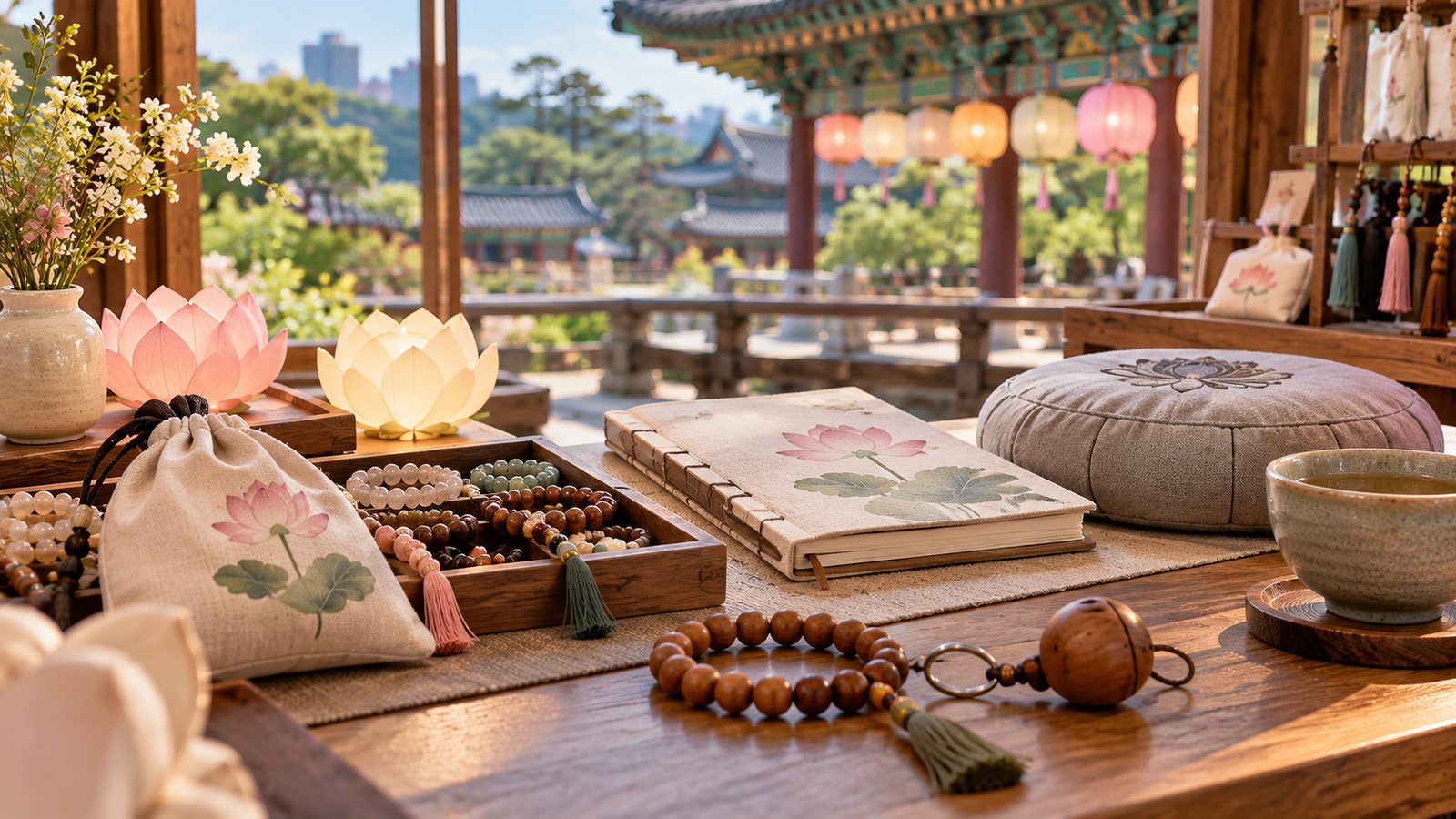
“Hip Buddhism” is not a new school of Buddhism or an official religious movement.
It is an informal label used to describe the increasingly contemporary way Buddhist ideas, symbols and experiences are being presented and consumed in Korea.
A young Korean interested in the trend might visit a Buddhist expo without identifying as Buddhist, buy a T-shirt built around a Buddhist joke, try meditation, watch short clips of a monk giving life advice, visit a temple with friends or carry a Buddhist-inspired charm.
That distinction matters.
Interest in Buddhist culture is not the same as religious conversion.
Korea’s Hip Buddhism trend sits somewhere between religion, philosophy, wellness, design and popular culture. That ambiguity may actually be one reason it has become accessible to people who would hesitate to join an organized religion.
The Numbers Behind Korea’s Hip Buddhism Trend
The 2026 Seoul International Buddhism Expo provides one of the clearest signs of the change.
The Jogye Order reported approximately 250,000 visitors over four days, about 50,000 more than the previous year.
More strikingly, 81.7% of visitors were from the MZ generation — Korea’s commonly used label encompassing millennials and Gen Z — while around 40% were religiously unaffiliated.
The trend is not limited to merchandise fairs.
The Jogye Order also reported that approximately 50,000 people participated in the 2026 International Seon Meditation Summit, with people in their 20s and 30s accounting for 55.9% of participants.
These figures do not prove that young Koreans are converting to Buddhism.
They show something different: Buddhist culture and practices are attracting substantial participation from younger people, including many who do not identify with a religion.
Why Is Buddhism Appealing to Young Koreans?
There is no single explanation, but several parts of contemporary Korean life help make the trend understandable.
1. Buddhist Messages Can Feel Like an Escape From Constant Competition
Young adults in Korea have grown up in a society strongly shaped by education, career competition, housing costs, social comparison and digital life.
Against that background, Buddhist ideas about attachment, desire, acceptance and letting go can sound surprisingly contemporary.
The message is almost the opposite of much of modern consumer culture.
Instead of:
achieve more, own more, compete more
the appeal can be interpreted as:
you do not have to chase everything.
That does not mean every young visitor is studying Buddhist doctrine. Sometimes a simple phrase about letting go of worry is enough to create an emotional connection.
This is one reason Buddhist-inspired products frequently turn traditional concepts into short, humorous or comforting messages that fit naturally into contemporary Korean internet culture.
2. Buddhism Is Being Presented With Humor
Religion is usually associated with seriousness.
Hip Buddhism often does the opposite.
At recent Buddhist expos and pop-ups, visitors have encountered shirts, stickers, towels, accessories and other merchandise that reinterpret Buddhist ideas through memes and wordplay.
Some events have mixed Buddhist imagery with DJs, hip-hop and electronic music.
That does not replace traditional Buddhist practice. Instead, it lowers the cultural barrier for people who might otherwise assume that a Buddhist event is only for practicing believers.
A visitor can arrive because a product looks funny or stylish and encounter Buddhist ideas after entering the space.
From Temple Merch to Department Store Pop-Ups
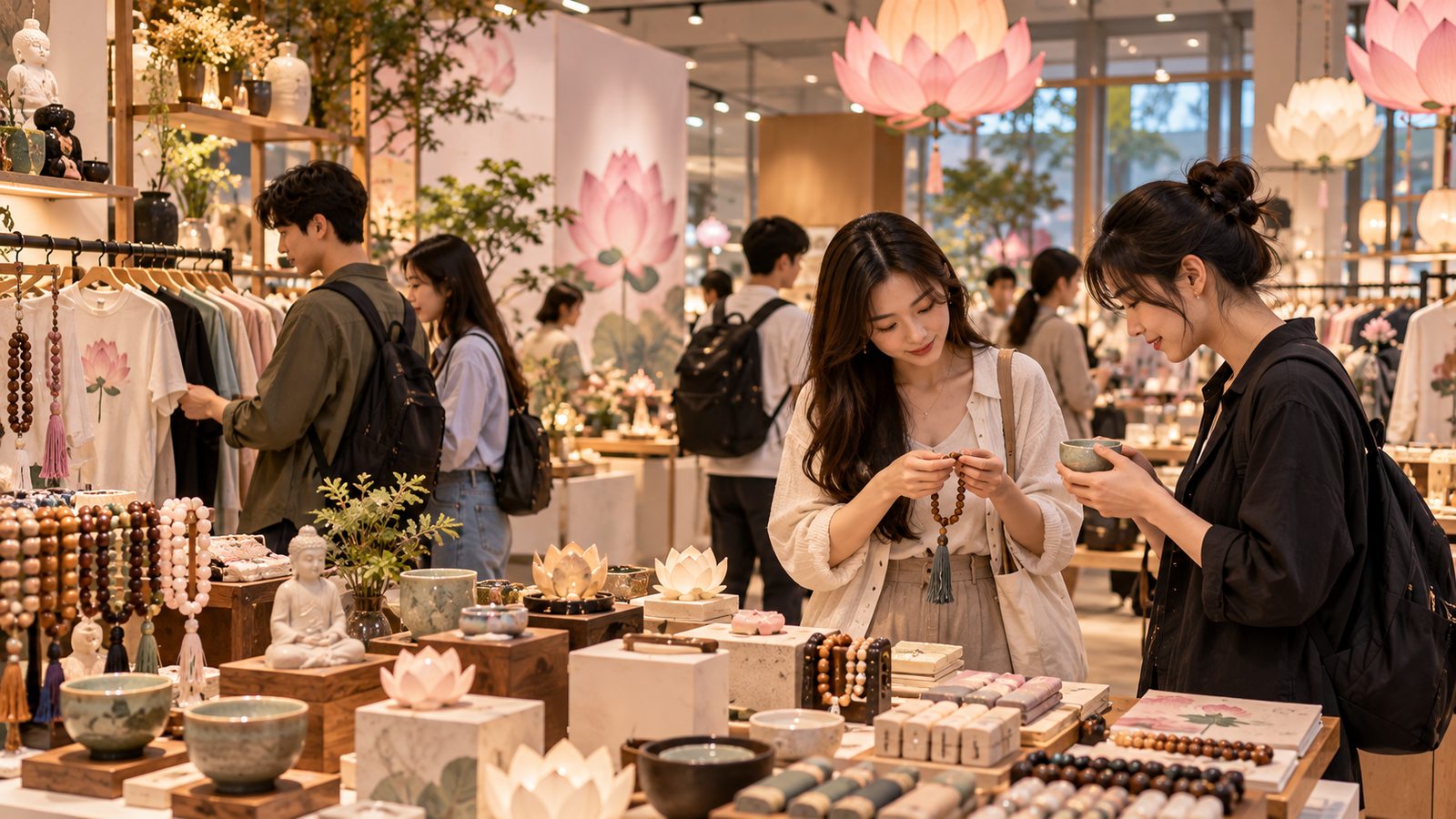
The trend has increasingly moved beyond temples and Buddhist events.
In 2026, Buddhist-themed pop-ups appeared in major Korean retail spaces, selling prayer-bead-inspired accessories, clothing, keyrings, home goods and other products that reinterpret Buddhist symbols for everyday use.
At one Temple Week event at The Hyundai Seoul, people in their 20s and 30s reportedly accounted for 70% of customers making purchases at the pop-up stores.
Meditation and temple-food programs also drew strong demand.
This crossover is important because it changes where people encounter Buddhism.
Someone no longer has to decide, “I am going to visit a Buddhist temple.”
They may first encounter Buddhist culture while visiting a shopping mall.
That turns Buddhism into something that can be discovered through the same spaces where younger Koreans encounter fashion, food, pop-ups and lifestyle brands.
The Viral “Gongdeok Keyring” Shows How the Trend Works
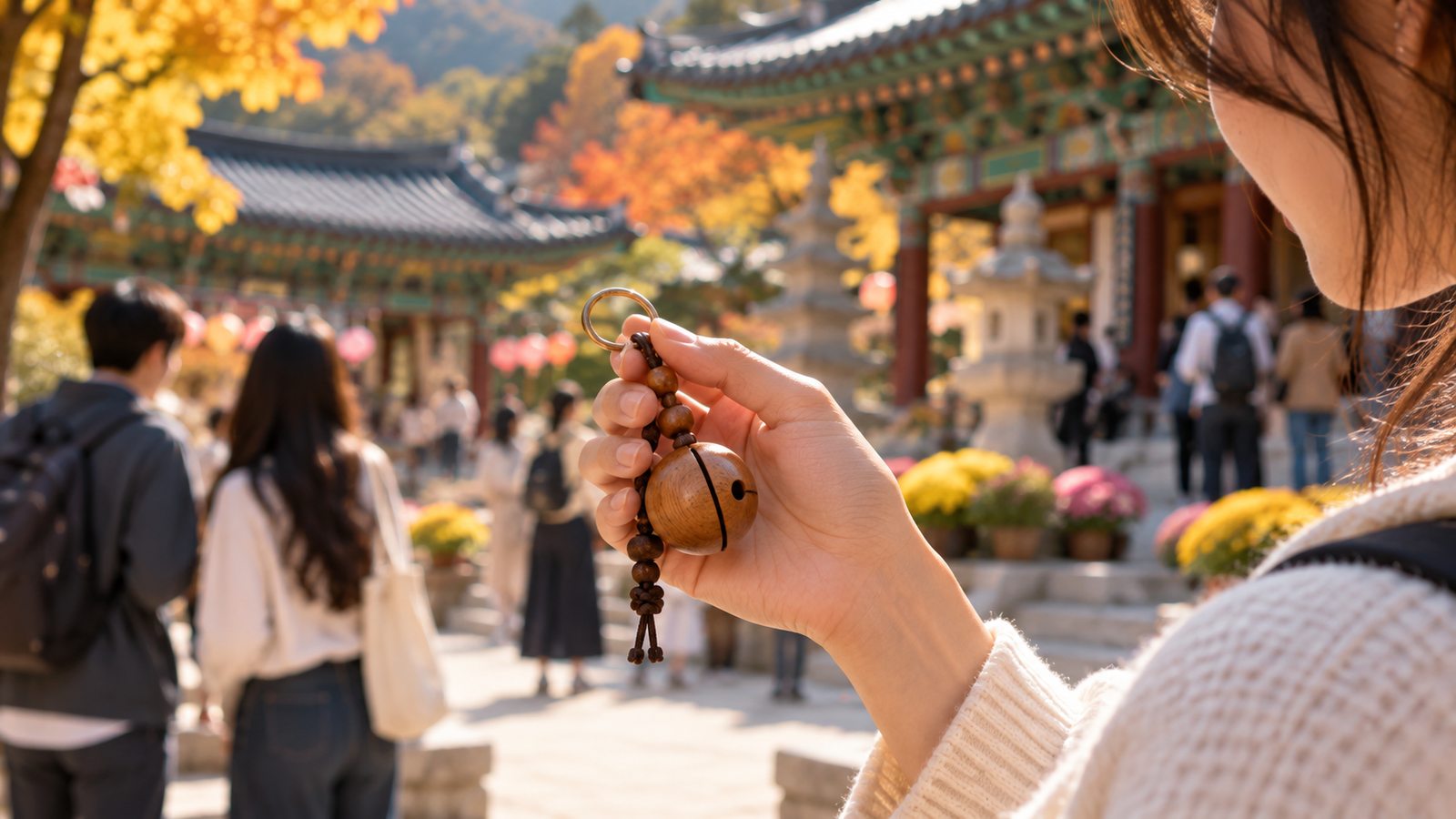
One of the clearest examples in late 2026 is the gongdeok keyring.
Gongdeok (공덕) is a Buddhist term associated with merit accumulated through good actions and practice.
The popular keyring playfully turns that idea into a small object: press it, and it makes the sound of a moktak.
In October 2026, people lined up early in the morning at Bongeunsa Temple in Seoul to buy the keyring. According to a Channel A report, a shipment of 2,000 keyrings sold out in about two and a half hours.
Some buyers were Buddhist.
Others were not.
That difference helps explain Hip Buddhism better than the product itself.
The keyring works simultaneously as a cute object, a social-media trend, a wish-related charm, a reference to Buddhist culture and, for some people, something with genuine religious meaning.
Traditional symbolism has not disappeared. It has been translated into a format that fits contemporary everyday culture.
Why Are Non-Buddhists Joining In?
This may be the most important part of the trend.
At the 2026 Seoul International Buddhism Expo, roughly four in ten visitors were reportedly religiously unaffiliated.
Korean media interviews with young visitors repeatedly show people saying they are not Buddhist while still expressing interest in Buddhist merchandise, philosophy, meditation or temple spaces.
For these participants, Buddhism can function less like a religious identity and more like a cultural resource.
They may appreciate:
- ideas about reducing attachment;
- meditation and mindfulness;
- the atmosphere of temples;
- humor built around Buddhist concepts;
- traditional Korean aesthetics;
- merchandise and design; or
- practical advice about anxiety and everyday life.
This is why saying “Gen Z Koreans are becoming Buddhist” would oversimplify the phenomenon.
A better description is that some young Koreans are becoming more comfortable engaging with Buddhism without necessarily becoming Buddhists.
From Pop Culture Back to Actual Temples
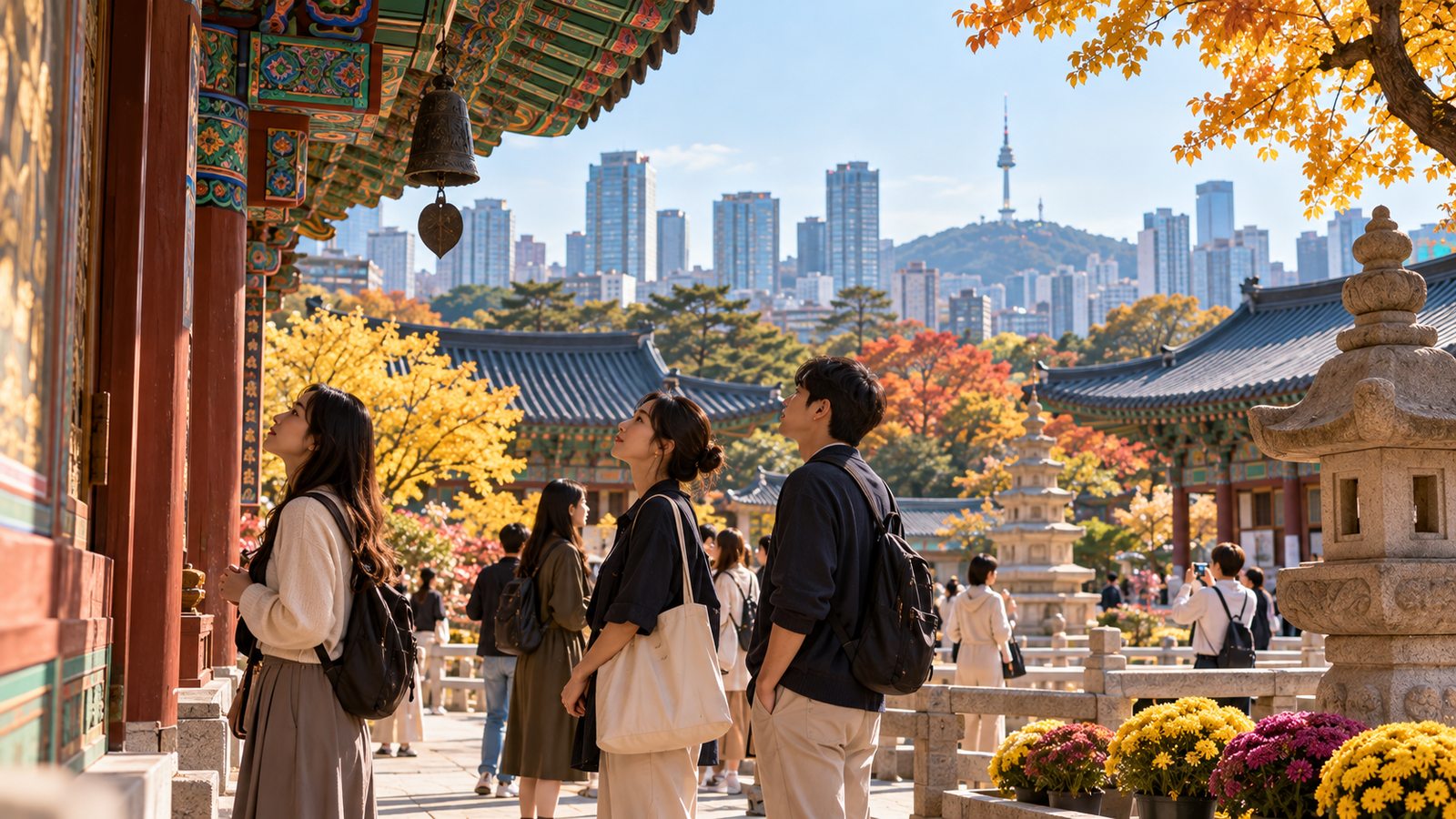
What makes the trend particularly interesting is that it does not always stop at merchandise.
Bongeunsa in Gangnam has become one of the most visible examples.
Young visitors may arrive because they saw a viral product or social-media post, but they are still entering a functioning Buddhist temple with a long history.
That creates an unusual loop:
traditional religion → modern cultural reinterpretation → social media → young visitors → physical temple
Korea’s official Templestay system represents a more structured version of cultural engagement with Buddhist life.
For international travelers, a Korean temple stay can include meditation, tea, temple meals, Buddhist ceremonies and other cultural activities. Korea Front Row’s Korean temple stay guide explains how those programs work for non-Buddhists and foreign visitors.
The two experiences should not be confused, however.
Buying a viral Buddhist keyring and participating in a temple stay represent very different levels of engagement with Buddhist culture.
Is Hip Buddhism Really About Buddhism — or Just Merchandise?
Not everyone is enthusiastic about the trend.
That criticism is important.
Some practicing Buddhists and repeat visitors to Buddhist events have questioned whether increasingly merchandise-heavy expos risk turning Buddhism into another lifestyle-shopping category.
At the 2026 Seoul International Buddhism Expo, some visitors interviewed by Korean media said the growing focus on merchandise made the event feel less centered on Buddhist culture itself.
It is a reasonable concern.
A meme can make a difficult philosophical idea approachable, but it can also reduce that idea to a punchline.
A Buddhist symbol can introduce someone to a tradition, but it can also become decoration separated from its original meaning.
Hip Buddhism therefore contains a tension similar to many modern cultural trends:
Does commercialization introduce people to a tradition — or dilute it?
The answer may be both.
For some visitors, a keyring is simply a keyring.
For others, a humorous T-shirt, meditation class or temple visit may become the first step toward learning more.
Hip Buddhism and Text Hip Have Something in Common
Hip Buddhism may look very different from Korea’s recent Text Hip reading trend, but the two reveal a similar pattern.
Text Hip turned books — something often associated with quiet, traditional reading — into a visible part of youth lifestyle and self-expression.
Hip Buddhism is doing something comparable with a much older tradition.
Both involve younger Koreans taking something that can appear old-fashioned or serious and rediscovering it through contemporary design, social media, physical experiences and personal identity.
Neither phenomenon means that every young Korean is suddenly reading literature or practicing Buddhism.
What matters is the change in cultural perception.
Things once seen as traditional can become new again when a younger generation gives them a different context.
Is Hip Buddhism Just a Passing Trend?
The merchandise will change.
Individual memes will disappear.
Today’s viral keyring will eventually be replaced by something else.
But the deeper forces behind Hip Buddhism may last longer.
Meditation, emotional rest, interest in traditional culture and dissatisfaction with constant competition are not dependent on one product or one social-media trend.
The 2026 data also shows that younger participation extends beyond shopping: meditation events, cultural programs and Buddhist expos have all attracted significant numbers of people in their 20s and 30s.
That does not guarantee a revival of organized Buddhism.
Instead, Korea may be seeing a different relationship with religion — one in which people participate selectively in philosophy, meditation, cultural traditions and temple experiences without adopting a formal religious identity.
What Hip Buddhism Tells Us About Korea Today
The most interesting part of Hip Buddhism may not be Buddhism itself.
It is what the trend says about how young Koreans interact with tradition.
Korea is highly digital, urban and fast-moving, but some of its most visible recent youth trends have involved slowing down, looking backward or rediscovering older forms of culture.
Books became “hip.”
Meditation became lifestyle content.
Temple merchandise became something people line up to buy.
Ancient ideas about desire and attachment found their way onto social media.
That does not mean Korea is turning away from modernity.
It suggests something more subtle: younger Koreans are increasingly comfortable taking pieces of older culture, separating them from some of their traditional expectations and giving them new meanings.
Hip Buddhism is one of the clearest examples of that process in 2026.
FAQ
What is Hip Buddhism in Korea?
Hip Buddhism is an informal term for the contemporary popularity of Buddhist-inspired culture among younger Koreans. It can include meditation, memes, merchandise, pop-up stores, temple visits and modern interpretations of Buddhist ideas. It is not an official Buddhist movement.
Are young Koreans actually becoming Buddhist?
The current trend does not prove a large-scale religious conversion. Many participants in Buddhist cultural events identify as having no religion. The trend is better understood as increased engagement with Buddhist philosophy, culture, wellness and lifestyle content.
What is Buddhism-core?
“Buddhism-core” is another informal expression used to describe Buddhist aesthetics and cultural elements appearing in contemporary lifestyle culture. It overlaps with the broader idea of Hip Buddhism but should not be treated as an official religious term.
What is a gongdeok keyring?
It is a popular Buddhist-themed keyring associated with the concept of gongdeok, or merit. Some versions make a moktak sound when pressed. The product became especially visible in Korea in 2026 after crowds lined up to buy it at temples including Bongeunsa.
Can non-Buddhists visit Buddhist temples in Korea?
Yes. Many Korean temples welcome visitors, although they remain active religious spaces and should be treated respectfully. Korea also has official Templestay programs designed for both Korean and international participants.
Is Hip Buddhism the same as a Korean temple stay?
No. Hip Buddhism describes a broad contemporary cultural trend. Templestay is an organized program that lets participants experience aspects of Korean Buddhist temple life, such as meditation, tea, meals and ceremonies.
Sources & Further Reading
- Jogye Order of Korean Buddhism — 2026 Seoul International Buddhism Expo and International Seon Meditation Summit participation data
- Yonhap News Agency — Report on young Koreans, Buddhist culture and Buddha’s Birthday café culture
- The Korea Times — Hip Buddhism takes over Seoul: Gen Z flocks to buy temple merch
- Korea JoongAng Daily — Hip Buddhism, retail pop-ups and younger Korean consumers
- Channel A — Bongeunsa gongdeok keyring open-run and October 2026 sellout
- Official Templestay — Korean Buddhist cultural experience programs