
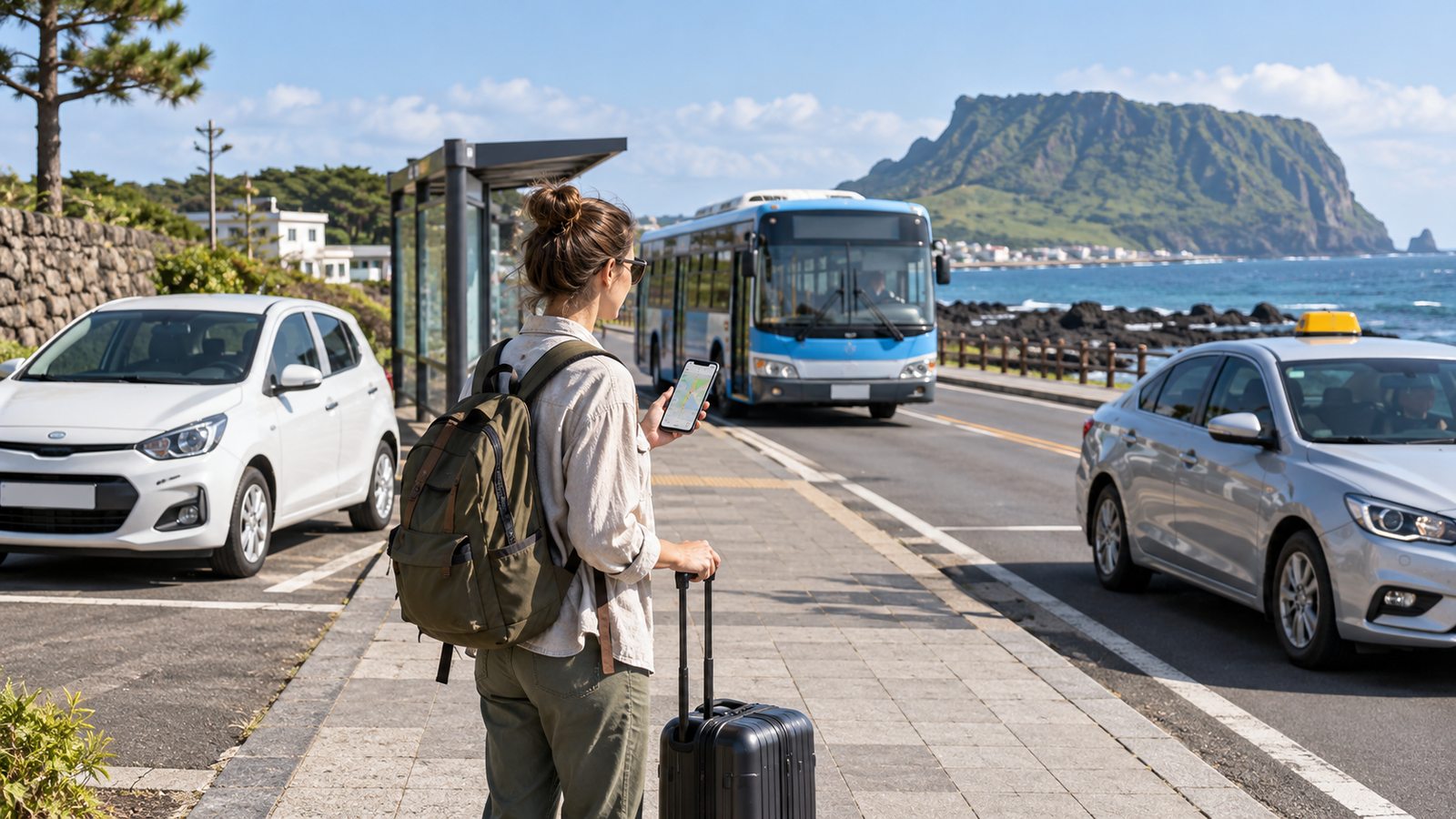
Jeju Island is one of the places in South Korea where your transportation choice can change the entire trip.
Unlike Seoul, Jeju has no subway or passenger rail network connecting its major attractions. Travelers generally choose between a rental car, public buses, taxis, or a combination of them.
So, do you actually need a car in Jeju?
Not always. But for many short itineraries with several attractions spread around the island, a rental car can save enough time to justify the extra cost.
If you are traveling alone, staying longer, or concentrating on Jeju City and a few well-connected destinations, buses combined with occasional taxis can be a reasonable alternative.
The important comparison is not simply rental-car price vs bus fare. It is:
total trip cost + door-to-door travel time + number of travelers + where you actually want to go.
This guide compares those factors and includes a calculator you can use with your own rental-car quote and itinerary.
Jeju Rental Car vs Bus vs Taxi at a Glance
| Factor | Rental Car | Bus | Taxi / Global Taxi |
|---|---|---|---|
| Lowest possible cost | △ | ◎ | × |
| Freedom to change plans | ◎ | △ | ◎ |
| Multiple attractions in one day | ◎ | △ | ◎ |
| Solo traveler | △ | ◎ | △ |
| Couple | ◎ | ○ | ○ |
| Family or 3–4 travelers | ◎ | △ | ○ |
| No driving required | × | ◎ | ◎ |
| Rural attractions | ◎ | △ | ◎ |
| Luggage convenience | ◎ | △ | ◎ |
| Longer relaxed trip | ○ | ◎ | △ |
| Short sightseeing-heavy trip | ◎ | △ | ○ |
The table explains why there is no universal winner.
A solo traveler spending five days on Jeju may reasonably accept longer bus journeys to save money.
A couple trying to visit several waterfalls, coastal viewpoints and rural attractions in two or three days faces a different calculation.
For them, transportation is not just an expense. It determines how much of the island they can realistically see.
Do You Actually Need a Car in Jeju?
You probably do not need a rental car if:
- you are traveling alone and keeping costs low;
- you have a relatively long stay;
- you do not mind organizing your day around bus schedules;
- your itinerary focuses on Jeju City, Seogwipo and well-connected attractions;
- you are comfortable using taxis to fill transportation gaps; or
- you cannot or do not want to drive abroad.
A rental car becomes much more attractive if:
- two or more people are sharing the cost;
- your trip is only two or three days;
- you want to visit several places in one day;
- your itinerary includes rural or widely separated attractions;
- you are traveling with children or substantial luggage;
- you want to start early or return late without depending on a bus schedule; or
- changing plans spontaneously matters to you.
The question is therefore not simply, “Can I travel around Jeju without a car?”
You can.
The more useful question is:
“How much time and flexibility am I willing to trade for the money I save?”
What Does Each Jeju Transportation Option Really Cost?
Transportation prices should be compared at the trip level, not one ride at a time.
A bus fare can look dramatically cheaper than renting a car. But a bus itinerary may still require several taxi rides when connections are inconvenient.
Likewise, a rental car advertised at an attractive daily rate is not necessarily your final cost after insurance, fuel or charging, and parking.
Jeju Bus Fares
According to Jeju’s official public transportation information, adult local bus fares paid with a transportation card are generally ₩1,150.
Jeju’s express buses use distance-based fares starting at ₩2,000 and reaching up to ₩3,000 for an adult transportation-card passenger.
That makes buses by far the cheapest option for many solo travelers.
The financial advantage becomes less dramatic, however, when several people are traveling together and a rental-car cost can be divided between them.
Jeju Taxi Fares
Jeju’s official taxi information lists the standard midsize taxi base fare at ₩4,300 for the first 2 kilometers.
Additional distance and time charges apply, and long-distance and late-night rules can increase the fare.
A taxi therefore works well as a gap-filler.
For example:
bus for the long journey + taxi for the inconvenient final section
can be much more economical than taking taxis for the entire trip.
If you need the basics of taxi apps, payment and fare checking first, see our guide to taking a taxi in Korea.
Jeju Global Taxi
Jeju also has a Global Taxi program designed for international visitors.
Official Jeju tourism information currently lists an eight-hour charter at:
- ₩220,000 for a regular taxi
- ₩330,000 for a jumbo taxi
Additional time costs extra.
This option can make sense for travelers who want the convenience of private transportation but do not want to drive.
It is not a budget substitute for the bus.
Instead, compare it with:
rental car + insurance + fuel + parking + the burden of driving
and with the cost of taking multiple ordinary taxis between distant attractions.
For a group, dividing a chartered taxi fare among several travelers also changes the calculation.
Rental Car Costs
There is no useful single “Jeju rental car price.”
The actual quote can change with:
- travel dates;
- vehicle category;
- rental duration;
- insurance;
- season;
- booking timing; and
- rental company.
That is why the calculator below does not use a supposedly average rental-car price.
Enter the quote you can actually book.
Then add insurance, expected fuel or charging, and parking.
That gives you a much more meaningful comparison.
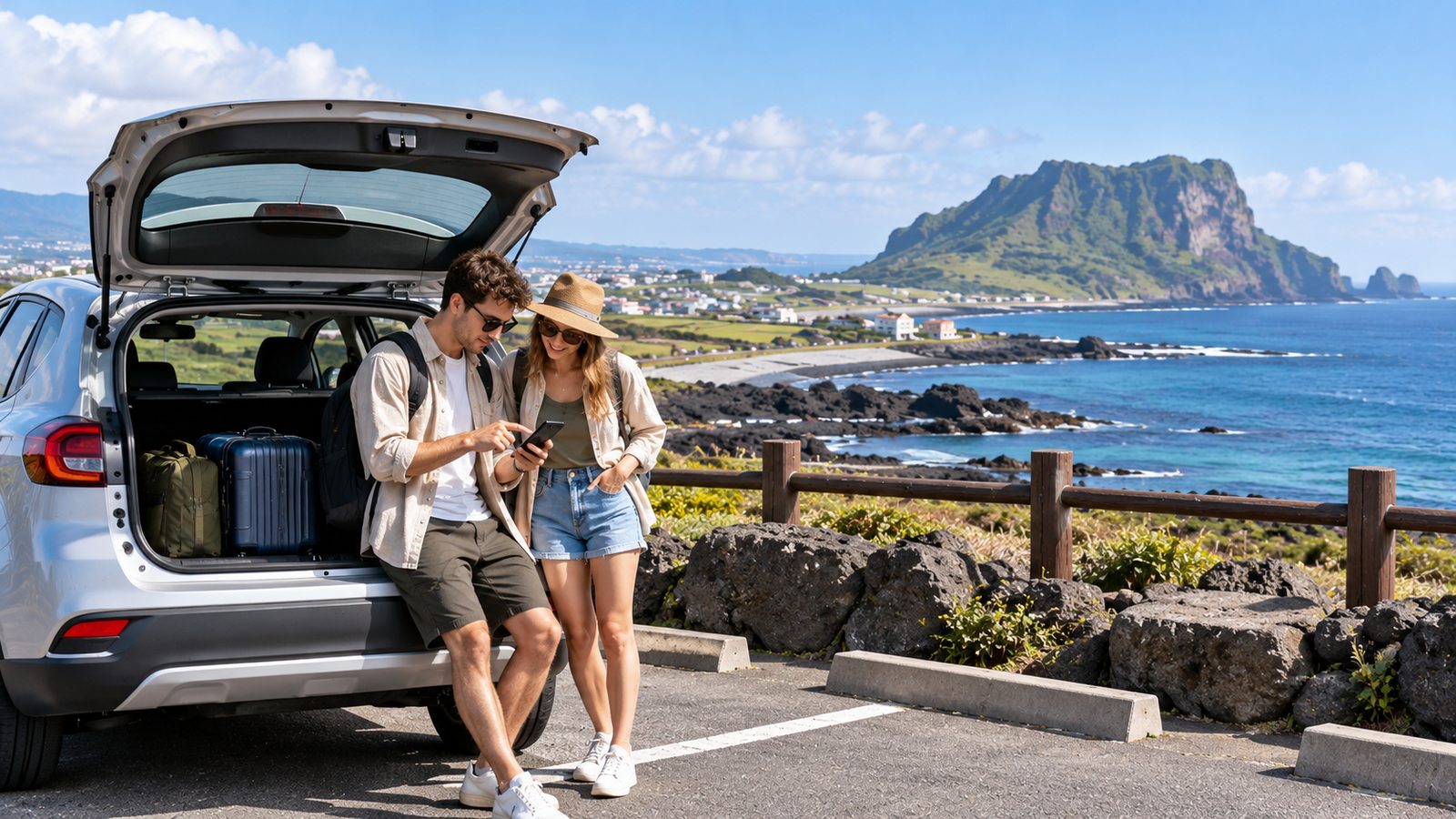
Jeju Transport Cost Calculator
Use this calculator to compare three transportation strategies:
- Rental car
- Bus + occasional taxis
- Global Taxi
Replace the example numbers with your actual rental quote and expected itinerary.
Compare the estimated total transportation cost for your Jeju itinerary. All amounts are in Korean won (KRW).
This calculator is for trip planning, not a fare quote. Enter your actual rental quote when possible. Rental prices, insurance, fuel, parking, bus routes and taxi costs vary by itinerary and travel date.
The calculator deliberately separates price from convenience.
A bus can win the cost calculation while losing several hours of sightseeing time.
A rental car can cost more but allow you to visit enough additional places that the premium feels worthwhile.
The correct choice depends on which resource matters more to you: money or time.
Rental Car: When It Usually Wins
A rental car is strongest when your itinerary is geographically ambitious.
Imagine trying to combine a coastal attraction, a waterfall, a café in a rural area and a sunset viewpoint in one day.
By car, you can travel directly from one location to the next.
By bus, the same itinerary may require:
- walking to a stop;
- waiting for the bus;
- traveling toward a transfer point;
- waiting again;
- walking from the final stop; and
- repeating the process at every attraction.
No individual step necessarily looks difficult.
The accumulated time is the problem.
This is why rental cars often make the most sense for travelers with short trips and long attraction lists.
Rental Cars Become More Economical in a Group
The rental cost is primarily a vehicle cost.
Bus fares are per passenger.
That distinction matters.
If four people are traveling together, the rental-car cost can be divided four ways while each traveler would otherwise pay individual bus fares and the group shares any taxi expense.
The cheapest choice can therefore change as soon as you change the number of travelers.
Use the calculator with your actual group size rather than assuming that buses always cost less.
But Driving Has a Non-Financial Cost
Do not rent a car simply because a spreadsheet says it saves time.
Ask:
- Are you comfortable driving in another country?
- Can you confidently use Korean road navigation?
- Will driving make your vacation more stressful?
- Do you want to think about parking?
- Will one person spend the entire trip acting as the designated driver?
A transportation choice that saves ₩50,000 but makes the driver miserable is not necessarily the better decision.
Bus: When Traveling Without a Car Makes Sense
Jeju can be traveled without a rental car.
The bus becomes particularly attractive when time is flexible and budget matters more than maximizing attractions per day.
A slower itinerary can work well.
Instead of attempting four distant attractions, choose one area and explore it properly.
For example, build each day around one major destination or one part of the island rather than crossing Jeju repeatedly.
This reduces one of the biggest weaknesses of bus travel: inefficient transfers between attractions that happen to be far apart.
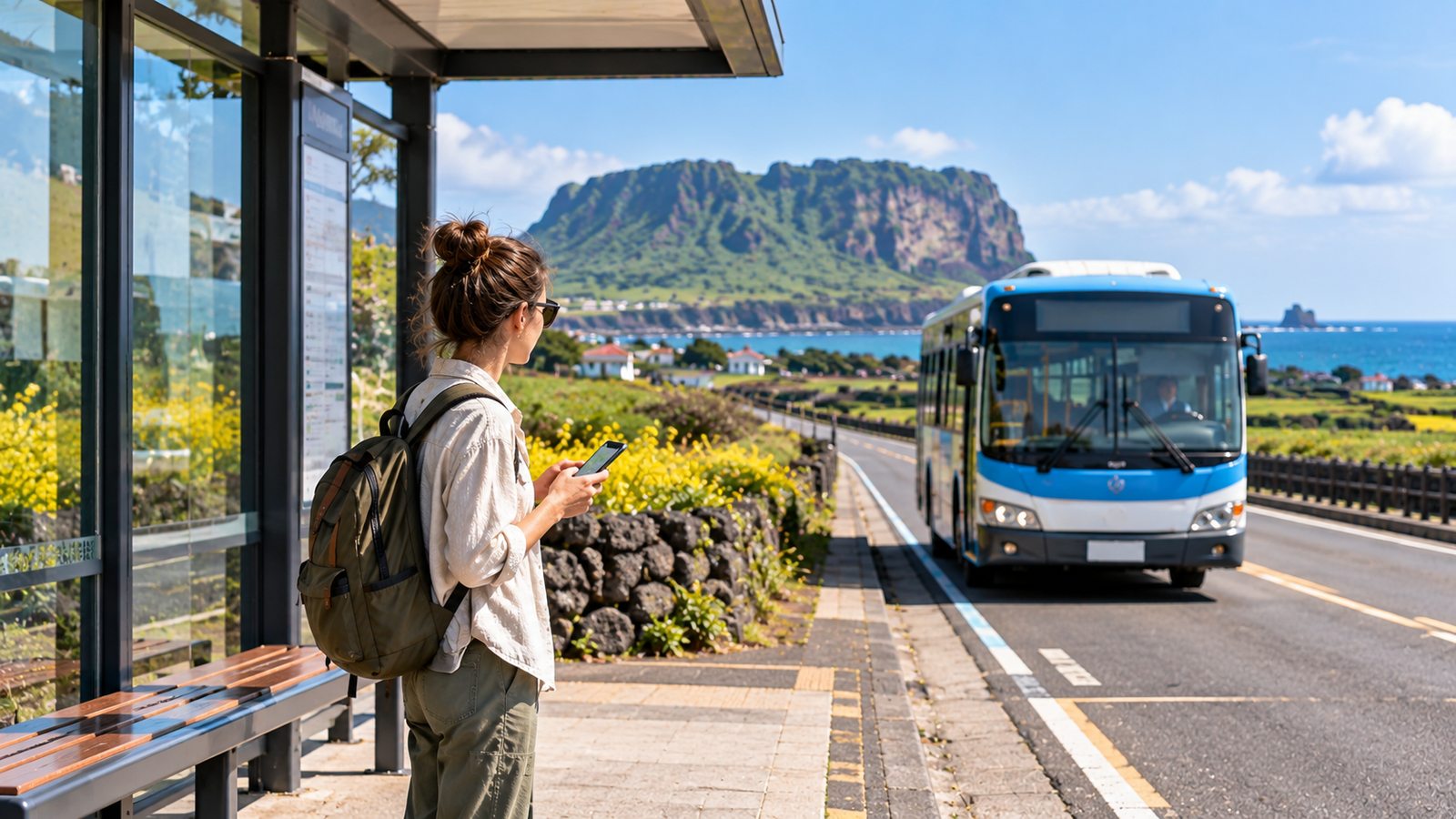
Who Is Best Suited to Bus Travel?
Consider a bus-first itinerary if you are:
- traveling solo;
- staying four or more days;
- comfortable walking;
- willing to wait;
- visiting fewer attractions each day;
- not carrying luggage during sightseeing; or
- prioritizing your budget.
It can also work well for travelers who simply do not want the responsibility of driving.
Use Taxis Strategically
Choosing the bus does not mean promising yourself that you will never take a taxi.
A more practical strategy is:
bus where it works well + taxi where it solves a real problem.
For example, take the bus for a long intercity section, then use a taxi for the final connection to a rural attraction.
Or take buses during the day and use a taxi after dinner when the alternative would involve a long wait.
This hybrid approach can preserve much of the bus’s cost advantage without allowing inconvenient connections to dominate your trip.
Taxi: Convenience Without Driving
Ordinary taxis sit between the two extremes.
They give you direct transportation without requiring you to drive.
For occasional trips, that can be ideal.
For repeated long-distance sightseeing journeys, however, individual taxi fares can accumulate quickly.
That is why taxis are best evaluated by how you intend to use them.
One taxi after a long hiking day is very different from using taxis as your primary transportation for three full days.
If you expect several long taxi journeys each day, compare that projected cost with both a rental car and Jeju’s Global Taxi service before deciding.
Is Jeju Global Taxi Worth It?
Global Taxi is not designed to beat public buses on price.
Its value is different.
You are paying for:
- a vehicle for a defined sightseeing period;
- a driver;
- no need to navigate or park;
- easier transportation between dispersed attractions; and
- visitor-oriented language support.
That can make it attractive for:
- travelers who cannot drive;
- parents who want private transportation;
- small groups splitting the fare;
- older travelers;
- short itineraries; or
- travelers who value convenience more than minimizing cost.
For one budget-focused solo traveler, ₩220,000 for an eight-hour day is a substantial transportation expense.
For four travelers, that same amount becomes ₩55,000 per person before any extra charges.
That does not automatically make it cheap, but it changes the comparison.
Door-to-Door Time Matters More Than the Ticket Price
This is the biggest mistake in many Jeju transportation comparisons.
A traveler sees:
Bus: ₩1,150
and
Rental car: much more
and concludes that the bus obviously wins.
But those prices purchase different things.
The bus fare purchases transportation according to a route and timetable.
A rental car purchases transportation plus control over departure time and routing.
Consider two hypothetical options.
Option A
A direct car journey takes 35 minutes.
Option B
The bus journey involves:
- 10-minute walk;
- 12-minute wait;
- 30-minute bus ride;
- transfer;
- 15-minute wait;
- 20-minute second bus ride; and
- 10-minute walk.
The bus fare can still be dramatically cheaper.
But the practical comparison is:
35 minutes vs 97 minutes.
Do that three times in one sightseeing day and transportation becomes an itinerary issue rather than merely a budget issue.
Before deciding, map several of the actual attraction-to-attraction journeys in your itinerary.
Do not judge the whole island from the route between Jeju Airport and your hotel.
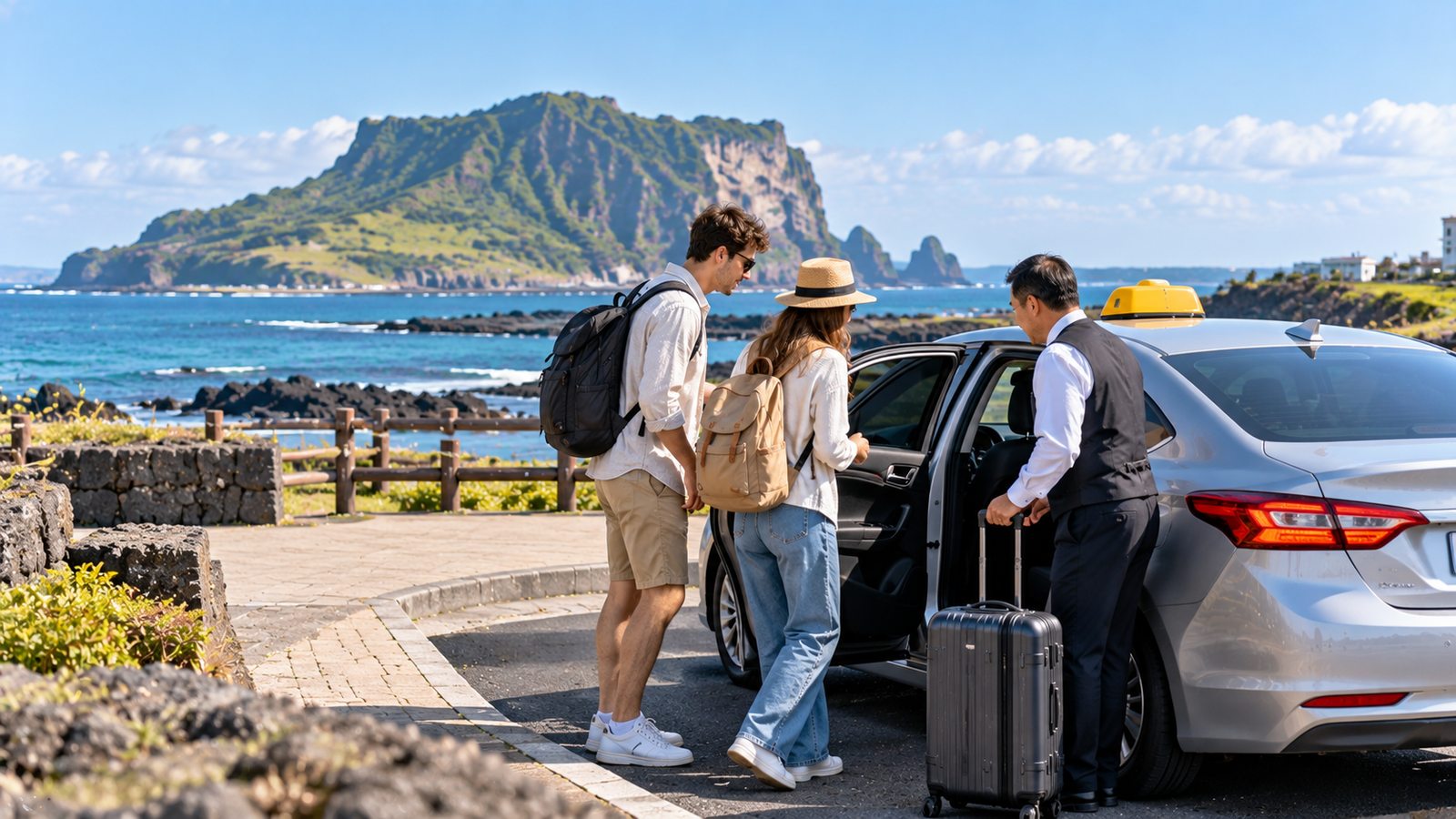
Which Option Should Different Travelers Choose?
Solo Budget Traveler
Start with buses.
The rental cost cannot be shared, making public transportation financially attractive.
Use taxis selectively when a bus connection wastes too much time.
Couple on a 2–3 Day Trip
Strong rental-car candidate.
Two people can share the vehicle cost, while a short itinerary makes lost travel time relatively expensive.
If neither traveler wants to drive, compare Global Taxi with a bus-and-taxi combination.
Family With Children
Rental car is often the practical choice.
Direct transportation, bags and schedule flexibility can matter more than the absolute cheapest fare.
Check vehicle size and any child-seat requirements with the rental company before booking.
Group of Three or Four
Run the numbers before assuming public transport is cheaper.
Dividing vehicle or chartered-taxi costs between several people can substantially change the per-person result.
Slow Traveler Staying a Week
Bus + taxi becomes much more realistic.
With more days available, you do not need to maximize the number of attractions reached every day.
Traveler Who Does Not Want to Drive
Do not force yourself to rent a car because a travel forum says Jeju “requires” one.
It does not.
Compare:
bus + selective taxis
with
one or two Global Taxi sightseeing days.
That may produce a much more comfortable trip.
What Changes If You Visit Udo?
Udo requires separate planning.
Do not assume that renting a car on Jeju automatically means you can simply drive that rental vehicle onto Udo.
Vehicle access to Udo is restricted, although official rules provide exceptions for certain qualifying vehicles and travelers, including specified accessibility, accommodation and other circumstances.
Restrictions have also been extended through July 31, 2029.
Because exceptions and operating rules matter, check the current official Udo information before building your itinerary around taking a rental car onto the island.
For many ordinary visitors, the safer planning assumption is:
park before entering Udo and use transportation available on the island unless you have confirmed that an exception applies to you.
This is also a good example of why the best Jeju transportation strategy can change by day.
You might rent a car for most of Jeju but plan one day differently for Udo.
What Do Foreign Visitors Need to Rent a Car in Jeju?
International visitors should verify the rental company’s requirements before paying.
Official Jeju tourism information advises foreign drivers to prepare an appropriate International Driving Permit (IDP) and passport.
Do not assume that a phone image of a license or an unofficial translation will substitute for the required documents.
Requirements can also depend on factors such as:
- driver’s age;
- driving experience;
- vehicle category; and
- rental-company policy.
Confirm eligibility directly with the rental provider before booking a non-refundable vehicle.
Also check what the quoted price includes.
A low headline rate becomes less useful if the insurance coverage you actually want materially changes the final cost.
Should You Book a Jeju Rental Car in Advance?
For busy travel periods, booking ahead is sensible.
Jeju tourism authorities advise advance reservations because popular vehicle types can become difficult to secure during peak periods.
But do not book solely because the first price looks cheap.
Compare:
final rental cost + insurance terms + vehicle size + cancellation conditions + pickup process.
The best-value rental is the one that fits your actual trip, not necessarily the lowest number on the first booking screen.
A Better Jeju Transportation Decision Framework
Before booking anything, answer these six questions.
1. How many people are traveling?
More travelers generally make private transportation more competitive on a per-person basis.
2. How many full sightseeing days do you have?
The shorter the trip, the more valuable transportation time becomes.
3. How many attractions do you want to visit each day?
One or two destinations work much better with buses than a tightly packed four-stop itinerary.
4. Are the attractions concentrated in one area?
Regional itineraries are easier without a car than repeatedly crossing the island.
5. Are you comfortable driving?
If not, remove rental cars from the comparison rather than forcing the cheapest theoretical solution.
6. What does your actual itinerary cost?
Put your real rental quote into the calculator.
Then estimate your bus rides and likely taxi use.
Only then compare the totals.
Bottom Line: Should You Rent a Car in Jeju?
For many couples, families and small groups on a short sightseeing-heavy trip, renting a car is likely to provide the best balance of time and flexibility.
For a solo traveler, longer stay or slower itinerary, buses plus occasional taxis can be much more economical without making the trip impractical.
If you do not want to drive but still want to cover several dispersed attractions efficiently, ordinary taxis or Jeju Global Taxi provide a third option worth calculating.
The key is not asking whether Jeju is “possible” without a car.
It is.
Ask instead:
What combination gives my itinerary the best balance of total cost, travel time and convenience?
That is the transportation decision that matters.
For your wider Korea budget, use our South Korea trip cost calculator to combine transportation with accommodation, food, activities and shopping.
Frequently Asked Questions
Can you travel around Jeju without renting a car?
Yes. Jeju has an island-wide bus network, and taxis can fill gaps where public transportation is inconvenient. A car becomes more useful when you have a short trip, several attractions per day or destinations spread widely around the island.
Is a rental car cheaper than taxis in Jeju?
It depends on your rental quote, insurance, fuel, parking, group size and how many taxi journeys you would otherwise take. Several long taxi rides can make a rental car comparatively attractive, particularly when multiple travelers share the cost.
Are buses cheap in Jeju?
Yes. Official adult local-bus fares are relatively inexpensive, making buses particularly attractive for solo and budget travelers. Express services use higher distance-based fares.
Is Jeju Global Taxi worth it?
It can be worth considering for travelers who want private sightseeing transportation without driving. Its value improves when several people split the fare or when a short itinerary makes transportation time especially important.
Do foreigners need an International Driving Permit to rent a car in Jeju?
Foreign visitors should prepare the driving documentation required for Korea, including an appropriate International Driving Permit where applicable, together with their passport, and confirm the rental company’s eligibility rules before booking.
Can I take a Jeju rental car to Udo?
Do not assume you can. Vehicle access to Udo is restricted, although specific exceptions exist. Check the current official rules for your vehicle and circumstances before your visit.
Sources & Further Reading
- Jeju Special Self-Governing Province — Public Transportation and Bus Fare Information
- Jeju Special Self-Governing Province — Official Taxi Fare Information
- VISIT JEJU — Transportation Information
- VISIT JEJU — Global Taxi Information
- VISIT JEJU — Rental Car Information
- VISIT JEJU — Udo Travel and Vehicle Restriction Information