
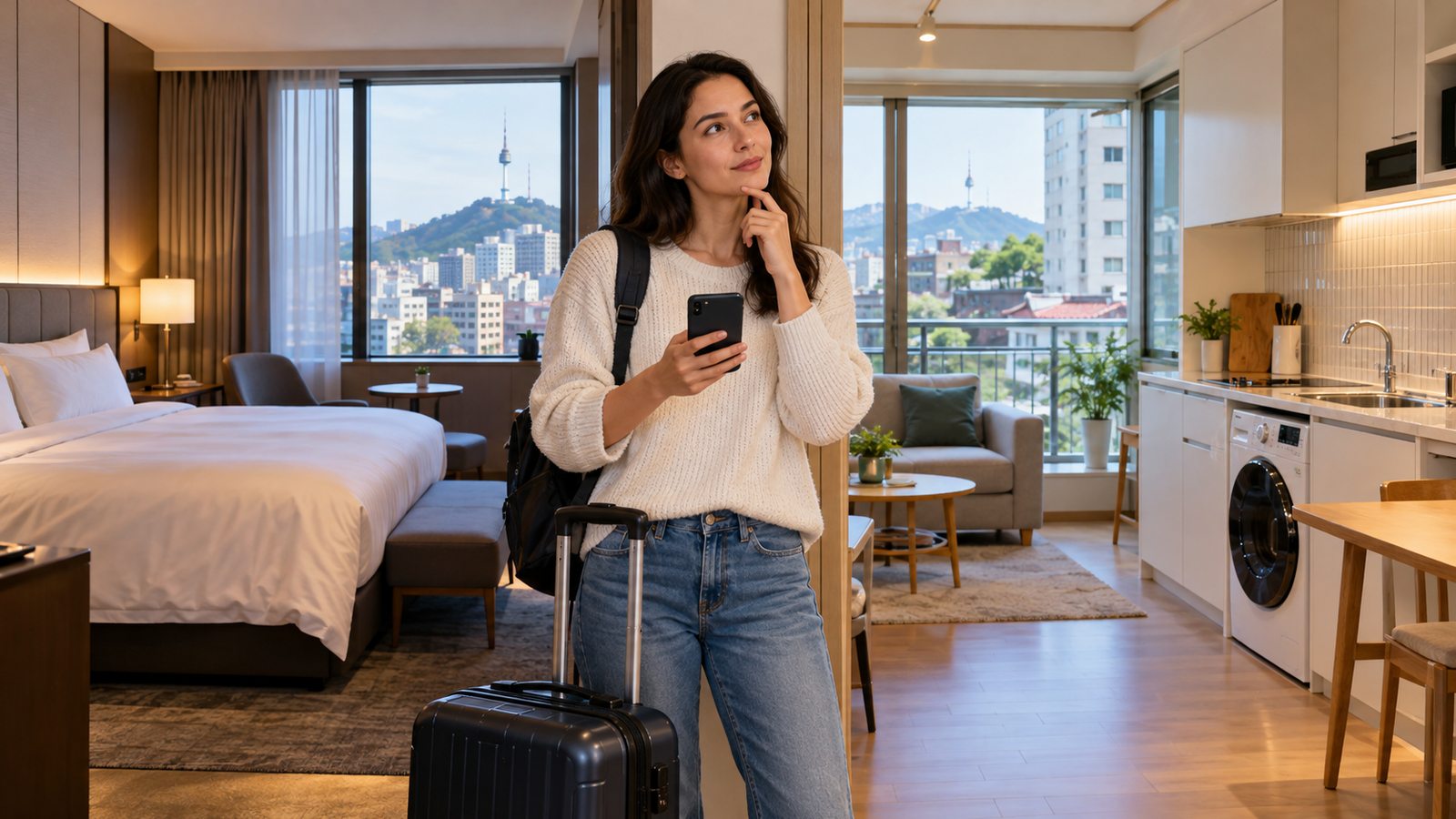
Choosing between a hotel and an Airbnb-style stay in Seoul is not simply a question of which nightly rate looks cheaper.
For a short first trip, a centrally located hotel may save you time, simplify luggage storage and make late check-in easier. For a family, group or longer stay, a registered private accommodation with more space, a kitchen and a washing machine may offer better value.
There is also a Korea-specific question that travelers should not ignore: is the accommodation properly registered to operate?
South Korea regulates short-term accommodation through specific lodging and homestay categories, making it important to check what you are actually booking. For a broader overview of lodging types, see VISITKOREA’s accommodations guide.
This guide compares hotels and Airbnb-style accommodations in Seoul based on total cost, location, group size, trip length, luggage, check-in, cancellation flexibility and accommodation registration.
Quick Answer: Hotel or Airbnb in Seoul?
For most first-time visitors staying in Seoul for a few nights, a well-located hotel is usually the simpler choice.
An Airbnb-style accommodation becomes more attractive when you:
- are traveling with three or more people
- want separate sleeping or living space
- are staying for a week or longer
- need a kitchen
- want an in-unit washing machine
- find a properly registered property in a good location at a competitive total price
Do not decide from the nightly rate alone.
Compare the final booking price and the practical cost of using the accommodation during your trip.
| Traveler | Usually the better starting point |
|---|---|
| Solo first-time visitor | Hotel |
| Couple on a 3–5 night trip | Hotel |
| Late-night arrival | Hotel |
| Family with children | Compare both |
| Group of 3–5 | Airbnb-style stay may offer better value |
| 7+ night stay | Compare both carefully |
| Need a kitchen | Airbnb-style stay |
| Need regular front-desk assistance | Hotel |
| Heavy luggage | Hotel or serviced property near transit |
| Flexible itinerary | Compare cancellation terms, not property type |
These are starting points rather than universal rules. A poorly located hotel can be less convenient than an excellent registered private stay, and an expensive short-term rental can cost more than a hotel once the final price is considered.
Hotel vs Airbnb in Seoul: The Main Differences
The best choice depends on what you value during the trip.
| Factor | Hotel | Airbnb-style accommodation |
|---|---|---|
| Short stays | Usually convenient | Depends on total fees |
| Groups | Multiple rooms may become expensive | Larger properties can be attractive |
| Kitchen | Uncommon in standard rooms | Often available |
| Washing machine | Often shared or paid service | Common in many listings |
| Front desk | Usually available | Often host or message-based |
| Luggage storage | Common | Not guaranteed |
| Late arrival | Often easier | Check self-check-in rules carefully |
| Daily housekeeping | Often available | Usually limited |
| Local residential feel | Less | Often stronger |
| Cancellation | Depends on booking rate | Depends on individual listing |
| Registration check | Established lodging business | Worth verifying before booking |
The table shows why there is no automatic winner.
The important question is:
Which accommodation gives you the lowest practical cost for the way you will actually travel?
Don’t Compare Only the Nightly Price
Suppose you see:
Hotel: KRW 150,000 per night
and
Private stay: KRW 125,000 per night
The private stay appears cheaper.
But that does not necessarily mean it costs less.
For an Airbnb-style reservation, the total may include the nightly accommodation rate plus cleaning charges, extra-guest charges, platform fees and applicable taxes.
The exact structure varies by listing, so always compare the final checkout price.
A useful formula is:
Practical Stay Cost = Final Accommodation Price + Extra Transport + Luggage Costs + Laundry/Convenience Costs
This is more useful than comparing two advertised nightly rates. For the bigger picture, our South Korea trip cost and budget calculator can help you see how accommodation fits into your total travel budget.
Example: Five Nights for Two Travelers
Imagine two properties.
Option A — Hotel
- Final accommodation price: KRW 750,000
- Near a subway station
- Luggage storage available
- No additional transportation needed for sightseeing
Option B — Private accommodation
- Final accommodation price: KRW 650,000
- Requires additional local transportation
- No luggage storage before check-in
- Better kitchen and laundry facilities
The KRW 100,000 difference may still make Option B worthwhile.
But if the location adds KRW 50,000 in transportation and you need paid luggage storage on arrival or departure day, the real savings become much smaller.
The reverse can also happen.
A family of four that would otherwise need two hotel rooms may save substantially by booking one larger registered accommodation.
The point is not that one type is cheaper.
The point is to compare the trip-level cost rather than the room rate.
Airbnb Pricing: Check the Final Checkout Price
Airbnb pricing can include several components depending on the property. Airbnb’s official pricing guide explains how the total price is built from the nightly price plus applicable fees, taxes or other costs.
These may include:
- nightly accommodation price
- cleaning fee
- extra-guest fee
- service fee
- applicable taxes
Airbnb’s pricing guidance states that the checkout page provides the total amount payable, including applicable fees and taxes.
This makes the final checkout screen—not the first nightly price you notice—the number you should use when comparing accommodations.
South Korea is also one of the markets where Airbnb has been changing how its service-fee structure works, so travelers should avoid relying on an old rule of thumb such as assuming every listing adds the same percentage at checkout.
KFR rule: compare the final price shown for the same dates and same number of guests.
The Korea-Specific Issue: Check Whether the Stay Is Registered
This is one of the most important differences between booking accommodation in Seoul and simply comparing room features.
South Korea regulates accommodation businesses, including certain private accommodations offered to foreign tourists. The Korea Tourism Organization’s SafeStay licensing database is a practical place to verify relevant registration information.
One relevant category is Foreign Tourist Urban Homestay Business (외국인관광 도시민박업).
Under Korea’s Tourism Promotion Act Enforcement Decree, this category covers eligible residential housing in urban areas where residents provide lodging and related services to foreign tourists.
Eligible housing types include certain:
- detached houses
- multi-family houses
- apartments
- row houses
- multiplex houses
That does not mean every apartment or private residence advertised online automatically qualifies.
The accommodation still needs to comply with the relevant registration and operating requirements.
What About Officetels?
Travelers should be particularly careful with listings described as an officetel.
An officetel is a common Korean building type combining residential-style units with a legal building classification that may differ from ordinary housing.
Airbnb’s South Korea guidance on officetels and goshiwons states that properties not suitable for residential use, including officetels, are not permitted as listings on Airbnb in Korea.
This is a useful warning sign when reviewing a listing.
If something about the property type or registration information is unclear, verify it before paying rather than assuming that being visible on a booking platform answers every regulatory question.
How to Check a Seoul Accommodation Before Booking
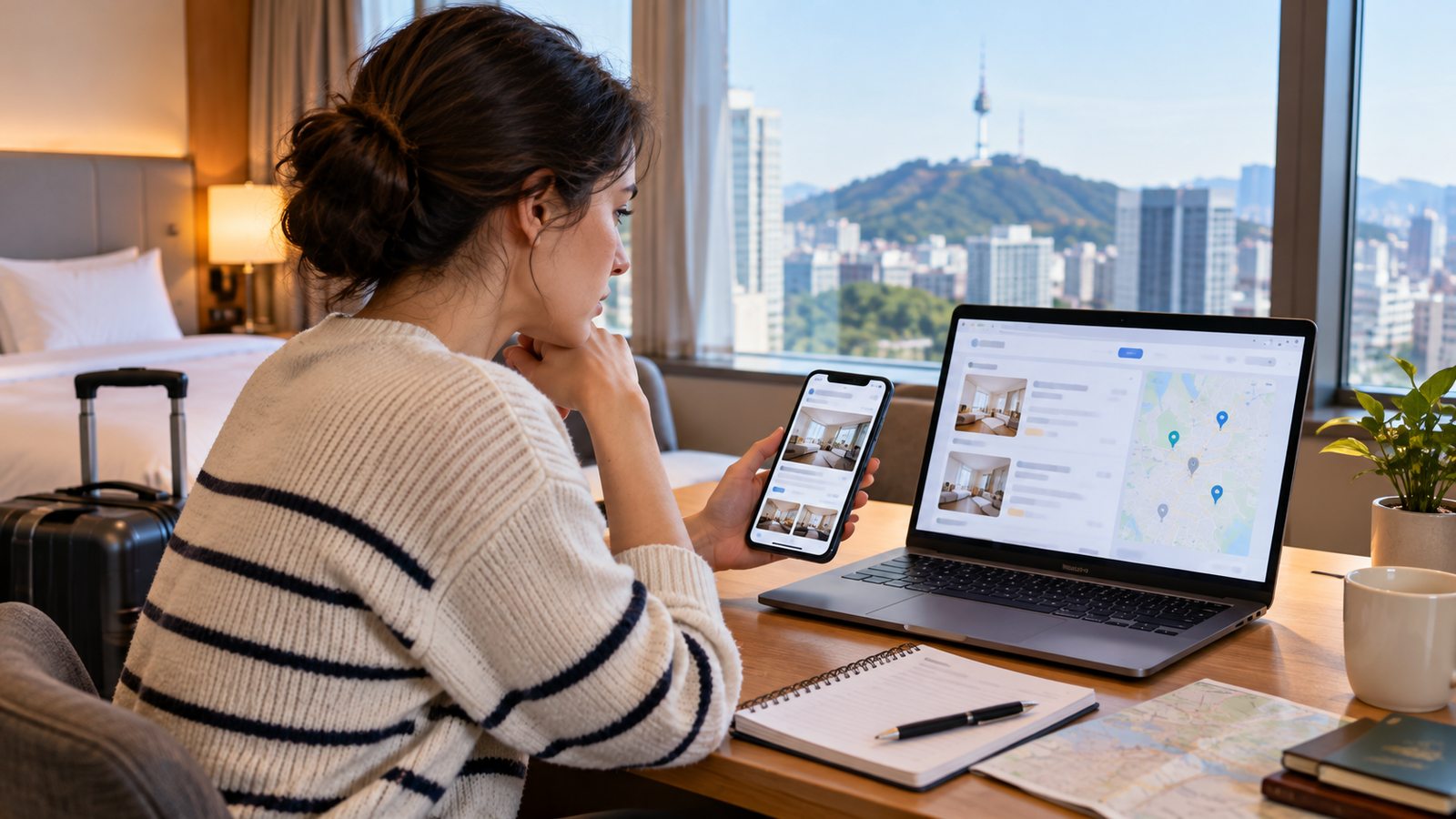
The Korea Tourism Organization operates SafeStay, which allows users to search accommodation licensing information.
Its licensing database includes categories such as:
- Foreign Tourist Urban Homestay Business
- Hanok Experience Business
- Tourist Pension Business
- Hostel Business
- Rural Homestay Business
SafeStay states that its licensing information is based on Korea’s local administrative licensing data.
KFR 3-Step Accommodation Check
Before booking a private stay:
1. Check the listing
Look for registration or license information and identify the accommodation type.
2. Check SafeStay
Search the property name or address in the Korea Tourism Organization’s SafeStay accommodation licensing database when applicable.
3. Compare the information
Check whether the location, accommodation name and operating status are consistent with what you are booking.
A registration check does not tell you whether the mattress is comfortable or the neighborhood is quiet.
It answers a different question:
Does the accommodation information make sense from a Korean licensing perspective?
That is worth checking before a major accommodation purchase.
Why Hotels Can Be Better for a First Trip to Seoul
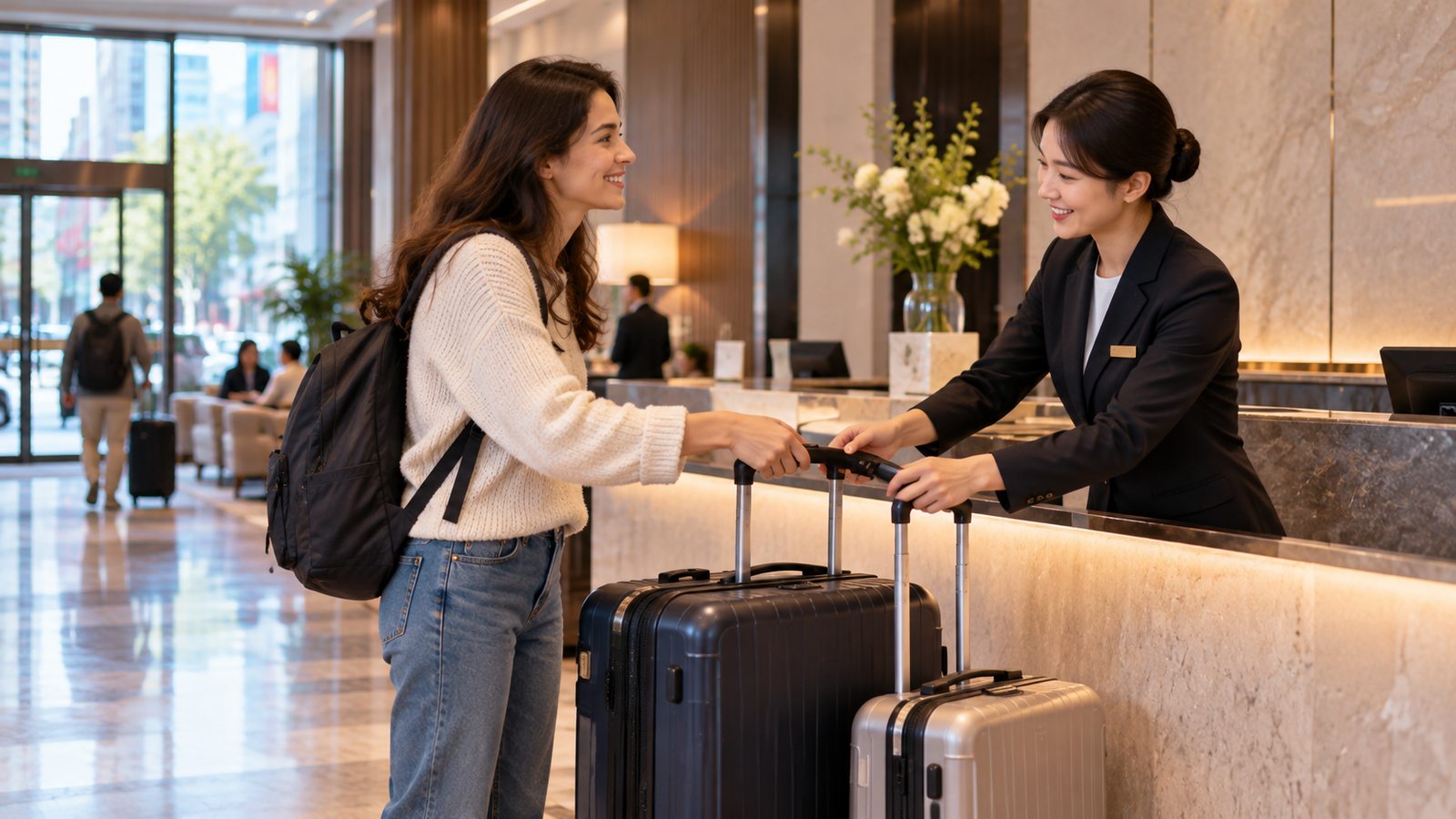
Hotels have several practical advantages that do not always appear in a price comparison.
1. Front-Desk Support
If something goes wrong, there is usually a physical place to ask for help.
That can matter when you:
- arrive late
- need a taxi
- cannot find an address
- have a room problem
- need local assistance
- want help storing luggage
For someone visiting Korea for the first time, this convenience has real value.
2. Luggage Storage
Many hotels can hold luggage before check-in or after checkout.
Private accommodations may not have this option, especially when one guest checks out shortly before another arrives.
If luggage logistics matter to your itinerary, see our Seoul luggage storage guide before deciding where to stay.
3. Easier Short Stays
For a three-night trip, you may barely use a kitchen or washing machine.
In that situation, paying for extra space you do not use may offer little benefit.
Location and convenience can be more valuable.
4. Predictable Arrival
Hotels generally have established check-in procedures.
With private accommodation, you may need to:
- follow keypad instructions
- locate a residential entrance
- find the correct building
- communicate with the host
- observe building-specific rules
Self-check-in can be extremely convenient when it works well, but first-time travelers should read the instructions carefully.
When an Airbnb-Style Stay Can Be Better
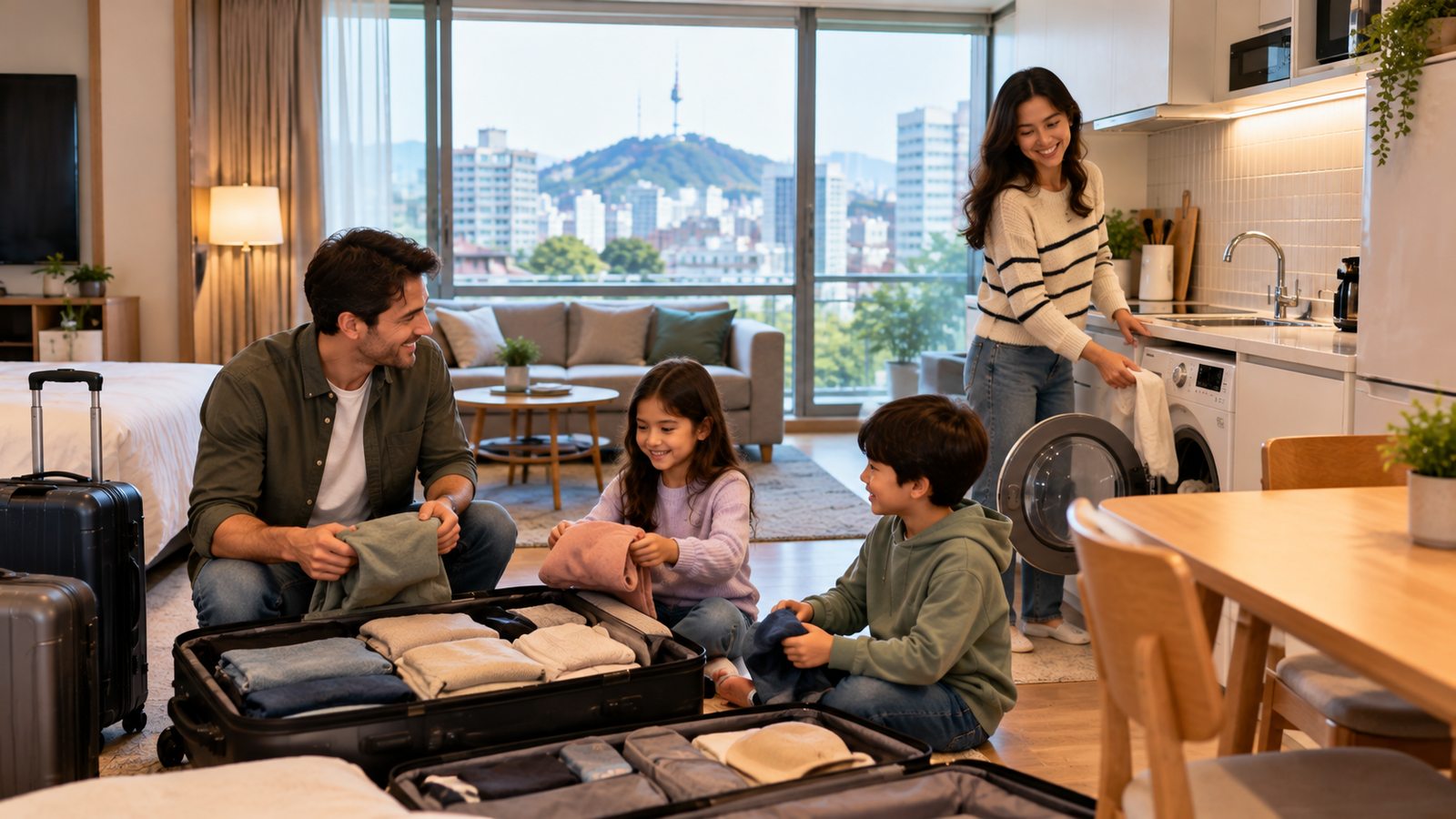
Private accommodations have genuine advantages when they match the trip.
Groups
This is one of the strongest use cases.
Compare:
two hotel rooms
against
one larger registered accommodation
for exactly the same dates and travelers.
The second option may provide both lower per-person cost and shared living space.
Families
A kitchen, washing machine and separate bedroom can matter much more to a family than daily housekeeping.
Parents may also value being able to prepare simple food rather than eating every meal outside.
Longer Stays
The value of a kitchen and laundry increases as a trip gets longer.
For two nights, a washing machine is a minor amenity.
For two weeks, it can materially change how much clothing you need to pack and how much you spend on laundry.
Travelers Who Want More Space
Standard Seoul hotel rooms can be compact.
A properly registered private accommodation may provide:
- separate bedrooms
- a living area
- kitchen facilities
- washing machine
- larger shared space
But always compare actual floor plans, beds and guest capacity rather than assuming that every private accommodation is large.
Location Can Matter More Than Accommodation Type
A common booking mistake is choosing a beautiful property far from the places you plan to visit.
Saving KRW 20,000 per night does not automatically make sense if you spend substantially more time commuting every day.
For a first trip, consider:
- walking distance to a subway station
- number of transfers to major destinations
- airport access
- late-night transportation
- hills and stairs
- luggage route from the station
- nearby restaurants and convenience stores
If you have not chosen your neighborhood yet, start with our Where to Stay in Seoul guide.
Choose the area first.
Then compare hotels and registered private accommodations within that area.
Don’t Ignore Luggage
Luggage is one of the most underestimated accommodation factors in Seoul.
Imagine:
- checkout at 11:00 a.m.
- evening KTX departure
- two large suitcases
A hotel that stores your luggage for several hours can make the final day much easier.
With a private stay, you may need a station locker or commercial luggage-storage service.
That does not make the private stay a bad choice.
It means luggage storage has a value that should be included in the comparison.
Compare Cancellation Policies Before You Pay
Do not assume that hotels are always flexible or that Airbnb reservations are always strict.
Both can vary.
Airbnb home cancellation terms depend on the policy applying to the specific listing and booking. The platform displays the applicable cancellation terms before payment.
Hotels also commonly offer different rates for the same room, such as flexible and non-refundable rates.
Therefore compare:
Hotel refundable rate vs Airbnb refundable option
rather than:
Hotel vs Airbnb
in the abstract.
If your flights are not final, flexibility may be worth paying for.
Late-Night Arrival: Hotel Usually Has an Advantage
If your flight lands late at Incheon Airport, accommodation logistics become more important.
Ask:
- Is there a check-in deadline?
- Is self-check-in available?
- Can I enter after midnight?
- What happens if my flight is delayed?
- Is someone available if the door code fails?
- How difficult is the walk from the station with luggage?
A 24-hour hotel front desk can reduce uncertainty.
A well-managed self-check-in property can also work perfectly—but confirm the process before arrival.
For airport transportation options, see our Incheon Airport to Seoul guide.
What About Hotel VAT Refunds?
Some travelers assume that every Korean hotel stay qualifies for a tourist VAT refund.
That is not correct.
Eligibility depends on the accommodation and the applicable program requirements.
Do not choose a more expensive hotel simply because you expect to receive the full VAT rate back; the refundable amount and eligibility depend on the applicable program and transaction.
Compare the final cost you can actually verify.
Our Korea hotel tax refund guide explains how to check eligibility and estimate the potential savings before booking.
Seven Traveler Scenarios
Here is a practical decision framework.
Scenario 1: Solo Traveler, 4 Nights
Likely choice: Hotel
You probably do not need a large kitchen or multiple rooms.
Prioritize location, transport and easy check-in.
Scenario 2: Couple, First Trip, 5 Nights
Likely choice: Hotel — unless the private stay offers a clear advantage
Compare location and final cost.
A central hotel can simplify a packed sightseeing itinerary.
Scenario 3: Family of Four, 7 Nights
Compare both carefully
A larger private stay with a kitchen and washing machine can be highly competitive.
Compare it with the cost of a family hotel room or two rooms.
Scenario 4: Four Friends, 6 Nights
Airbnb-style accommodation may win
Shared accommodation can reduce per-person costs and provide common space.
Check beds carefully. “Sleeps four” does not necessarily mean four full beds.
Scenario 5: 14-Night Stay
Private accommodation becomes increasingly attractive
Kitchen, laundry and living space have greater value over a longer trip.
But cancellation terms become more important as the reservation value increases.
Scenario 6: Midnight Arrival at Incheon Airport
Hotel often wins
A staffed front desk and predictable late check-in can be worth paying more for.
Scenario 7: Heavy Luggage + Late Departure
Hotel has a practical advantage
Free or convenient luggage storage may save both money and time.
KFR Seoul Accommodation Decision Scorecard
Before booking, give each option 0–2 points.
| Question | 0 | 1 | 2 |
|---|---|---|---|
| Good location for your itinerary? | Poor | Acceptable | Excellent |
| Final total price? | Expensive | Similar | Best value |
| Space for your group? | Poor | Adequate | Excellent |
| Check-in convenience? | Difficult | Manageable | Easy |
| Luggage solution? | None | Paid/limited | Easy |
| Laundry/kitchen needs? | Poor | Partial | Excellent |
| Cancellation flexibility? | Poor | Moderate | Strong |
| Registration information clear? | Unclear | Some information | Clear/verified |
13–16: Strong fit
9–12: Reasonable option
0–8: Keep comparing
Do this separately for the hotel and private accommodation.
The highest score is often more useful than the lowest nightly rate.
Before You Book: Seoul Accommodation Checklist
Check these items before paying:
- final price for the entire stay
- exact number of guests
- bed configuration
- distance from the nearest subway station
- stairs or elevator
- check-in and checkout times
- late-arrival procedure
- luggage storage
- washing machine
- kitchen facilities
- cancellation deadline
- recent reviews
- accommodation registration information where applicable
- airport transportation
- expected tax refund only if eligibility is confirmed
Taking five minutes to check these details can prevent an accommodation choice from creating problems throughout your trip.
Final Verdict: Hotel or Airbnb in Seoul?
There is no universal winner.
For a first-time visitor on a short Seoul trip, a centrally located hotel is usually the safest starting point because it combines convenient check-in, luggage support and predictable service.
For families, groups and longer stays, a properly registered Airbnb-style accommodation can offer significantly more space and practical amenities.
The best decision is not:
Which has the cheaper nightly rate?
It is:
Which gives me the best combination of total cost, location, space, convenience, flexibility and booking confidence for this specific trip?
Choose your Seoul neighborhood first, compare the final price for identical dates and guest numbers, check the practical costs that sit outside the room rate, and verify private-accommodation registration when appropriate.
That gives you a much better answer than simply choosing “hotel” or “Airbnb.”
FAQ
Is Airbnb legal in Seoul?
Airbnb itself is a booking platform, so the more useful question is whether the specific accommodation is legally permitted and properly registered to provide lodging. South Korea has several accommodation categories, including Foreign Tourist Urban Homestay Businesses. Travelers can check relevant licensing information through the Korea Tourism Organization’s SafeStay service, while the Tourism Promotion Act Enforcement Decree defines the foreign-tourist urban homestay category.
Can tourists stay in an apartment Airbnb in Seoul?
Some eligible residential properties can legally operate under applicable accommodation categories, but an apartment being listed online does not by itself establish that it meets every requirement. Check the property’s registration information through SafeStay when applicable.
Are officetel Airbnbs legal in Korea?
Airbnb’s South Korea guidance states that properties not suitable for residential use, including officetels, are not permitted as listings on Airbnb in Korea. If a Seoul listing is described as an officetel, verify the accommodation status before booking.
Is Airbnb cheaper than a hotel in Seoul?
Sometimes, but not always. Groups and longer-stay travelers may benefit from larger accommodations, while solo travelers and couples can find hotels competitive. Compare the final booking price, not just the advertised nightly rate.
Is a hotel better for first-time visitors to Seoul?
Often, yes—especially for a short trip. Front-desk support, luggage storage and predictable check-in can be valuable when you are unfamiliar with Seoul. But a well-located, properly registered private stay can also be an excellent choice.
How can I check whether accommodation in Korea is registered?
The Korea Tourism Organization’s SafeStay licensing search provides licensing information for several accommodation categories using local administrative licensing data. Search the property information and compare it with the accommodation you intend to book.
Sources & Further Reading
- Korea Tourism Organization — SafeStay Accommodation Licensing Information
- Korea Tourism Organization — SafeStay Private Accommodation Information
- Korean Law Information Center — Enforcement Decree of the Tourism Promotion Act
- Airbnb — Officetel and Goshiwon Removal in Korea
- Airbnb — How Pricing Works for Homes
- Airbnb — Understanding Home Cancellation Policies as a Guest
- VISITKOREA — Accommodations in Korea