
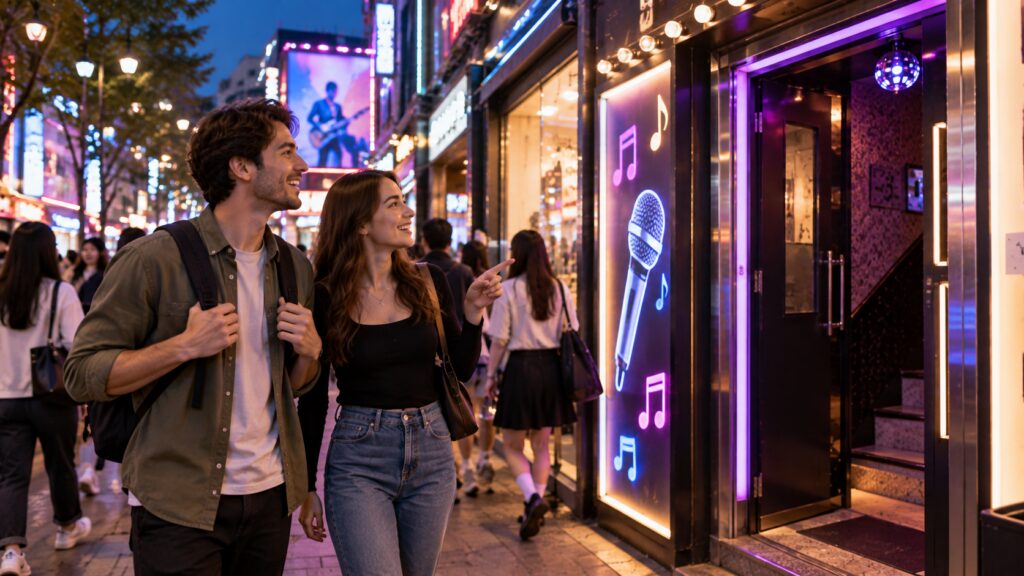
Walk through a busy neighborhood in Seoul after dinner and there is a good chance you will see the Korean word 노래방 somewhere above the street.
It means noraebang — literally, a “song room.”
But if your idea of karaoke involves singing on a stage in front of strangers at a bar, the Korean version may feel surprisingly different.
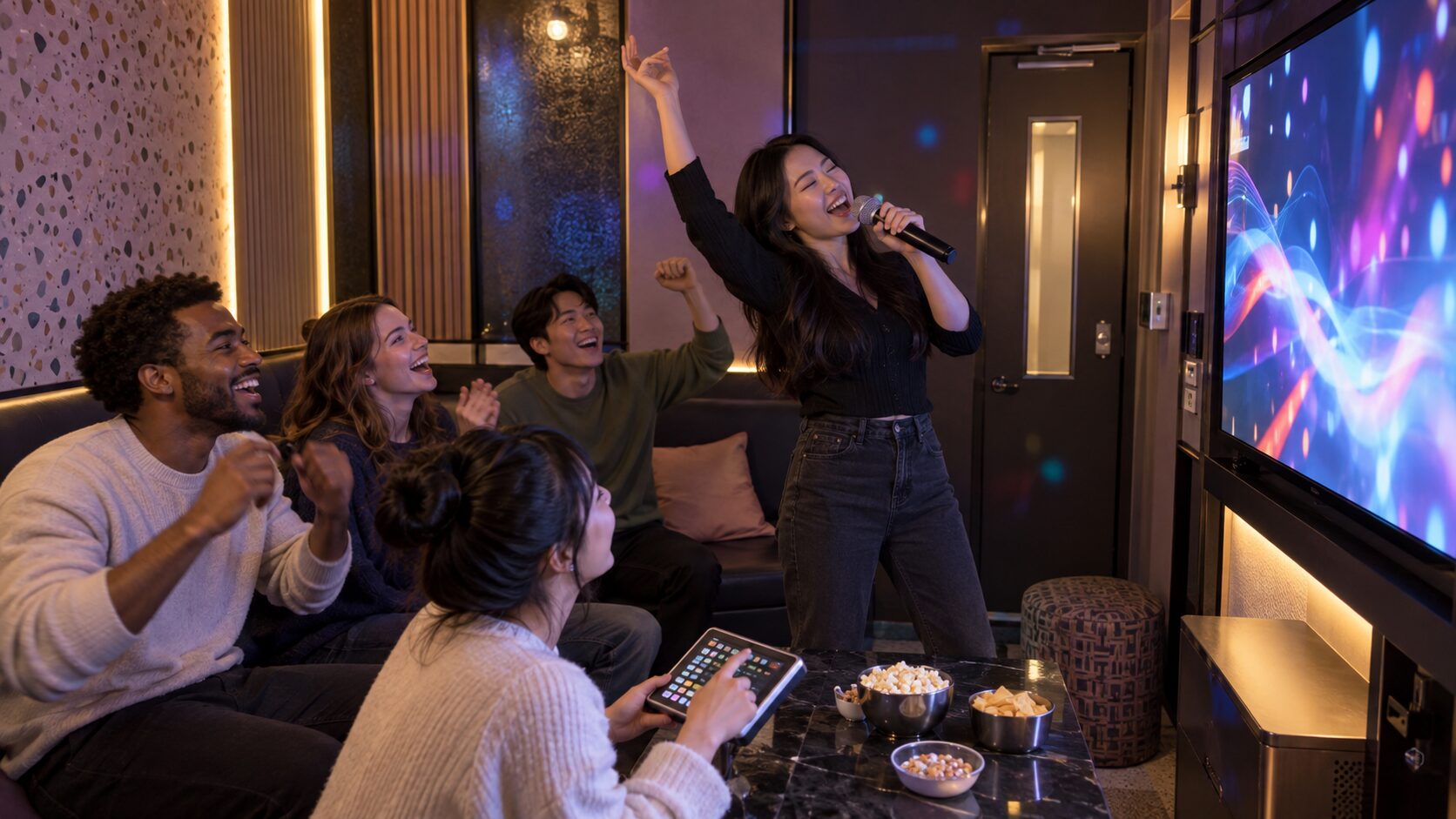
A typical noraebang gives you and your friends a private room, microphones, a screen and a huge song catalog. You can also go alone, and Korea’s compact coin noraebang makes that particularly easy.
Here is what first-time visitors should know before picking up the microphone.
What Exactly Is a Noraebang?
A noraebang is a private singing room where people choose songs and sing along to instrumental tracks while lyrics appear on a screen.
The word comes from norae (노래), meaning “song,” and bang (방), meaning “room.”
That second word explains an important part of the experience.
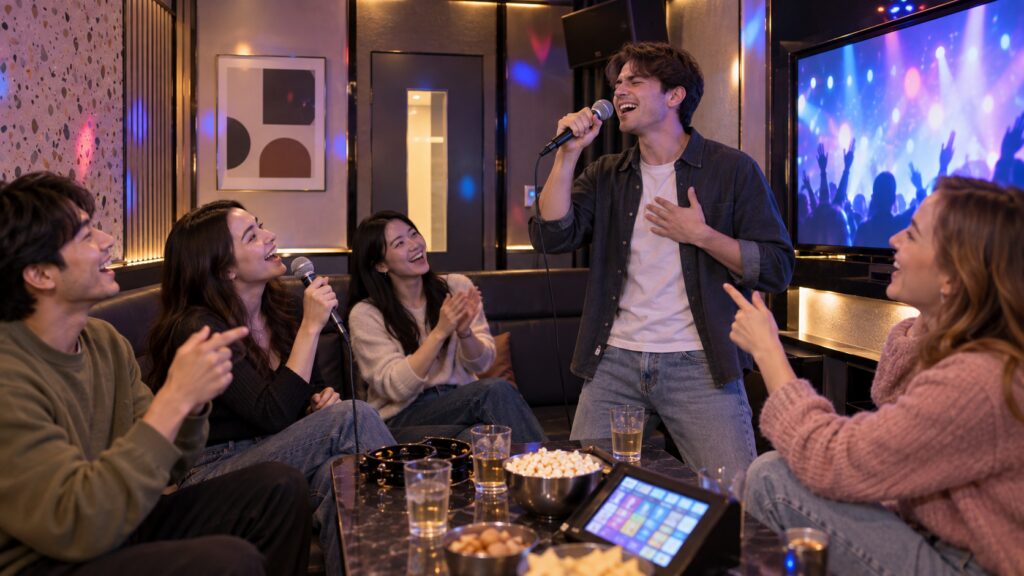
Unlike many Western karaoke bars, where people may sing in front of an entire venue, Korean noraebang usually revolves around a private room.
You might go with friends after dinner, with coworkers after a gathering, with a partner on a date or simply by yourself.
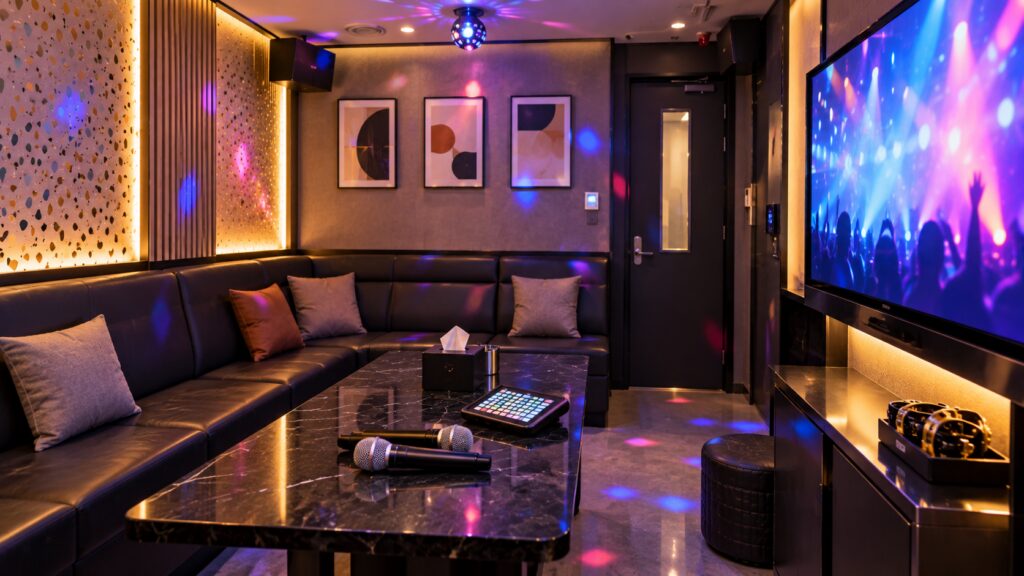
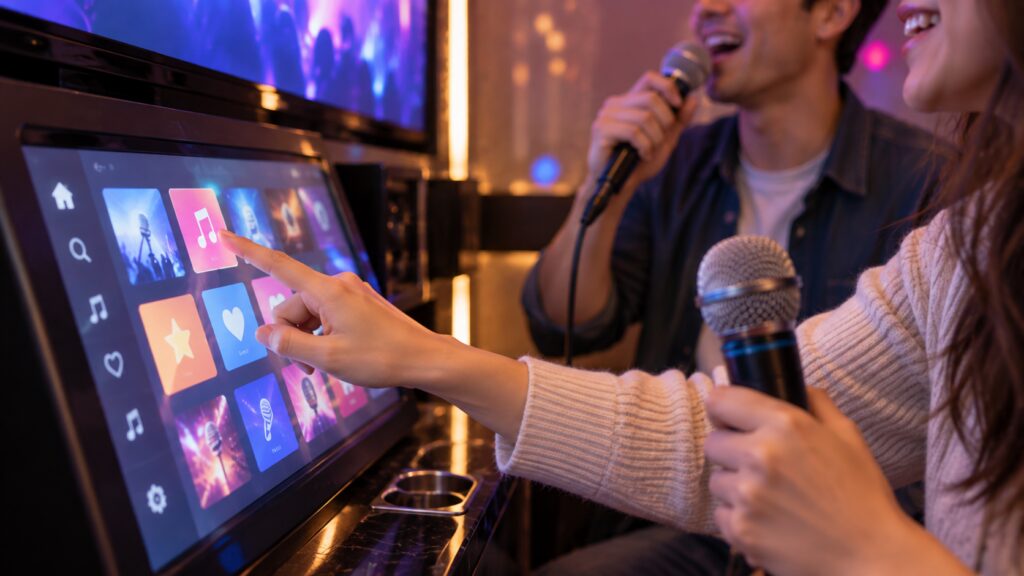
Inside, you will typically find microphones, a television or large display, speakers and a karaoke controller or touchscreen used to search for songs.
Depending on the venue, there may also be lighting effects, tambourines and other equipment designed to make the room feel like a miniature stage.
The point is not necessarily to sing well.
For many people, the fun comes from singing loudly with people you already know — without an audience of strangers watching.
Why Is Noraebang Such a Familiar Part of Korean Culture?
Noraebang is more than a tourist activity invented around K-pop.
It has long been part of Korean social life.
A singing room can become an informal next stop after dinner, a place for friends to spend an evening together or simply somewhere to sing without needing a stage or an audience.
Korea’s wider “bang culture” also includes spaces such as PC bangs, where people play computer games, and other private or semi-private entertainment rooms.
Noraebang fits naturally into that culture because the activity happens inside a space temporarily shared by your own group.
K-pop has given international visitors another reason to become curious about the experience.
If you have learned a favorite song through performances, music videos or fan culture, singing it in a Korean noraebang can turn something previously experienced through a screen into a very ordinary Korean night out.
Regular Noraebang vs. Coin Noraebang
One of the first things travelers should understand is that not every noraebang works the same way.
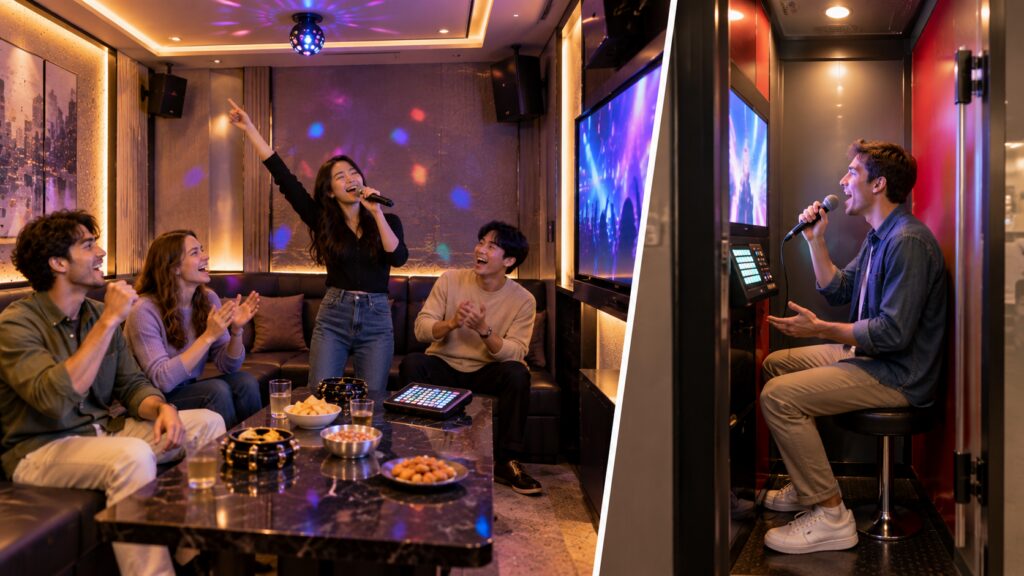
Regular Noraebang
At a conventional noraebang, you generally pay for use of a private room for a period of time.
This format works particularly well for groups because everyone shares the same room and takes turns choosing songs.
Room sizes, facilities, operating hours and prices vary by location.
Some venues are simple and practical. Others have larger rooms, elaborate lighting or more polished interiors.
Because pricing is not standardized nationwide, check the displayed rate or ask before you begin.
Coin Noraebang
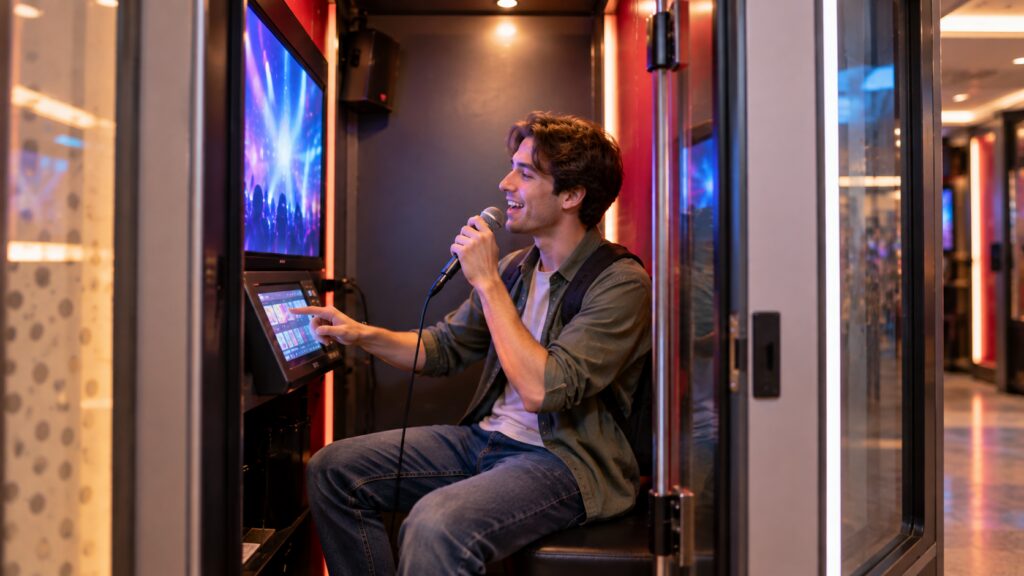
A coin noraebang (코인노래방) is designed for shorter, more flexible sessions.
Instead of necessarily renting a large room for an extended period, you can use a compact singing booth and pay for a small number of songs or a short session, depending on the venue.
That makes coin noraebang particularly convenient if you are traveling alone, want to practice one song or simply want to experience Korean karaoke without committing much time.
Despite the name, do not assume every machine accepts only physical coins. Payment systems vary by location.
For a first-time visitor who is nervous about entering a full-size noraebang, a coin noraebang can be the easiest introduction.
Can You Go to a Noraebang Alone?
Absolutely.
Solo singing is normal enough in Korea that compact coin noraebang has become a familiar part of the entertainment landscape.
You do not need to assemble a group just to try it.
For travelers, this makes noraebang unusually flexible.
You could spend ten or twenty minutes singing after shopping, stop by while exploring a university neighborhood or use it as a rainy-day activity between other plans.
Going alone also has one obvious advantage: nobody else gets to control the playlist.
How Do You Use a Korean Noraebang?
The exact system varies, but the basic process is straightforward.
At a regular noraebang, enter the venue and tell the staff how many people are in your group and how long you would like to use a room. Check the price and payment conditions before starting.
At a coin noraebang, the process may be more self-service.
Once inside your room, look for the song-selection controller, touchscreen or remote.
Search for the song you want, add it to the queue and start singing.
Korean songs are naturally a major part of the catalog, but many machines also contain international songs. The selection depends on the system and how recently its catalog has been updated.
If searching by English title does not work, try searching by artist or ask staff for help.
And if the controls initially look complicated, do not panic.
After finding the search function and successfully queuing one song, the rest usually becomes much easier.
Do You Need to Know Korean?
Knowing a few Korean words can help, but speaking Korean is not a requirement for enjoying noraebang.
The biggest potential obstacle is the machine interface rather than the singing itself.
Some systems are easier for international visitors than others, and the availability of English menus varies.
If you already know what you want to sing, keeping the song title and artist name on your phone can make searching easier.
You can also prepare the Korean spelling of a K-pop song or artist before going.
For example, a map search for 노래방 will help you find regular noraebang, while 코인노래방 will help you look for coin-operated or compact karaoke venues.
Those two Korean search terms can be more useful than searching only for “karaoke.”
What Kind of Songs Can You Sing?
K-pop is an obvious choice, but it is far from the only option.
Korean karaoke systems commonly contain a broad mix of Korean pop, ballads, older Korean music and international songs.
The exact catalog depends on the machine and venue, so there is no guarantee that every English-language song will be available.
If your main goal is to sing one particular track, especially a less well-known international song, check the song catalog if the venue or machine provider makes one available.
For many visitors, however, part of the fun is discovering what is already there.
You may arrive planning to sing one current K-pop hit and leave after attempting a ballad, a song from years ago and something your friends insisted would be “easy.”
Is Noraebang Only for K-Pop Fans?
Not at all.
K-pop fans may have an extra reason to be excited, but noraebang existed as a mainstream Korean social activity long before today’s global K-pop boom.
That distinction is useful for travelers.
You are not visiting a K-pop attraction in the same sense as a themed exhibition or merchandise shop.
You are participating in an ordinary leisure activity that happens to overlap naturally with Korea’s music culture.
That is also why a noraebang visit can complement other experiences such as exploring Korean fandom culture or making four-cut photos with friends.
Travelers who want to experience another side of K-pop performance culture can also try a K-pop dance class in Seoul, where beginner-friendly sessions let visitors learn part of a choreography themselves.
How Much Does Noraebang Cost in Korea?
There is no single nationwide noraebang price.
Regular room rates can vary according to the neighborhood, time, room size and venue. Coin noraebang pricing can also vary according to the number of songs, time-based options and payment system.
For that reason, treat prices found in old travel blogs as examples rather than fixed rates.
Check the current price displayed at the venue before paying.
Coin noraebang is generally designed to make short singing sessions easy, while a regular room may make more sense when several people want to sing together for longer.
Noraebang Etiquette for First-Time Visitors
Noraebang is relaxed, but a little common sense makes the experience better.
Take turns choosing songs when you are with a group rather than filling the entire queue yourself.
Keep drinks away from electronic equipment.
Do not assume that extra time, drinks or snacks are automatically included in your room rate.
And remember that a private room is not permission to damage equipment or ignore venue rules.
If staff tell you that your session is ending, check whether you need to leave or whether additional time can be purchased.
Most importantly, do not worry about performing perfectly.
Noraebang is one of the few places where enthusiastic singing can matter considerably more than good singing.
A Note About Different Types of Karaoke Venues
Travelers may encounter different businesses using karaoke-related English descriptions.
If you simply want the everyday Korean singing-room experience described in this guide, look for 노래방 or 코인노래방 and check what kind of venue you are entering.
A standard noraebang is a singing-room business, not automatically a nightclub or adult-entertainment venue.
Checking the Korean name, entrance information, pricing and venue type before entering is especially useful when exploring unfamiliar nightlife areas.
Where Can Travelers Find Noraebang in Seoul?
Noraebang is not limited to one special tourist district.
You can find singing rooms in commercial and entertainment areas throughout Seoul.
Neighborhoods with busy evening scenes, university districts and major shopping areas commonly have multiple options.
Hongdae is an obvious example because music, nightlife and youth culture are already concentrated in the area, but there is no need to travel across Seoul solely to find a noraebang.
Searching 노래방 or 코인노래방 on a Korean map service near your current neighborhood is often the simplest approach.
Check recent operating information before making a special trip because individual businesses can change hours, prices or close entirely.
Is Korean Noraebang Worth Trying?
If you want to understand contemporary Korean culture beyond palaces, shopping and restaurants, noraebang is an unusually accessible experience.
It does not require a tour.
You do not need to be fluent in Korean.
And you certainly do not need to be a good singer.
A short coin noraebang session can fit between other activities, while a longer private-room session can become an entire evening with friends.
More importantly, it offers a glimpse of something visitors often want from Korea: an experience that feels culturally distinctive but is still part of ordinary everyday life.
Choose a song you know, close the door and pick up the microphone.
Nobody outside the room needs to know how the high note went.
Frequently Asked Questions About Korean Noraebang
What does noraebang mean?
Noraebang (노래방) literally combines the Korean words for “song” and “room.” It generally refers to a private karaoke or singing room.
Is Korean noraebang private?
Most conventional Korean noraebang experiences take place in private rooms used by your own group rather than on an open stage in front of strangers.
Can foreigners use noraebang in Korea?
Yes. You do not need to speak fluent Korean, although some machine interfaces may be easier to navigate than others. Keeping song titles and artist names on your phone can help.
Can I go to noraebang alone?
Yes. Coin noraebang in particular is well suited to solo visitors because you can use a small booth for a short singing session.
What is the difference between noraebang and coin noraebang?
A regular noraebang typically involves using a private room for a period of time. Coin noraebang is designed for shorter sessions and may charge according to songs or time, depending on the venue.
Do Korean noraebang have English songs?
Many karaoke systems include international music, but song catalogs vary by machine and venue. A particular English-language song is therefore not guaranteed to be available.
Sources & Further Reading
Visit Seoul — Seoul Local Life Course: How to Use Noraebang
VISITKOREA — Experience Korean Room Culture as Seen in K-Content