
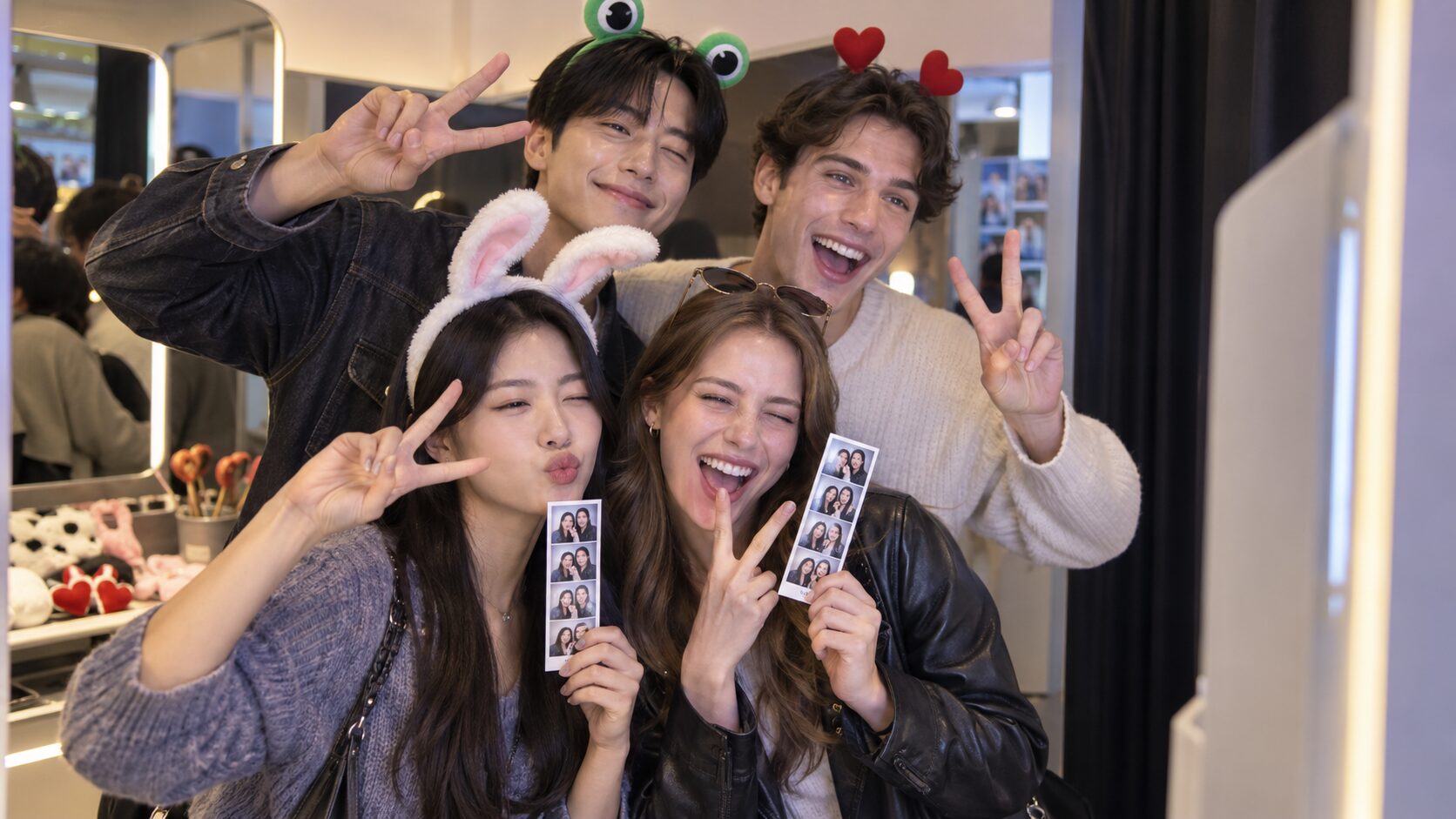
Walk through a busy neighborhood in Seoul and you may notice something that looks familiar but works a little differently from the photo booths you know.
Friends disappear behind a curtain, a countdown begins, several poses happen in rapid succession, and a few minutes later everyone walks out holding narrow strips of photos.
These are Korea’s four-cut photo booths.
What began as a popular way for young Koreans to record everyday moments has grown into a recognizable part of contemporary Korean culture — and an easy experience for travelers to try.
But what exactly is a four-cut photo, why is it so popular, and what should you know before stepping into a booth?
What Is a Korean Four-Cut Photo?
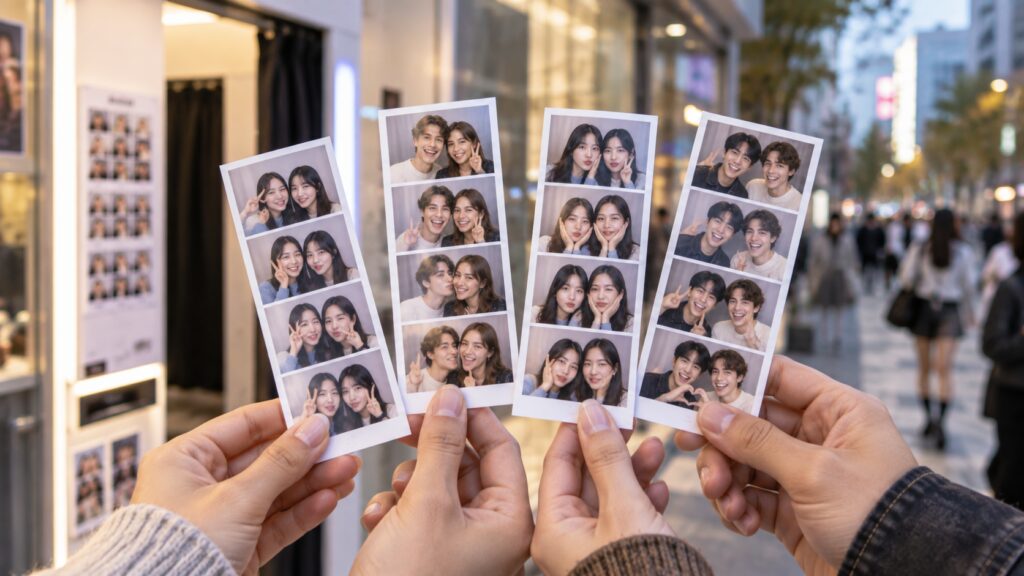
A Korean four-cut photo, often called ne-cut sajin (네컷사진), is a sequence of photos taken in a self-service photo booth and printed together on a photo strip.
Despite the name, the exact layout can vary. The important idea is the sequence: instead of taking one formal portrait, you create several quick images that capture different poses or expressions.
You usually choose a frame or layout, enter the booth, follow a countdown and take a series of photos.
Depending on the booth, you may then select your favorite shots before the final strip is printed.
The result is small, physical and easy to keep — a souvenir from an otherwise ordinary day.
Why Are Four-Cut Photos So Popular in Korea?
The appeal is partly about photography, but it is also about what happens around the photograph.
Friends take them after eating together.
Couples take them on dates.
People take them on birthdays, during trips or simply because they like what they are wearing that day.
The Korea Tourism Organization reported that the number of unmanned four-cut photo booths in Korea grew from 1,006 in 2023 to more than 3,000 in 2024, with teenagers and people in their twenties accounting for most users.
That scale helps explain why the booths can feel less like a special attraction and more like part of an ordinary outing.
A smartphone can take unlimited pictures. A photo booth does almost the opposite.
There is a countdown.
You have limited time.
Someone inevitably changes their pose too late.
And at the end, you leave with something physical.
That combination of spontaneity and a printed keepsake is a large part of the charm.
Is “Life Four Cuts” the Same as Every Korean Photo Booth?
Not exactly.
Travelers sometimes encounter the Korean name Insaengnekeot (인생네컷) and assume it is the Korean word for every four-cut photo booth.
It is actually the name of a well-known photo booth brand.
Korea has multiple self-photo booth companies and styles, and their lighting, filters, layouts, props and collaboration frames can differ.
So it is more accurate to use four-cut photo or Korean photo booth when talking about the overall culture, rather than using one brand name for the entire category.
For travelers, the difference can also be part of the fun.
Walk through a busy neighborhood and you may see several booths within a short distance, each offering a slightly different visual style.
How Does a Korean Photo Booth Work?
The exact process varies by company, but the basic experience is usually simple.
First, choose the photo format or frame you want.
Some booths offer simple borders, while others have seasonal designs, characters or limited collaboration frames.
Next, pay and enter the shooting area.
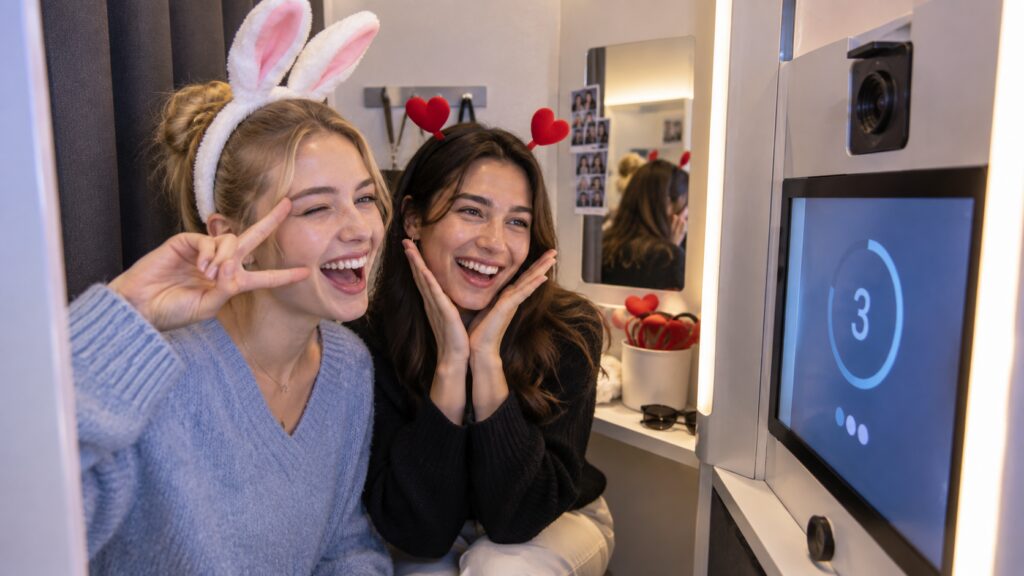
A countdown appears on the screen and the camera takes a series of photographs.
This is where first-timers often discover that the process moves faster than expected.
There may not be much time to invent a completely new pose between shots, so thinking of a few poses before the countdown starts can help.
After shooting, some systems allow you to choose which images appear on the final strip.
The booth then prints the photographs.
Depending on the operator, the finished strip may also include a QR code that lets you download digital photographs or a short video from the session.
If a digital download is important to you, save it promptly. QR download availability and expiration periods can vary between services.
Why Do Korean Photo Booths Have Mirrors and Props?
The photography often begins before you enter the actual booth.
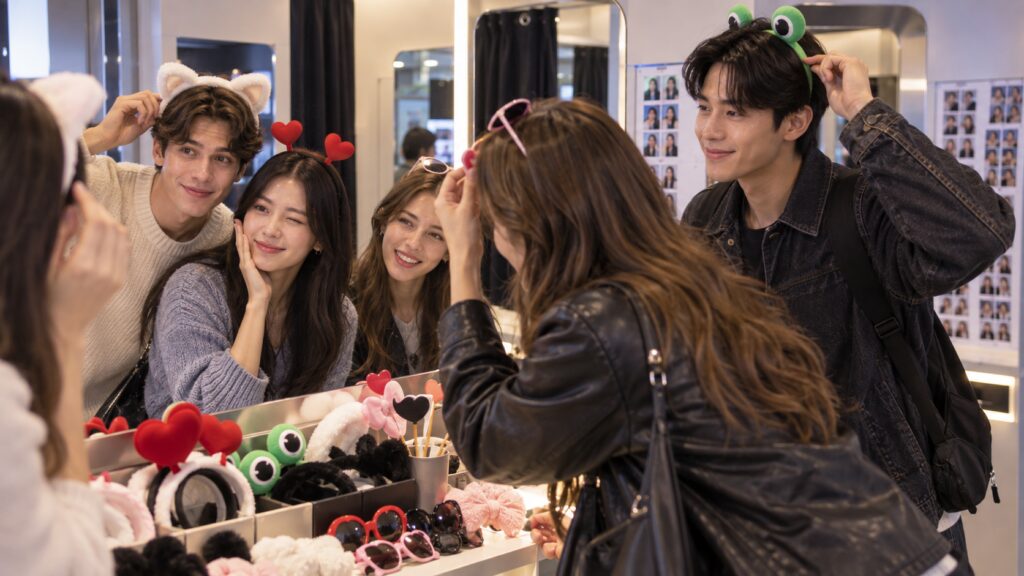
Many self-photo studios provide mirrors, and some locations also have simple accessories or hair-styling tools that visitors can use before shooting.
Props may include playful glasses, headbands or other accessories.
Not every booth has the same setup, so it is better to treat these as common features rather than something guaranteed at every location.
The preparation area also explains why Korean photo booths can feel more like miniature self-photo studios than old-fashioned vending-machine photo booths.
Visitors do not simply sit down for one picture.
They prepare a look, choose a visual style and create a short sequence together.
What Are K-Pop Photo Booth Frames?
This is where Korean photo booth culture overlaps directly with fandom.
Photo booth companies sometimes collaborate with K-pop artists, actors, influencers or character franchises to release special frames.
A fan can pose in their half of the image while the artist or character appears as part of the designed frame.
These collaborations are often tied to events such as an artist’s comeback, birthday or another promotional period.
The printed strip then works as both a photograph and a piece of fandom memorabilia.
If you are new to the way lightsticks, photocards, fanchants and other fan practices fit together, our guide to K-pop fandom culture explains the larger ecosystem around modern Korean fandom.
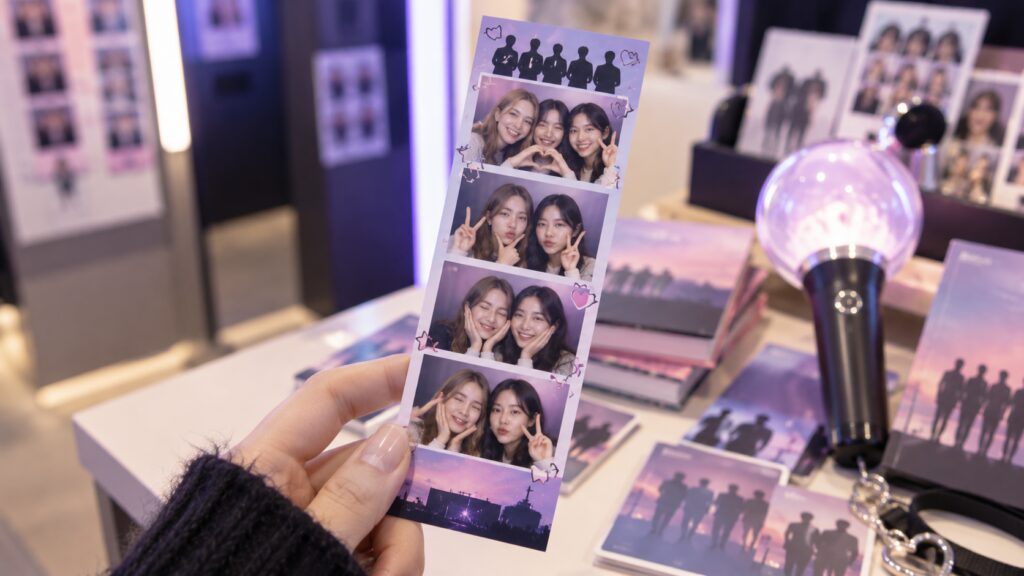
There is one important catch with collaboration frames: they are temporary.
A frame you see online may only be available during certain dates or at selected branches.
If a specific artist is the reason you want to visit, check the photo booth company’s current official information before making a special trip.
Where Can Tourists Try Korean Photo Booths?
You do not usually need to plan an entire journey around finding one.
Self-photo booths are common in busy entertainment and shopping districts.
The Korea Tourism Organization specifically points to Gangnam, Seongsu and Hongdae as areas where visitors can find multiple booths and concepts.
Seongsu is especially interesting because photo booths now sit alongside the neighborhood’s cafés, pop-ups, fashion stores and beauty experiences.
If you are planning to spend time there, our Seongsu-dong Seoul guide explains how those experiences fit into the wider neighborhood.
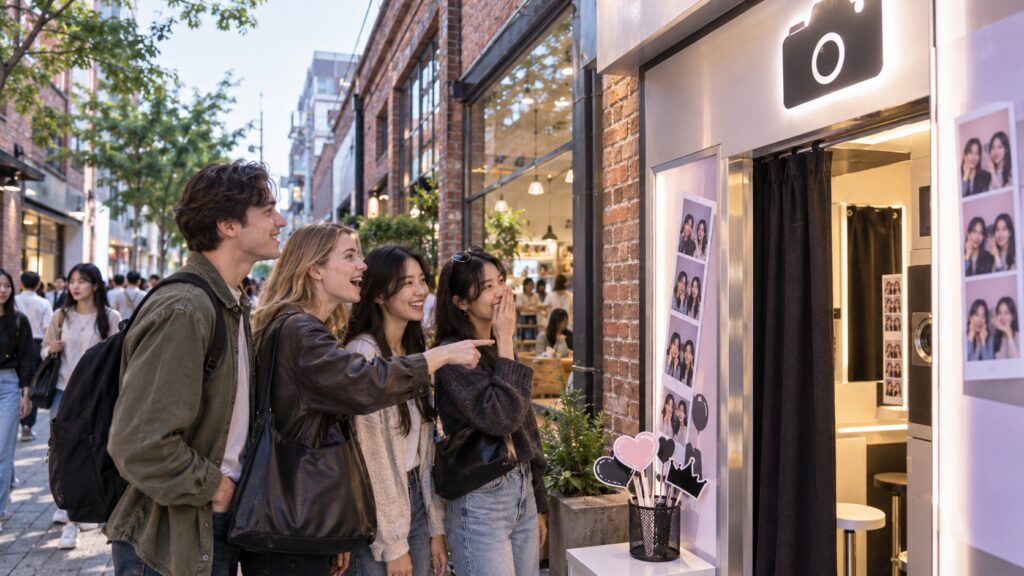
The official Seoul tourism site also highlights Seongsu’s themed self-photo booths as one of the activities available in the area.
Wherever you go, do not assume that every branch offers the same backgrounds, frames or collaboration events.
That constant variation is part of the culture.
How Much Do Korean Photo Booths Cost?
There is no single nationwide price.
Prices vary depending on the company, location, photo format, number of prints and special frame selected.
Historically, four-cut booths became popular partly because they offered a relatively inexpensive way for friends to create a physical souvenir together.
For a current price, however, check the kiosk or posted information at the location you are actually using.
This is particularly important for special formats or collaboration frames, which may be priced differently from standard options.
What Should First-Time Visitors Know?
The experience is easy, but a few small decisions can make it more enjoyable.
Think of several poses before you begin. The countdown between photographs may feel surprisingly quick.
Check the frame before paying, especially if you came for a particular K-pop collaboration.
Look at the print quantity so you know whether everyone in your group will receive a copy.
If the strip has a QR code, download any digital files soon rather than assuming the link will remain active indefinitely.
And do not worry too much about creating four perfect pictures.
Awkward timing and mismatched poses are often part of what makes the strip memorable.
Why Do Printed Photos Still Matter?
This may be the most interesting part of the trend.
Korean photo booth culture became popular during an era when almost everyone already had a high-quality camera in their pocket.
The booths did not solve a lack of photographs.
They created a different kind of photograph.
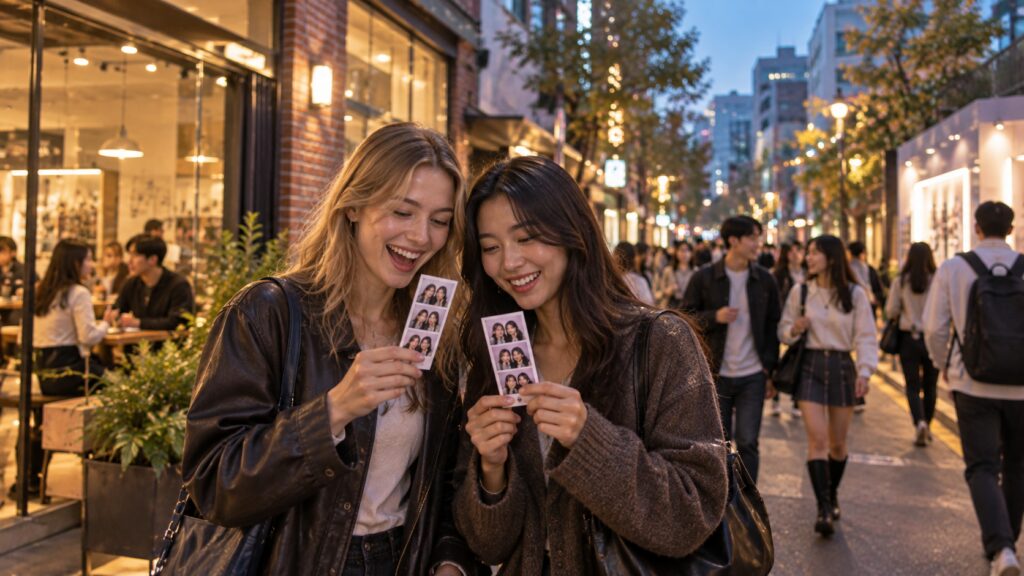
A phone gallery can contain thousands of images that are rarely seen again. A small printed strip can end up inside a phone case, on a wall, in a diary or stored with other memories.
The physical object gives an ordinary meeting a beginning and an end: you went somewhere together, stood in front of the camera and came away with the same souvenir.
That helps explain why the experience has survived beyond its initial novelty.
Are Korean Photo Booths Worth Trying?
For most travelers, the commitment is small.
You do not need a reservation for a typical unmanned booth, you do not need to understand a complicated cultural ritual, and the entire experience can fit naturally between other activities.
More importantly, it offers something different from simply photographing a famous Seoul landmark.
If you want to try another everyday Korean experience after taking your photos, stepping into a Korean noraebang offers a similarly easy way to experience contemporary social culture.
A four-cut strip is a small piece of contemporary Korean everyday culture — the kind of thing friends, couples and fans actually do themselves.
You may enter because the booth looks fun.
You leave with four tiny photographs that can end up being one of the simplest souvenirs from your trip.
Frequently Asked Questions
What is a Korean four-cut photo?
A four-cut photo is a sequence of self-service booth photographs printed together as a strip. Users typically take several timed shots and choose photographs or a layout for the final print.
Is Insaengnekeot the name for all Korean photo booths?
No. Insaengnekeot, commonly translated as Life Four Cuts, is a photo booth brand. Korean four-cut photo culture includes multiple companies and booth styles.
How much does a Korean photo booth cost?
Prices vary by operator, location, photo format, number of prints and special frames. Check the price displayed at the booth before paying, especially if you choose a limited-edition collaboration frame.
Can tourists use Korean photo booths?
Yes. They are self-service experiences, and Korea’s official tourism organization describes four-cut booths as popular with tourists as well as Korean users. Interfaces and payment options vary by operator.
Can I download Korean photo booth pictures to my phone?
Many booths provide QR-based digital downloads, sometimes including a short video of the session. Availability and expiration periods vary, so save the files promptly if you want to keep them.
Where can I find Korean photo booths in Seoul?
They are common in busy shopping and entertainment areas. The Korea Tourism Organization specifically highlights Gangnam, Seongsu and Hongdae for finding multiple four-cut booths, while Seoul’s official tourism site also maintains a current listing for self-photo booths in Seongsu.
Sources & Further Reading
VISITKOREA — The Four-Cut Photo Craze in Korea