
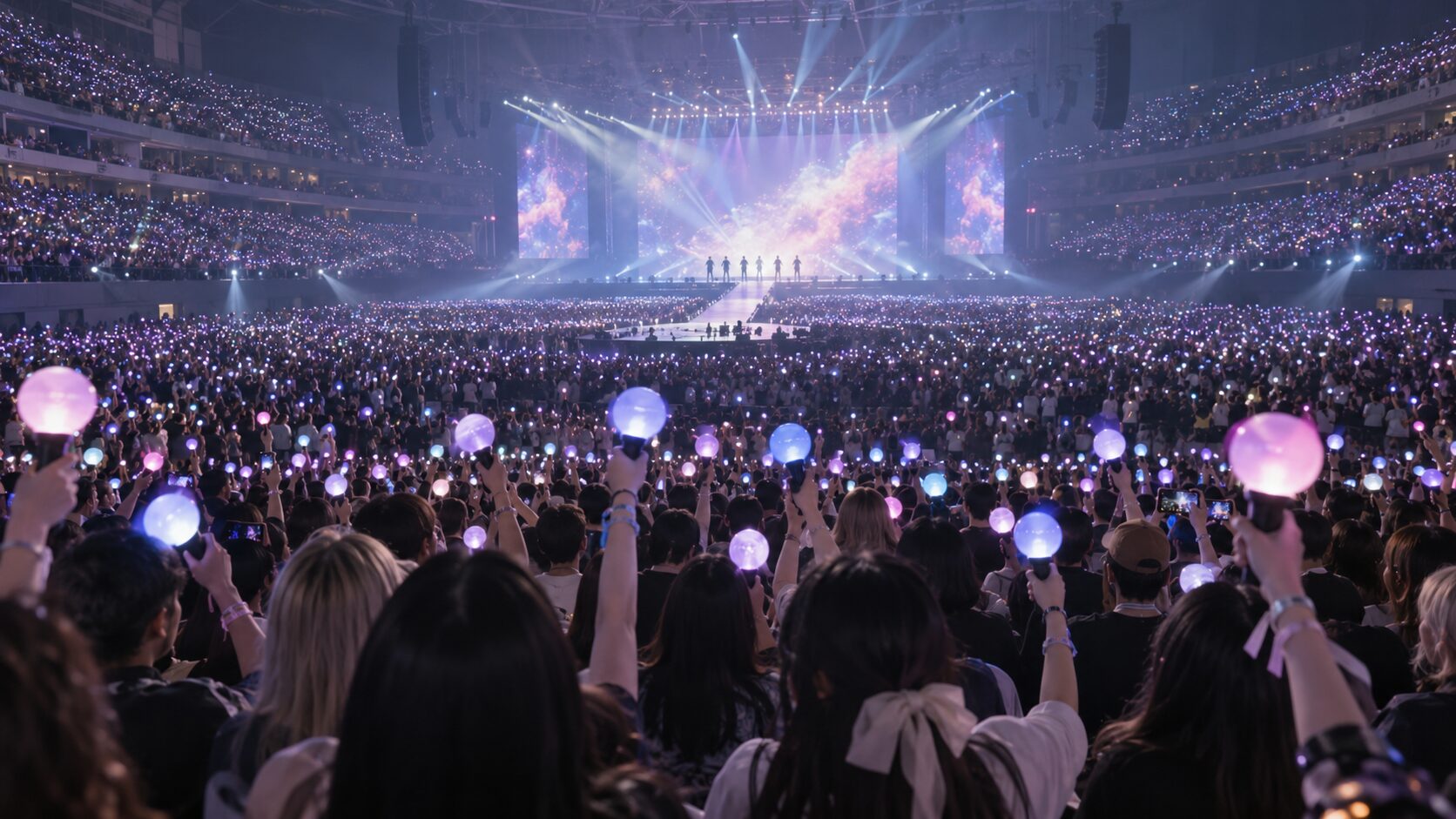
K-pop can be surprisingly confusing when you first step beyond the music.
Why is everyone at a concert holding the same glowing object? How do thousands of fans know exactly what to shout during a song? Why does opening a new album sometimes feel more like opening a pack of collectible cards?
These are all parts of K-pop fandom culture — a highly participatory fan culture that has developed alongside the Korean music industry and spread far beyond South Korea.
You do not need to memorize every rule or collect anything to enjoy K-pop. But understanding a few of these traditions can make the world around the music much easier to understand.
What Does “Fandom” Mean in K-Pop?
In K-pop, a fandom is more than a general description for people who like an artist.
Many K-pop artists have an official fandom name, often announced by the artist or entertainment company. Over time, that name can become a shared identity used at concerts, online communities, fan events and official membership programs.
Some fandoms also have their own symbols, colors and inside references.
That does not mean every fan participates in the same way. Someone who occasionally listens to a group on Spotify and someone who attends concerts, collects albums and joins fan events can both be fans.
K-pop simply offers more structured ways to participate if you want to go deeper.
What Is a K-Pop Lightstick?
One of the easiest parts of K-pop fandom culture to recognize is the official lightstick, known in Korean as an eungwonbong (응원봉).
Unlike a generic glow stick, an official K-pop lightstick is usually designed specifically for an artist or group. Its shape, colors and details often reflect the artist’s identity or fandom.
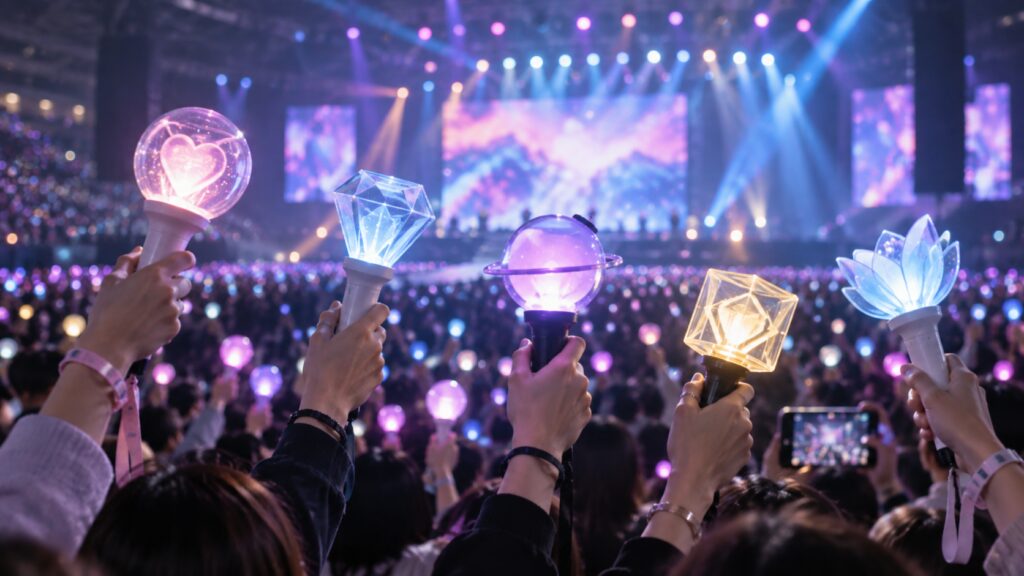
At a large concert, thousands of these lights can transform the audience into part of the visual production.
Modern lightsticks may also connect wirelessly at certain concerts, allowing their colors and lighting patterns to be synchronized during the performance.
The result is the famous “lightstick ocean” seen at many K-pop concerts.
For fans, however, a lightstick can mean more than concert lighting. It can also function as a symbol of belonging — a physical way of showing which artist or fandom they support.
You do not usually need a lightstick to enjoy a K-pop concert, though. Concert rules and technology vary by artist, venue and event, so first-time visitors should check the official event information rather than assuming one is required.
What Is a K-Pop Fanchant?
Then there is the sound.
Watch a Korean music-show performance or attend a K-pop concert and you may hear the audience shouting particular words or members’ names at precisely timed moments.
That is a fanchant.
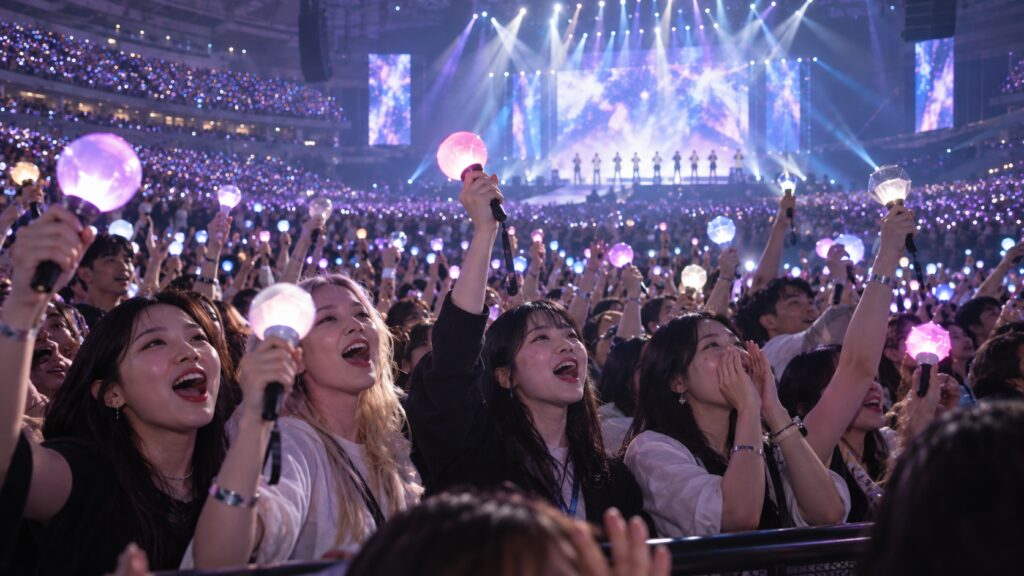
Known as eungwonbeop (응원법) in Korean, fanchants are organized responses designed for particular songs. They might include artist names, parts of the lyrics or short phrases shouted between vocal lines.
For many releases, official fanchant guides are shared so fans can learn where the responses belong.
This creates an interesting relationship between performer and audience.
Instead of simply cheering whenever they want, participating fans can effectively become another rhythmic layer of the performance.
International fans do not need to know every fanchant before attending a concert in Korea. Listening, watching and joining in when comfortable is perfectly normal.
A similarly participatory cheering culture can also be found at a Korean baseball game in Seoul, where coordinated chants and player songs are a major part of the stadium experience.
Why Are K-Pop Photocards So Popular?
Buy a physical K-pop album and you may discover that the CD is only one part of the package.
Albums often include photobooks, posters, stickers and other inserts. Among the most sought-after inclusions are photocards: small collectible cards featuring individual artists.
The important part is that many album photocards are randomly inserted.
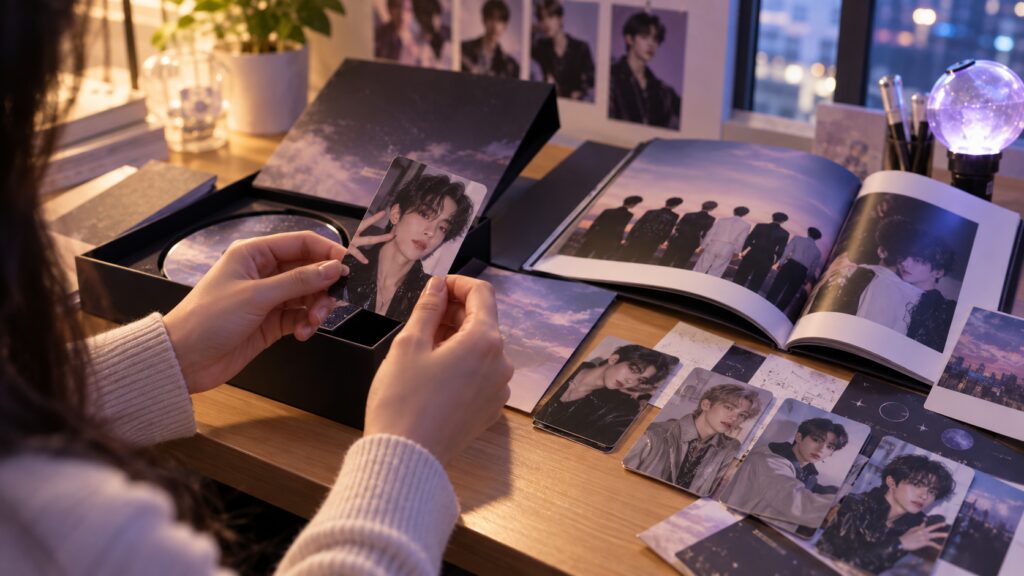
A fan buying an album therefore may not know which member’s card is inside until the package is opened.
That element of chance has helped create an enormous collecting and trading culture.
Fans trade duplicate cards, search for cards featuring their favorite member and sometimes collect entire sets from a particular album era.
That fan culture also extends beyond traditional merchandise. Korean photo booths increasingly offer limited collaboration frames that let fans create four-cut photos connected to their favorite artists, a trend explained in our guide to Korean photo booth culture.
In Korea, the word poca (포카), shortened from “photocard,” is commonly used among fans.
The culture now extends far beyond Korea. Online communities and resale platforms allow collectors in different countries to trade and purchase cards, while rare or event-exclusive cards can become particularly difficult to find.
Still, collecting photocards is optional. It is one part of K-pop fandom, not a requirement for being a “real” fan.
What Does “Bias” Mean?
Sooner or later, a new K-pop fan will probably encounter this question:
“Who’s your bias?”
In K-pop fandom language, your bias is your favorite member of a group.
You may also hear “bias wrecker,” an informal expression for another member who keeps challenging that favorite position.
These expressions illustrate how K-pop fandom developed its own vocabulary — some originating in Korea, others evolving through international fan communities.
Another potentially confusing term is “comeback.”
In everyday English, a comeback can suggest that an artist disappeared for a long time and then returned.
In K-pop, it usually means an artist is releasing new music and beginning another promotional period. A group can therefore have multiple “comebacks” without ever having broken up or gone away.
K-Pop Fandom Goes Beyond Concerts
K-pop fan culture does not stop when the concert ends.
For travelers in Korea, music culture can also become a more everyday experience — even something as simple as singing favorite K-pop songs in a Korean noraebang.
Travelers who want to experience the performance side of K-pop can also try a K-pop dance class in Seoul, with beginner-friendly sessions available for visitors who want to learn part of a choreography themselves.
Fans may organize birthday café events, exchange photocards, visit pop-up stores, create fan projects or participate in online communities.
In South Korea, birthday cafés are a particularly visible example.
For an idol’s birthday or another anniversary, fans may temporarily decorate a café with photos, banners and themed items. Visitors buy a drink and may receive fan-made souvenirs such as photo cards or cup sleeves.
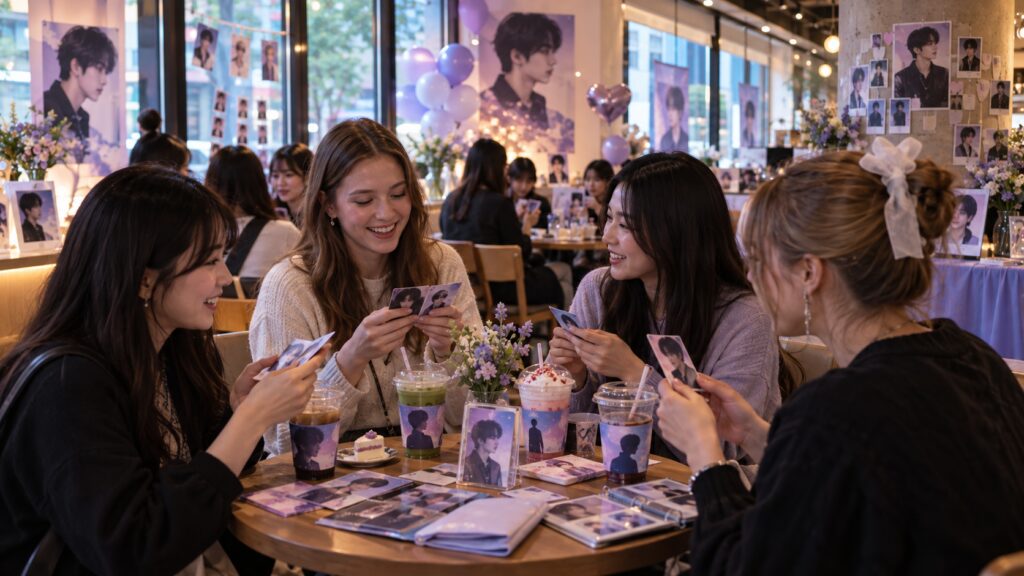
These events can turn ordinary cafés into temporary gathering places for people who may have previously known one another only online.
Again, there is no single way to participate. Different artists and fandoms develop different traditions, and practices change over time.
Is K-Pop Fandom the Same Outside Korea?
Not exactly.
K-pop fandom is global, but fan culture does not simply travel unchanged from Seoul to Los Angeles, London or anywhere else.
International fans adopt Korean fandom practices while also creating their own communities and customs.
Access can be different too.
A fan living in Korea may have easier access to music shows, pop-up stores, fan-sign events and locally distributed merchandise. An overseas fan may experience the same fandom primarily through concerts, social platforms, online stores and international fan communities.
As K-pop has become increasingly global, however, those worlds have become much more connected.
Photocards can be traded internationally. Fanchant guides can be watched online before a concert. Birthday café events inspired by Korean fan culture now appear in cities outside Korea.
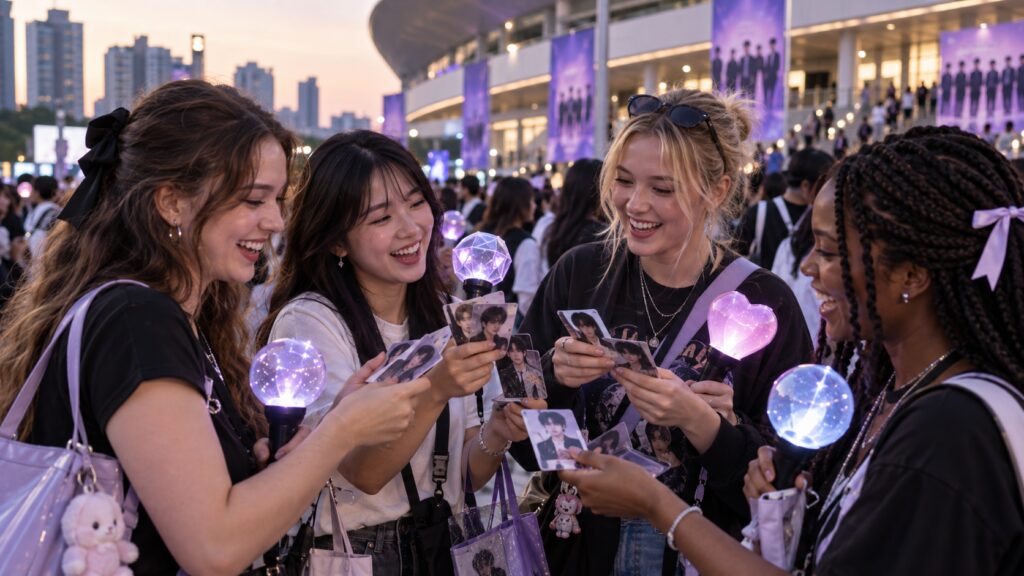
K-pop fandom today is better understood as a culture that began around the Korean music industry but continues to evolve through interaction between Korean and international fans.
Do You Need to Do All This to Be a K-Pop Fan?
This may be the most useful thing for newcomers to know.
You do not need an official lightstick.
You do not need hundreds of photocards.
You do not need to memorize every fanchant, buy every album version or join an official fan club.
These practices are ways of participating in K-pop fandom, not entrance requirements.
You can simply listen to the music.
But if you eventually find yourself comparing photocards, learning a Korean fanchant or standing in an arena surrounded by thousands of synchronized lights, you will understand why K-pop fandom can feel different from simply following a pop artist.
The audience is not always watching the culture from the outside.
Very often, the fans are helping create it.
FAQ
What is a K-pop fandom?
A K-pop fandom is the community of fans surrounding an artist or group. Many artists have official fandom names, while fans may also participate through concerts, albums, fan events and online communities.
What is a K-pop lightstick?
A K-pop lightstick is an official illuminated merchandise item associated with an artist or group. At some concerts, compatible lightsticks can be synchronized to create coordinated lighting effects across the audience.
What is a fanchant in K-pop?
A fanchant is an organized audience response performed during specific parts of a K-pop song. It can include artist names, lyrics or short phrases timed to the performance.
Why do K-pop fans collect photocards?
Photocards are collectible artist photos often included randomly in physical albums. The random selection encourages a culture of collecting and trading, especially among fans searching for cards of particular members.
What does “bias” mean in K-pop?
A bias is a fan’s favorite member of a K-pop group. The term is commonly used by both Korean and international fans.
Do I need a lightstick or photocards to be a K-pop fan?
No. Lightsticks, photocards, fan clubs and fanchants are optional ways to participate in fandom culture. Simply enjoying the music is enough.
Sources & Further Reading
Ministry of Culture, Sports and Tourism — 2025 Overseas Hallyu Survey
Yonhap News Agency — K-pop album exports hit record high in the first half of 2026
Yonhap News Agency — Global K-pop goods and photocard trading