
Traveling in South Korea does not require memorizing a long list of social rules.
Most visitors will find that everyday situations are fairly easy to navigate, even when they do not know much Korean. Still, a few local habits can make public transportation, restaurants, homes and cultural sites feel much less confusing.
The useful approach is not to worry about performing every Korean custom perfectly. It is to know which situations have practical expectations and to pay attention to what people around you are doing.
Here are the Korea travel etiquette basics that matter most for a first-time visitor.
Do Tourists Need to Know Korean Etiquette?
You do not need to master formal Korean etiquette before your trip.
Korean social customs can vary depending on age, setting, relationship and occasion. The formal behavior expected at a family gathering or workplace, for example, is not necessarily what a tourist needs while ordering lunch or riding the subway.
For travelers, a few principles go a long way:
- respect shared spaces;
- follow signs and staff instructions;
- avoid being unnecessarily loud;
- watch how a particular place operates; and
- do not assume every custom applies in every setting.
A small nod or polite greeting is usually enough in ordinary tourist interactions. You are not expected to perform an elaborate bow every time you enter a café or convenience store.
Do You Tip in South Korea?
For ordinary restaurants in South Korea, tipping is generally not expected.
The Korea Tourism Organization specifically tells visitors that tipping is not required or expected when dining at Korean restaurants.
That makes Korea different from countries where calculating a percentage-based restaurant tip is part of paying the bill.
Usually, you simply pay the amount shown.
Hotels, tours and other specialized services can operate differently, particularly when a service is designed for international travelers. If a business clearly states a service charge or tipping policy, follow the information provided by that business rather than assuming one rule applies everywhere.
For the full restaurant process — including ordering, banchan, call buttons and paying — see our guide to how to eat at a Korean restaurant.
When Should You Take Off Your Shoes in Korea?
The most important rule is not “always remove your shoes indoors.”
Instead, look at the space.
Shoes are normally removed before entering a Korean home. Some traditional accommodations, temples and floor-seating spaces may also require visitors to take them off.
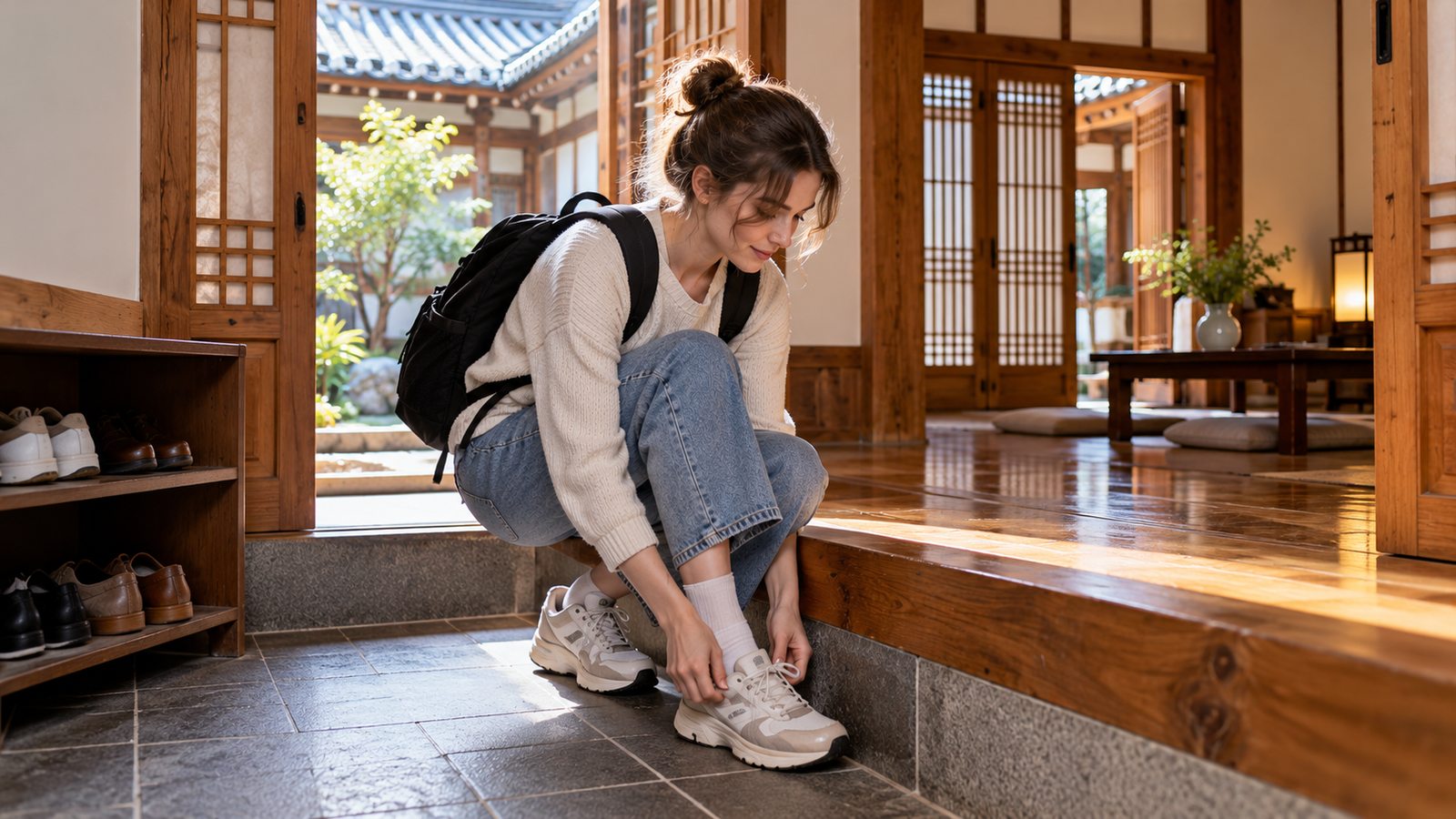
A useful clue is the entrance itself.
If you see shoes lined up near the door, a shoe cabinet, slippers or a raised floor beyond the entrance, stop and check before walking farther inside.
Modern cafés, shops, hotel lobbies and most ordinary restaurants generally do not expect customers to remove their shoes.
Following the setup of the specific place is more useful than applying one universal rule.
What Is Good Subway Etiquette in Korea?
Public transportation is one of the places where simple consideration makes the biggest difference.
Let People Get Off Before You Get On
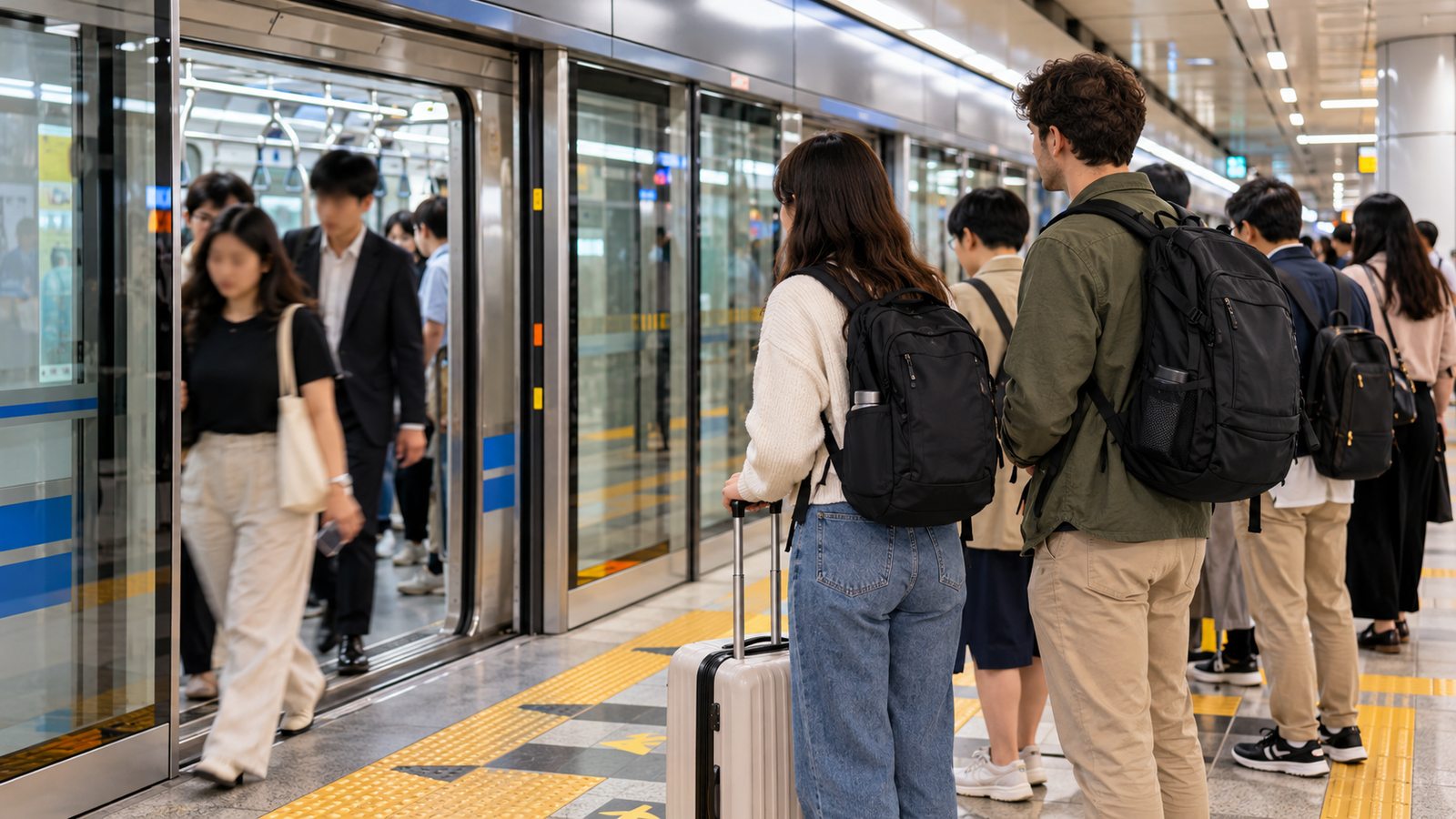
When subway doors open, stand aside and allow passengers to exit before boarding.
This is especially important at busy stations where large numbers of passengers may be moving through the same doors.
Be Careful With Priority Seating
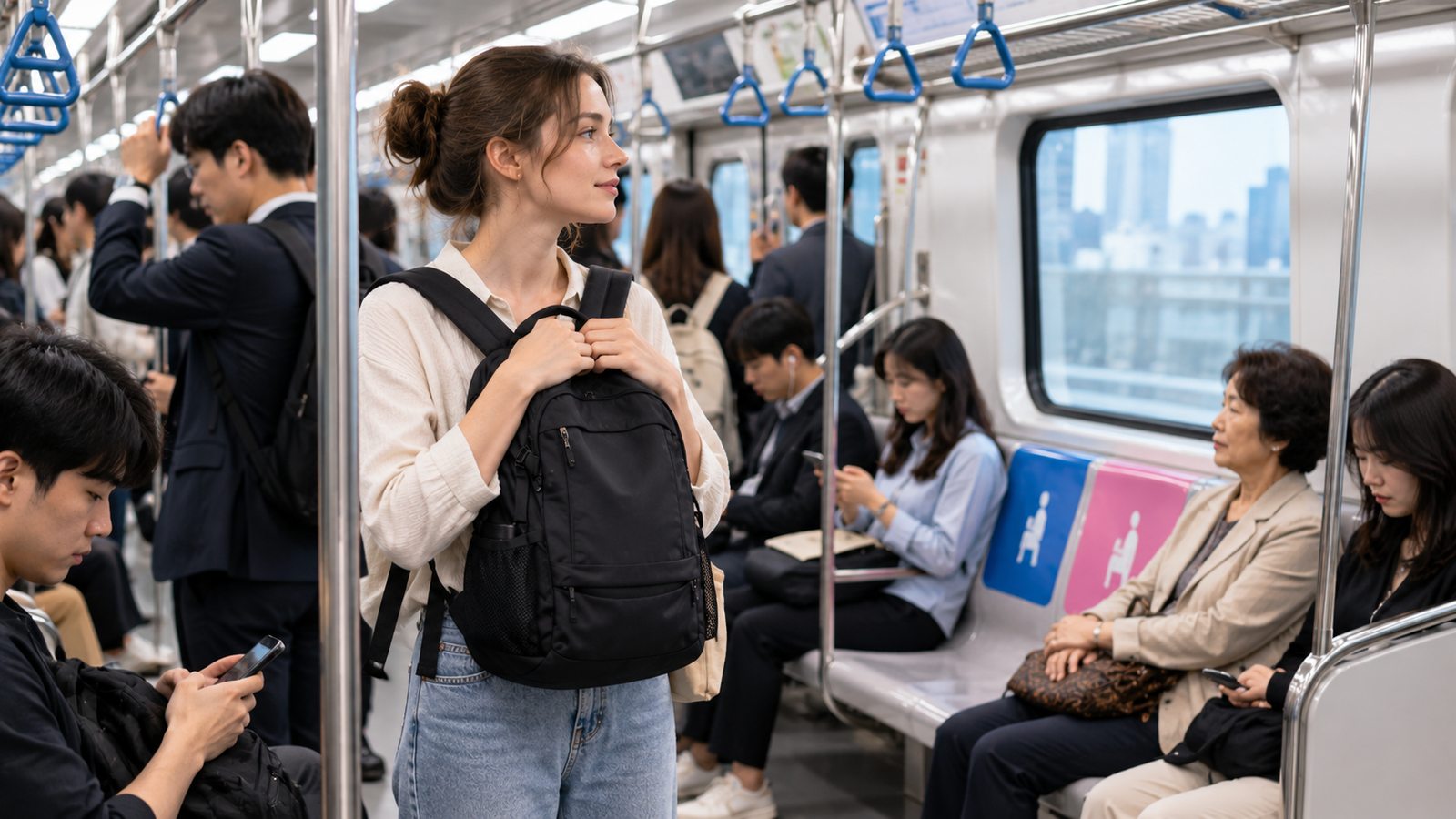
Subway cars have designated priority seating for passengers who may need it, including older adults and people with mobility needs. Separate seats are also designated for pregnant passengers.
Visitors should pay attention to the signs and avoid treating designated seating like ordinary seating simply because it happens to be empty.
Keep Large Bags Under Control
A travel backpack that feels normal while walking can take up a surprising amount of room on a crowded train.
Seoul’s official tourism guidance recommends moving a bulky backpack to the front or putting it down so it does not hit or obstruct other passengers.
Keep Noise Reasonable
You do not need to remain completely silent on Korean public transportation.
But loud phone calls, videos playing through speakers or very loud conversations can disturb people in a crowded shared space. Headphones and a moderate speaking volume are the safer choice.
For fares, T-money, transfers and navigating the network itself, use our Seoul subway and T-money guide.
What Should You Know About Korean Restaurant Etiquette?
Restaurant etiquette is often simpler than visitors expect.
You do not need perfect chopstick technique, and nobody expects a short-term visitor to know every traditional dining custom.
What matters more is understanding how that particular restaurant works.
Some restaurants have staff take your order. Others use table tablets, kiosks or self-service stations. Water and banchan refills may also be self-service.
If a restaurant has shared side dishes or a refill station, take what you expect to eat rather than loading your table with food that will be left behind.
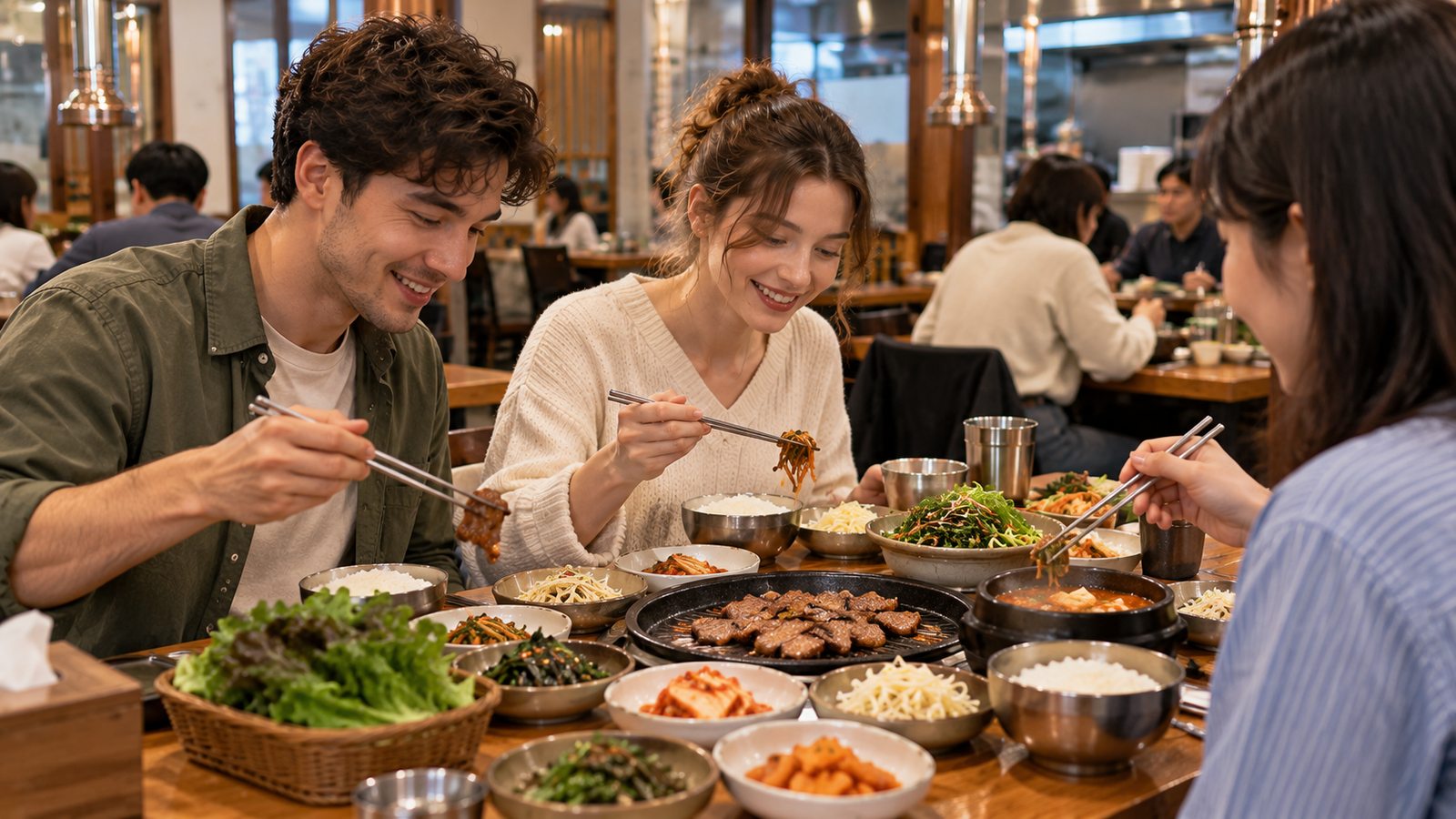
One traditional rule worth remembering is not to leave chopsticks standing vertically in a bowl of rice.
And if you are eating with Korean hosts in a more formal setting, waiting for the oldest person at the table to begin can be a polite gesture.
For tourists eating casually, however, consideration and observation matter more than trying to perform a long list of traditional rules.
Should You Bow to People in Korea?
A slight bow or nod is a common polite greeting in Korea.
But tourists do not need to make a deep formal bow every time they meet someone.
A small nod with “Annyeonghaseyo” can work naturally when greeting hotel staff, a host or someone helping you.
Formal Korean etiquette has much more detailed rules involving age, status and relationships, but those rules should not be confused with what an international traveler needs during ordinary sightseeing.
When in doubt, being calm, polite and attentive is more important than trying to calculate the correct angle of a bow.
Should You Use Two Hands When Giving Something?
Using two hands when giving or receiving something can be a polite gesture, particularly in a more formal interaction or when dealing with someone older.
You may notice people supporting one hand with the other when handing over an object.
A tourist does not need to panic about every small transaction, however.
When passing a document, gift or important item to someone, using both hands is an easy respectful habit. Ordinary automated transactions at ticket machines or self-checkouts obviously do not require any special etiquette.
What About Paying in Shops and Restaurants?
Korea is highly card-oriented, but payment procedures vary.
At a restaurant, you may pay at the counter rather than waiting for someone to bring a card terminal to your table. At a café or convenience store, you will usually pay when ordering or checking out.
Do not leave cash on the table as a restaurant tip simply because that is normal in your home country.
International cards work in many places, but travelers should still have a backup payment method because overseas cards can occasionally fail.
Our guide to paying in Korea as a tourist explains cards, cash and transportation payments separately.
How Should You Behave at Temples and Cultural Sites?
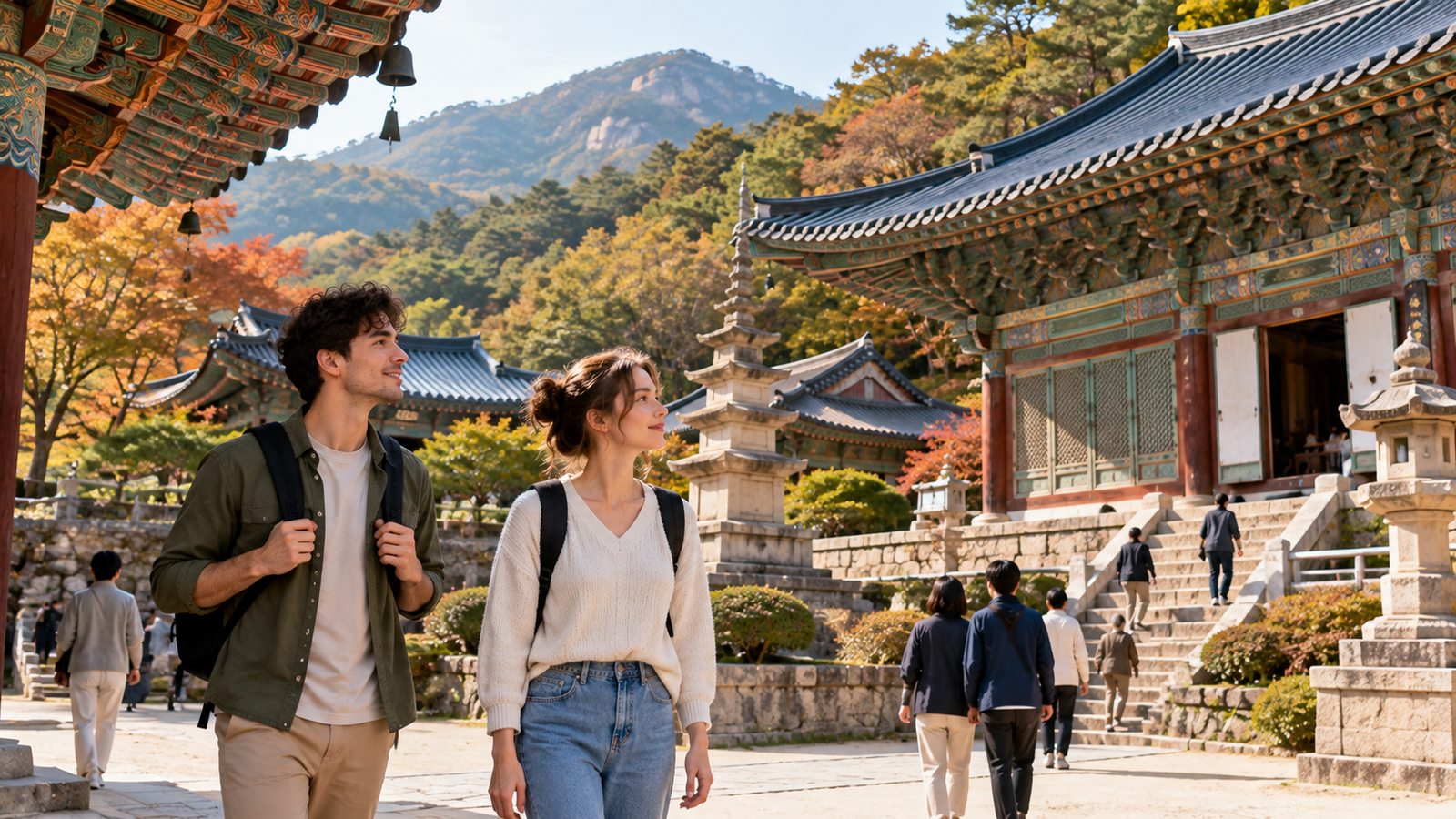
A Buddhist temple is not simply a photo backdrop.
Many Korean temples are active religious spaces where people may be praying, meditating or participating in ceremonies.
The Korea Tourism Organization advises visitors to avoid entering restricted areas or speaking loudly at temples. When entering a Buddha Hall, visitors may also be asked to use the side doors rather than the central entrance.
Photography rules deserve particular attention.
Do not assume that photography is allowed simply because other parts of the site are open to tourists. At temples and other sensitive cultural sites, follow posted restrictions and ask staff when unsure.
This principle also applies to places such as the DMZ, where photography can be restricted in specific areas.
If you want a deeper introduction to temple life rather than a short sightseeing visit, our Korean temple stay guide explains the experience separately.
What About Jjimjilbang Etiquette?
A jjimjilbang has its own rules because the bathing area is different from the communal sauna area.
In the gender-separated bathing section, visitors generally wash before entering the shared baths. Phones and photography should be avoided in bathing and changing areas.
In communal areas, visitors normally wear the clothes provided by the facility.
Rules and facilities vary, so posted instructions at the specific jjimjilbang take priority over a general travel guide.
Our Korean jjimjilbang guide explains bathing customs, clothing, lockers and basic etiquette in detail.
Is It Okay to Take Photos of People in Korea?
Treat photography as you would in any busy modern country: a public location does not automatically make every person an appropriate subject for a close-up photograph.
Tourist attractions are naturally photographed constantly, but be considerate when recognizable individuals become the main subject of your image.
Extra care is appropriate in places involving privacy, worship or security.
Bathing and changing areas are obvious no-photo environments. Temples may have their own photography rules, and some DMZ locations restrict photography.
When a sign says photography is prohibited, follow it even if you see another visitor ignoring the rule.
Do You Need to Speak Formally in Korean?
You do not need to become an expert in Korean speech levels before a vacation.
Learning a few polite expressions is enough to make everyday interactions easier.
Useful basics include:
| Korean | Romanization | Meaning |
|---|---|---|
| 안녕하세요 | Annyeonghaseyo | Hello |
| 감사합니다 | Gamsahamnida | Thank you |
| 죄송합니다 | Joesonghamnida | I’m sorry / Excuse me |
| 괜찮아요 | Gwaenchanayo | It’s okay |
| 주세요 | Juseyo | Please give me / Please |
Starting with polite language is safer than trying to imitate casual Korean expressions heard in dramas or online videos.
A translation app can help when a conversation becomes more complicated.
Are Public Spaces in Korea Very Strict?
Usually, no.
Korea is a modern society, not a collection of rigid etiquette rules.
The most useful public-space behavior is familiar: avoid blocking paths, control large luggage, keep excessive noise down and respect designated areas.
At busy tourist attractions, following signs and staff instructions becomes especially important because rules may exist for crowd management, cultural heritage protection or safety rather than traditional etiquette.
In 2026, the Korea Tourism Organization again highlighted visitor guidelines at Korea’s royal palaces, including keeping noise down, staying out of restricted areas and following on-site instructions.
The lesson is simple: local instructions are more reliable than stereotypes about what Koreans supposedly always or never do.
What Mistakes Should Tourists Avoid?
Most small mistakes are not disasters.
If you forget to use two hands when receiving something or do not bow at exactly the right moment, your trip is unlikely to fall apart.
More important mistakes are practical ones:
- ignoring a no-photography sign;
- entering a restricted area;
- blocking subway doors while people are trying to exit;
- occupying designated seating without considering who needs it;
- using a phone or camera in a jjimjilbang changing or bathing area;
- speaking very loudly in a quiet shared space; or
- assuming your home country’s tipping customs apply automatically.
These situations involve other people’s comfort, privacy or safety, which is why they matter more than performing ceremonial etiquette perfectly.
A Simple Korea Etiquette Rule for First-Time Visitors
If you remember only one thing, remember this:
observe the space before deciding what to do.
Look at where people put their shoes.
Let passengers leave the subway before boarding.
Check whether a restaurant is self-service.
Read signs before taking photographs.
Follow staff instructions at cultural sites.
And when you are unsure, a polite question is better than pretending you already know the rule.
That approach will take you much further in Korea than memorizing a list of cultural stereotypes.
Frequently Asked Questions
Do tourists need to bow in South Korea?
A small bow or nod is a common polite greeting, but tourists do not need to make formal deep bows during ordinary travel interactions. A friendly greeting and respectful behavior are usually enough.
Is tipping rude in Korea?
Tipping is generally not required or expected at ordinary Korean restaurants. Rather than assuming it is rude in every situation, follow the pricing and service policy of the specific business.
Do you have to take your shoes off everywhere in Korea?
No. Shoes are normally removed in homes and in certain traditional accommodations, temples or floor-seating spaces. Most modern shops, cafés and ordinary public spaces do not require it. Look at the entrance and follow local instructions.
Can tourists sit in priority seats on the Seoul subway?
Designated priority seats are intended for passengers who need them. Seoul’s official tourism guidance recommends leaving these seats available and paying attention to designated seating, including seats for pregnant passengers.
Is it okay to talk on the subway in Korea?
Conversation is not prohibited, but keeping your voice moderate is considerate. Avoid loud calls, speakerphone audio and behavior that unnecessarily disturbs other passengers.
What is the biggest etiquette mistake tourists make in Korea?
There is no single universal mistake. Ignoring clearly posted rules involving privacy, photography, restricted areas or shared public space is more important than getting a minor traditional custom wrong.
Sources & Further Reading
Seoul Tourism Organization — Public Transportation Etiquette in Korea (updated July 9, 2026)
Korea Tourism Organization — About Korean Food: Restaurant Dining and Tipping Guidance
Seoul Tourism Organization — The Basics of Korean Etiquette
Korea Tourism Organization — Korean Temple Food: Beginner’s Guide to Templestay and Temple Etiquette
Korea Tourism Organization — Tips for Visiting Korea’s Royal Palaces (April 16, 2026)
Korea Tourism Organization — DMZ Tours: Identification and Photography Guidance