

Getting sick while traveling can be confusing even when the problem is not an emergency.
You may know that South Korea uses 119 for medical emergencies, but what should you do when you need a doctor without needing an ambulance?
For an international visitor, the challenge is often practical: deciding where to go, finding a facility that can communicate with you, explaining your medical history, understanding payment and collecting documents for travel insurance.
South Korea has clinics, hospitals and larger general hospitals, and some medical institutions provide dedicated services for international patients.
Here is how to approach the system as a traveler.
First: Is It an Emergency?
The first distinction is between emergency and non-emergency care.
If you believe you are experiencing a medical emergency, do not spend valuable time searching online for an English-speaking clinic.
Call 119 for an ambulance or emergency medical assistance.
Korea’s official tourism guidance lists 119 for fire, rescue and medical emergencies. International visitors can also request language assistance when communicating with emergency services.
For situations that are not emergencies, you can take more time to identify an appropriate clinic or hospital.
This article focuses mainly on that second situation.
Our South Korea emergency numbers guide explains when to use 119, how to request English interpretation and what information to give an emergency operator.
Clinic or Hospital: Where Should You Start?
Korea has several types of medical institutions, from neighborhood clinics to hospitals and large general or tertiary hospitals.
For a traveler, bigger is not automatically better.
A local clinic may be appropriate for many routine outpatient problems, while a larger hospital may provide more specialties, diagnostic facilities or international-patient services.
The appropriate choice depends on the medical problem and the level of care required.
Do not choose a facility only because its English name contains the word “hospital.” Instead, check:
- what type of medical institution it is;
- which medical specialties it provides;
- whether appointments are required;
- whether it provides language assistance; and
- whether it can provide the documentation your insurer may require.
If you are uncertain about the level of care you need, seek professional medical guidance rather than diagnosing the problem yourself from a travel website.
How Can Foreign Travelers Find a Doctor in Korea?
One official starting point is Medical Korea, operated by the Korea Health Industry Development Institute.
Its Registered Hospitals database allows users to search medical institutions registered to serve foreign patients.
You can filter by region and institution type, including:
- tertiary general hospital;
- general hospital;
- hospital;
- clinic;
- dental clinic; and
- Korean medicine hospital.

This can be particularly useful when you want a medical facility accustomed to dealing with international patients.
However, being a foreign traveler does not mean you are limited to the institutions appearing in this database.
Think of the Medical Korea directory as an official search resource, not a rule that every visitor must use a particular facility.
What Does “Registered for Foreign Patients” Mean?
South Korea operates a registration system for medical institutions serving foreign patients.
Medical Korea explains that the system is administered under the Ministry of Health and Welfare framework and includes requirements intended to protect international patients.
Registered institutions serving foreign patients are subject to requirements that differ from simply being an ordinary medical facility.
For travelers, the practical benefit is that the official directory provides another way to identify institutions already participating in Korea’s international-patient system.
It should not be confused with a personal recommendation or a guarantee that a particular hospital is right for your medical condition.
What Are KAHF-Accredited Hospitals?
You may also see references to hospitals accredited for international patients.
Korea operates an evaluation and certification program for medical institutions serving foreign patients.
According to Medical Korea, the program evaluates both international-patient services and patient-safety systems.
Its criteria include areas related to:
- management of foreign patients;
- interpretation;
- medical staff and operations;
- medication management;
- infection control; and
- patient safety.
This is a more specific designation than simply finding a hospital through a web search.
But again, accreditation should not be interpreted as Korea Front Row recommending one hospital over another.
Your medical needs, location, specialty required, insurance arrangements and language requirements still matter.
How Do You Find English-Language Medical Support?
Do not assume that every doctor, nurse or receptionist at a Korean medical facility speaks English.
Some facilities have international healthcare centers or interpretation services.
Medical Korea’s listings can include information such as:
- interpretation languages;
- medical specialties;
- contact details;
- international healthcare center information; and
- additional services.
Some listed institutions provide English interpretation, while others support Chinese, Japanese, Russian, Mongolian or additional languages.
Check the individual institution before traveling there.
Language support can also depend on the day, department or whether an interpreter must be arranged in advance.
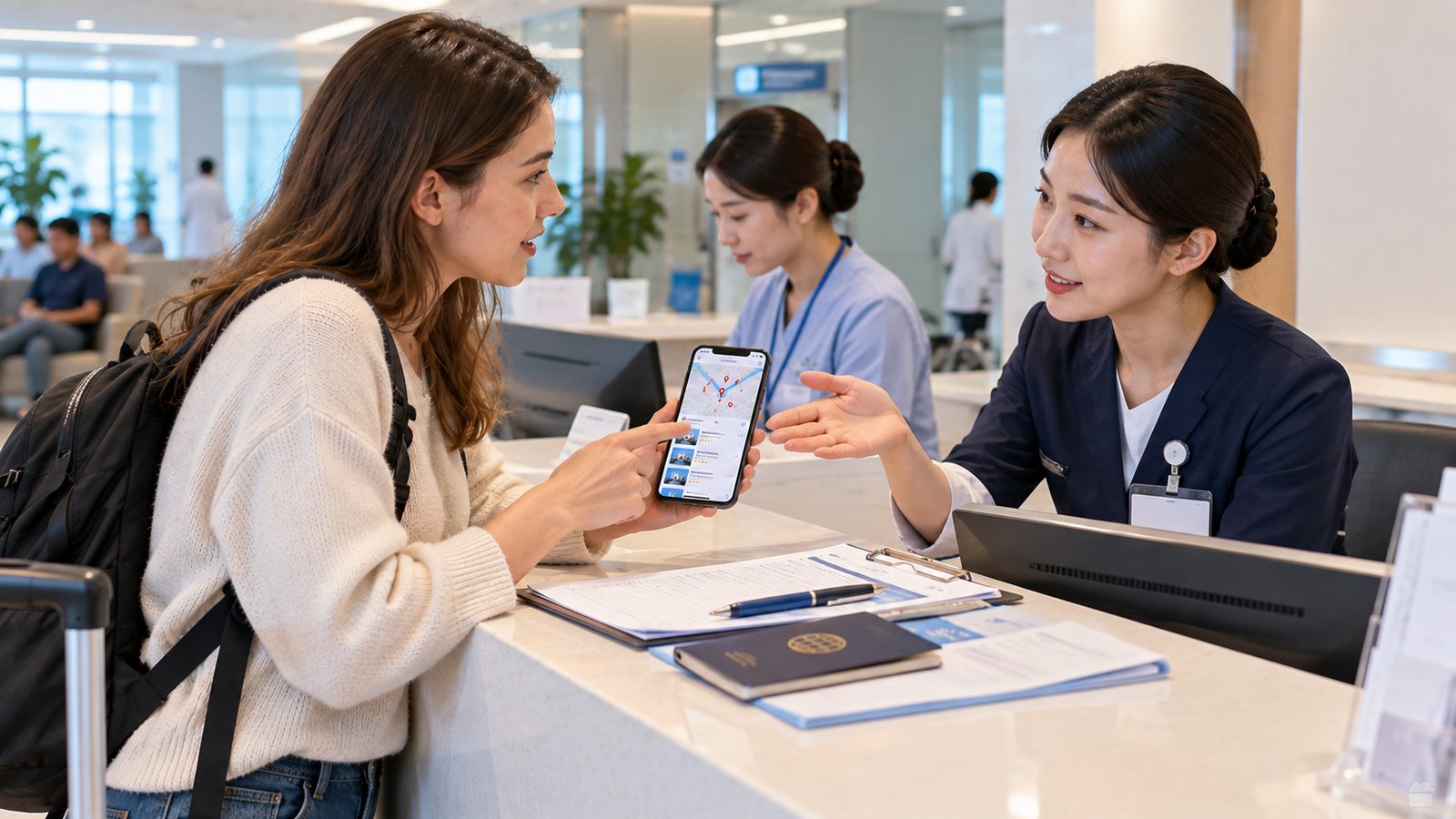
Medical Korea Has an Information Center
Medical Korea also operates an information service for international patients.
Its current official information lists support in multiple languages and assistance with matters such as:
- information about medical institutions;
- medical-service reservations;
- medical-service consultations; and
- complaints related to using Korean medical institutions.
The published Medical Call number is:
+82-2-1577-7129
Medical Korea currently lists the service as operating daily from 09:00 to 18:00 Korea time.
Because contact hours and services can change, verify the current information on Medical Korea before relying on it during your trip.
Should You Make an Appointment?
It depends on the facility.
Some neighborhood clinics accept walk-in patients during consultation hours. Larger hospitals, specialist departments and international healthcare centers may use appointments.
Do not assume that arriving at a major hospital guarantees immediate non-emergency consultation.
Before leaving your hotel, check the medical institution’s current website or contact the facility.
Ask:
- whether an appointment is required;
- which department you need;
- what time registration closes;
- whether language assistance is available; and
- what identification or documents you should bring.
Operating hours can also differ on weekends and public holidays.
What Should You Bring to a Doctor’s Visit?
Bring enough information to identify yourself and explain your medical situation clearly.
Useful items may include:
- your passport or another identification document;
- travel insurance details;
- a list of medicines you currently take;
- medication packaging or photographs;
- information about medication or food allergies;
- relevant medical documents;
- your accommodation address and contact details; and
- a payment method.
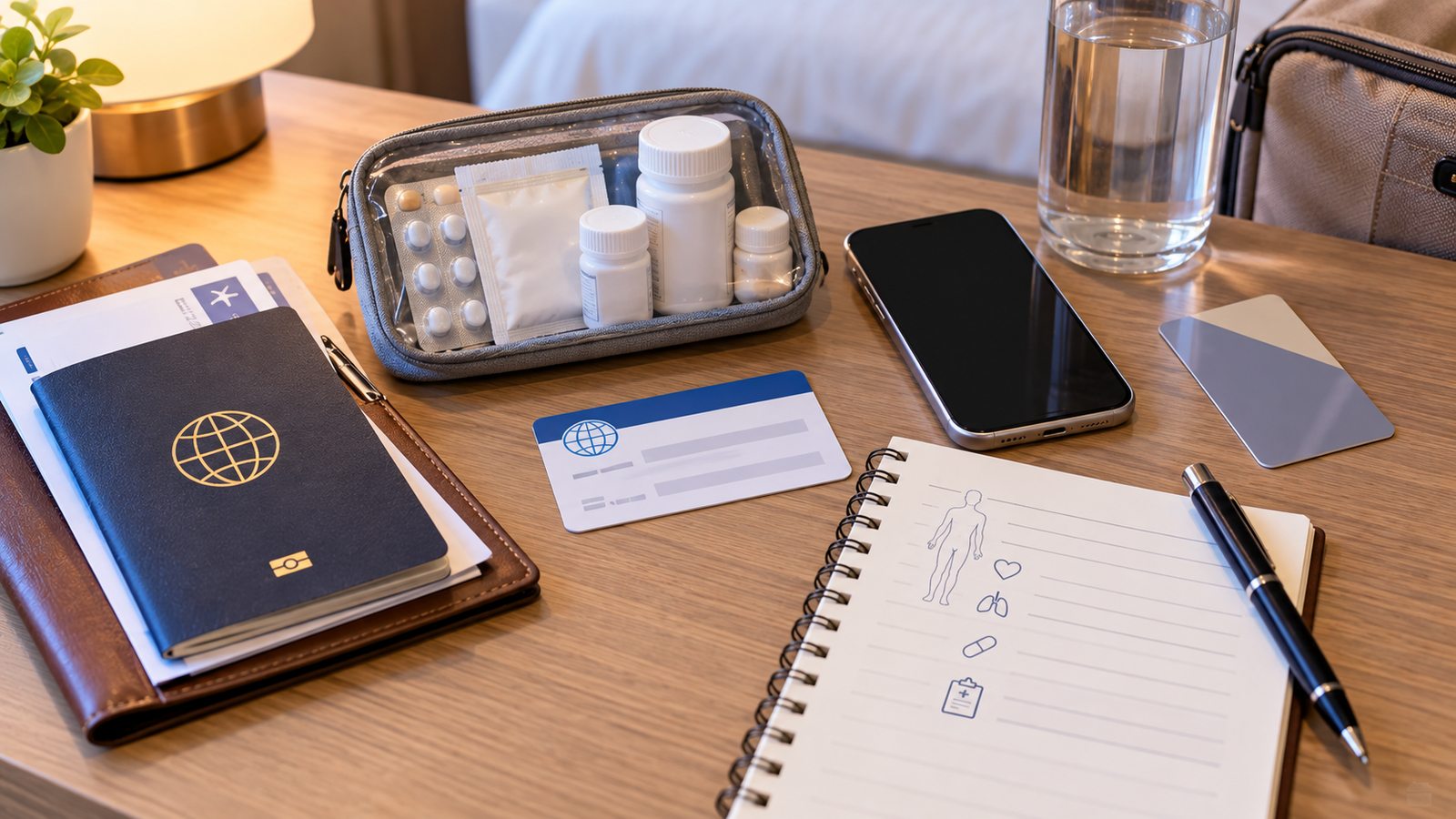
If you have an existing medical condition, having a concise summary in English can be useful.
Do not rely on remembering complicated medicine names under stress.
A photograph of your regular medication packaging or a written list of active ingredients may make communication easier.
Tell the Medical Staff About Allergies and Current Medicines
Medication allergies and current medicines can be important medical information.
Prepare them before the appointment.
If you have a serious food or medication allergy, keep the exact ingredient or medicine name available in writing.
Our food allergies in South Korea guide explains how to prepare written allergy information and why automated translation should be treated as a communication aid rather than a medical guarantee.
For medical discussions, the same principle applies.
A translation app can be useful, but important information should be confirmed with medical staff.
Can You Use a Translation App at the Doctor?
A translation app may help with basic communication, especially when registering or explaining simple information.
But medical conversations can involve terminology, nuance and follow-up questions that automatic translation may not handle accurately.
If the medical institution offers professional interpretation, ask whether it is available for your language.
Medical Korea’s hospital information can help identify facilities listing interpretation support.
For ordinary travel preparation, our essential apps for traveling in Korea guide explains translation and map tools worth setting up before departure.
What Happens When You Arrive?
The exact process varies by facility, but a non-emergency outpatient visit may involve several stages.
You may need to:
- register at reception;
- provide identification and contact information;
- explain which department or problem you need help with;
- wait for consultation;
- see the doctor;
- complete tests or other procedures if ordered;
- pay the medical bill; and
- receive a prescription or other documents if applicable.
International-patient centers at larger hospitals may coordinate some of these steps.
Do not assume every facility follows exactly the same process.
If you do not understand what happens next, ask before leaving the counter.
How Much Does Seeing a Doctor Cost in Korea?
There is no single tourist price for “seeing a doctor in Korea.”
The final amount can depend on:
- the type of medical institution;
- the specialty;
- consultation and procedure fees;
- tests or imaging;
- medication;
- whether you are covered by applicable insurance; and
- the services you receive.
Do not rely on a social-media post quoting one person’s clinic bill as the expected cost of your visit.
If cost matters before a planned non-emergency consultation, ask the institution what information it can provide in advance.
For travel insurance reimbursement, also ask what receipts and medical documentation are available.
Will Travel Insurance Pay the Hospital Directly?
That depends on your insurance policy and the medical institution.
Some international healthcare centers list direct-billing arrangements with certain insurers or assistance companies, but this is not universal.
Do not assume that showing a travel insurance policy means you can leave without paying.
Contact your insurer as early as practical and ask:
- whether the facility is covered;
- whether pre-authorization is required;
- whether you need to pay first and claim later;
- which documents are required; and
- whether the insurer has a preferred provider.
If the situation is an emergency, obtaining urgent medical care takes priority over sorting out reimbursement paperwork.
Ask for Receipts and Medical Documents Before You Leave
If you plan to make a travel insurance claim, collect your documents while you are still in Korea.
Depending on the situation and insurer, useful documentation may include:
- an itemized receipt;
- proof of payment;
- a medical certificate or other clinical document;
- prescription information; and
- test or treatment records.
The exact documents required are determined by your insurer, not by Korea Front Row.
Check your policy and ask your insurer what it needs.
Some Medical Korea-listed international healthcare centers specifically advertise English receipts or medical certificates, but services differ by institution.
What Happens if the Doctor Gives You a Prescription?
In Korea, prescription medicines are generally dispensed through a pharmacy after a doctor or dentist issues a prescription.
The medical facility may tell you where nearby pharmacies are located.

Do not assume the clinic itself will hand you every prescribed medicine.
Keep the prescription and take it to a pharmacy according to the instructions you receive.
Our guide to using a pharmacy in Korea explains the difference between prescription and non-prescription medicine, how to recognize a Korean pharmacy and what information to give the pharmacist.
Can You Just Go to a Pharmacy Instead?
Sometimes a pharmacy is the first place a traveler considers for a minor problem.
Certain medicines can legally be sold without a prescription, while others require medical evaluation and a prescription.
A pharmacist can help with medicines within the scope of pharmacy practice, but a pharmacy is not a replacement for medical diagnosis or emergency treatment.
If the pharmacist advises you to seek medical care, or your situation requires evaluation by a doctor, move to the appropriate medical service.
Likewise, do not delay calling 119 during a medical emergency because you are searching for an open pharmacy.
What If You Need Medical Care at Night?
Options become more limited outside normal consultation hours.
A clinic that appears on your map may be closed, and weekend or holiday schedules vary.
Check current operating information rather than relying only on a map listing.
For urgent or emergency medical problems, use Korea’s emergency medical system.
For non-emergency situations, your hotel, insurer or an international-patient information service may be able to help identify an appropriate available facility.
Avoid publishing or saving a fixed list of “24-hour hospitals” months before your trip because schedules and services can change.
What if You Have a Serious Allergic Reaction?
A severe allergic reaction is different from planning a routine clinic visit.
Follow the emergency plan provided by your healthcare professional and use prescribed emergency medication as directed.
Call 119 when emergency medical assistance is required.
Do not spend time comparing clinics or looking for an English-speaking doctor while an emergency is developing.
Our food allergy guide explains the preparation travelers can do before eating in Korea, including allergy cards, ingredient checking and emergency planning.
What About Dental Care?
Medical Korea’s registered-institution directory also includes dental clinics.
If you develop a dental problem while traveling, you can use the same general approach:
- determine whether immediate treatment is needed;
- search for an appropriate dental facility;
- check language support;
- confirm opening hours or appointments;
- ask about costs; and
- retain documentation for insurance if necessary.
A dental emergency involving severe injury or another serious medical complication may require emergency services rather than routine dental scheduling.
Do Not Choose a Hospital Only From Social Media
Online travel communities can be helpful for understanding other travelers’ experiences.
They are less reliable as your only source for medical-provider selection.
A review may be old, the doctor may have moved, interpretation services may have changed, or the reviewer’s medical needs may be completely different from yours.
Use current official information and contact the medical institution directly when the details matter.
Medical Korea provides both a registered-institution directory and information on hospitals accredited for international patients.
These are better starting points than an anonymous recommendation alone.
A Simple Medical-Care Plan Before Your Trip
You do not need to create a list of every hospital in Korea.
Instead, prepare a small amount of information that will be useful anywhere in the country.
Before departure:
Save 119.
Know that it is Korea’s number for ambulance, fire and emergency rescue.
Save your insurer’s assistance number.
Know whether your policy has a 24-hour medical assistance service.
Keep a medication list.
Include active ingredients when possible.
Record allergies clearly.
Keep serious medication and food allergies easy to show.
Bookmark Medical Korea.
It can provide an official starting point for finding institutions serving foreign patients.
Keep your accommodation address in Korean and English.
This is useful when arranging transportation or explaining your location.
Bring an appropriate payment method.
Do not assume every medical expense will be billed directly to your insurer.
A few minutes of preparation can make an unexpected medical visit much easier to manage.
Frequently Asked Questions
Can tourists see a doctor in South Korea?
Yes. International visitors can use medical services in South Korea. The appropriate clinic or hospital depends on the type of care required. Medical Korea provides an official directory of medical institutions registered to serve foreign patients.
How do I find an English-speaking doctor in Korea?
Check the medical institution’s current language services before visiting. Medical Korea listings can include interpretation languages and international healthcare center information. Language availability varies by institution and may require advance arrangements.
Do I need an appointment to see a doctor in Korea?
It depends on the facility and department. Some clinics accept walk-ins, while hospitals, specialists and international healthcare centers may require appointments. Contact the institution or check its current official information first when possible.
How much does a doctor visit cost in Korea for a tourist?
There is no universal tourist consultation fee. Costs depend on the institution, specialty, tests, procedures, medication and insurance arrangements. Ask the provider about expected costs when practical and keep documentation for your insurer.
Can I use travel insurance at a Korean hospital?
Possibly, but procedures vary. Some facilities have direct-billing arrangements with particular insurers, while other travelers may need to pay first and file a claim. Check your policy and contact your insurer for instructions.
What should I do if I need an ambulance in South Korea?
Call 119 for an ambulance or medical emergency. Do not delay emergency care while trying to arrange a routine clinic appointment or confirm insurance reimbursement.
Sources & Further Reading
Medical Korea — Registered Hospitals
Medical Korea — Registration System for Medical Institutions Serving Foreign Patients
Medical Korea — Korean Accreditation Program for Hospitals Serving Foreign Patients
Medical Korea — Accredited Hospitals for International Patients
Medical Korea — Medical Korea Information Center and Medical Call
Medical Korea — Reliable Medical Services and Foreign Patient Registration System
Korea Tourism Organization — Emergency Situations
Korea Tourism Organization — Disaster Safety Services for International Visitors in Korea