
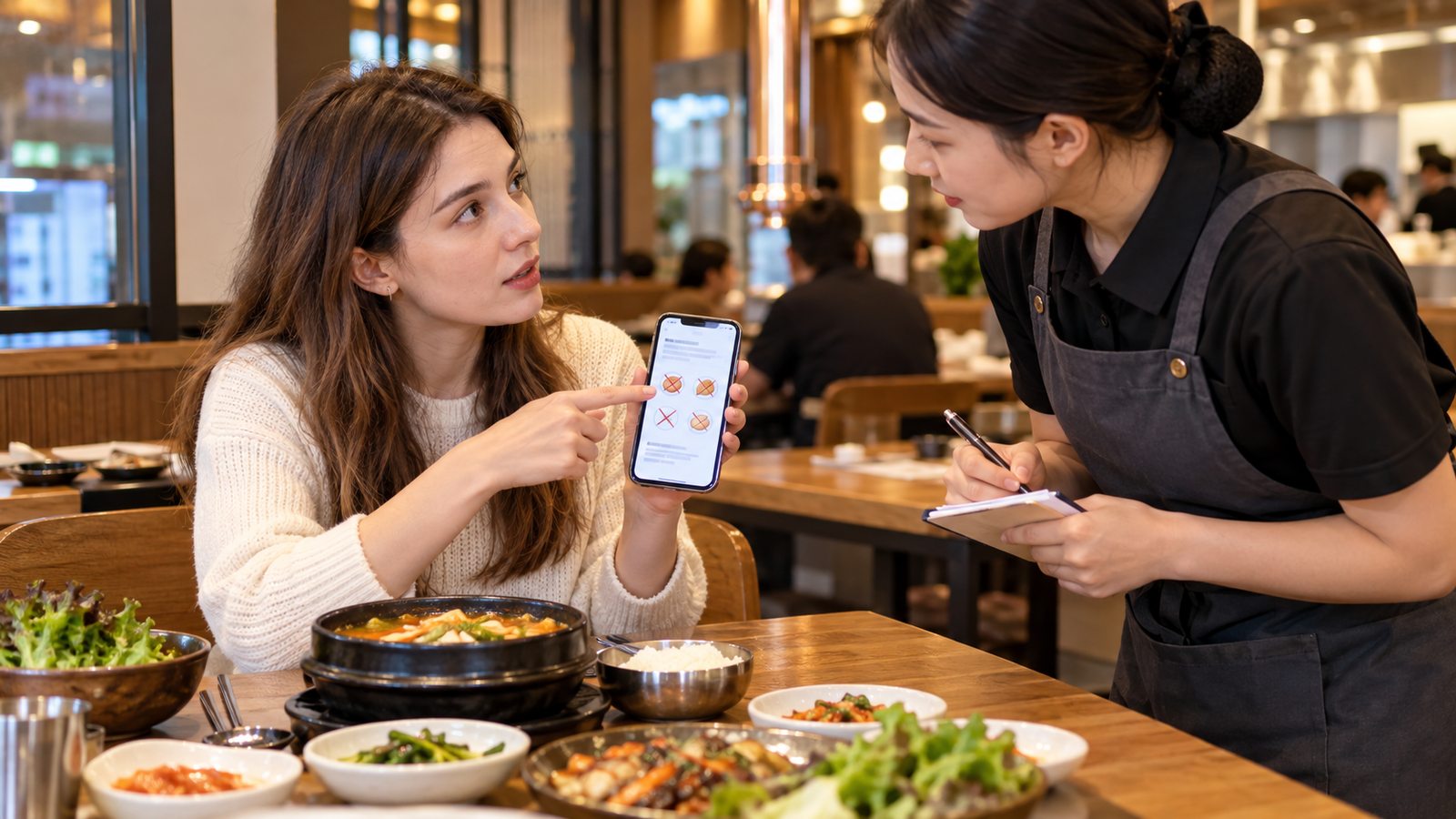
Traveling through South Korea with a food allergy requires more preparation than simply learning the names of a few dishes.
Korean packaged foods have allergen-labeling requirements, but eating at a restaurant is different. A sauce, broth, garnish or shared cooking surface can matter just as much as the ingredients you can see.
That makes one rule especially important: do not treat the name or appearance of a Korean dish as proof that it is safe for your allergy.
Instead, learn how food labels work, prepare a clear explanation of your allergy and know what to do when a restaurant cannot give you enough information.
This guide explains the practical steps travelers can take.
How Food Allergen Labeling Works in South Korea
South Korea has regulations requiring specified allergenic ingredients to be declared on applicable food products.
Under current Korean food-labeling rules, the regulated allergen list includes:
- eggs from poultry;
- milk;
- buckwheat;
- peanuts;
- soybeans;
- wheat;
- mackerel;
- crab;
- shrimp;
- pork;
- peaches;
- tomatoes;
- sulfites when they meet the regulatory threshold;
- walnuts;
- chicken;
- beef;
- squid;
- shellfish, including oysters, abalone and mussels; and
- pine nuts.

For applicable packaged foods, these ingredients are subject to allergen-labeling requirements when used as ingredients under the relevant rules.
That makes the label an important tool when shopping for packaged food in Korea.
But there is an important limitation for international travelers:
the Korean regulated-allergen list may not match the allergen list used in your home country.
Do not assume that an ingredient important to your own allergy will always receive the same type of highlighted warning you are accustomed to seeing at home.
Packaged Food and Restaurant Food Are Different
This distinction is one of the most important things to understand before traveling.
A sealed packaged product sold in a convenience store or supermarket may provide an ingredient list and a separate allergen declaration under Korean labeling requirements.
A meal prepared in an ordinary restaurant is a different situation.
Korea does have allergen-disclosure requirements for certain food-service businesses and specified foods, but travelers should not assume that every independent restaurant is required to provide a complete allergen list for every menu item.
You may therefore need to ask staff directly about ingredients and preparation.
Even when a dish appears simple, the answer may depend on a sauce, broth, seasoning or ingredient prepared earlier.
Learn the Korean Name of Your Allergen
Before traveling, write down the exact Korean name of every ingredient you must avoid.
Do not rely only on the English word.
Examples include:
| English | Korean |
|---|---|
| Peanut | 땅콩 |
| Walnut | 호두 |
| Pine nut | 잣 |
| Milk | 우유 |
| Egg | 계란 / 달걀 |
| Wheat | 밀 |
| Buckwheat | 메밀 |
| Soybean | 대두 / 콩 |
| Shrimp | 새우 |
| Crab | 게 |
| Mackerel | 고등어 |
| Squid | 오징어 |
| Shellfish | 조개류 |
| Peach | 복숭아 |
This table is a communication aid, not a complete medical or regulatory translation guide.
Some foods and ingredients can appear under more specific names, and compound ingredients may make label reading more complicated.
If your allergy is severe, prepare your exact allergen names before leaving home rather than trying to translate them for the first time while ordering dinner.
Use a Written Allergy Card
A written message can be more reliable than trying to explain a serious allergy with a single Korean word.
Your card or phone message should communicate three things:
- you have a food allergy;
- the exact ingredient or ingredients you must avoid; and
- that food containing those ingredients should not be served to you.
For example, a traveler with a peanut allergy could show:
저는 땅콩 알레르기가 있습니다. 땅콩이 들어간 음식은 먹을 수 없습니다.

Meaning:
“I have a peanut allergy. I cannot eat food containing peanuts.”
For a severe allergy, a professionally translated allergy card prepared for your individual needs is preferable to improvising a long medical explanation with machine translation.
Keep the message easily accessible on your phone and consider carrying a printed copy in case your battery dies.
Do Not Translate “Allergy” as a Preference
This matters in restaurants.
A dietary preference and a medically significant food allergy are not the same thing.
Saying only:
“I don’t eat peanuts.”
may sound like a preference.
Clearly saying:
“I have a peanut allergy.”
communicates a different level of concern.
If avoiding even small amounts is medically important for you, your communication needs to make that clear.
Do not expect restaurant staff to infer the severity from the ingredient name alone.
Why Korean Dish Names Are Not Enough
A familiar dish name does not guarantee one fixed recipe.
Consider bibimbap.
It may contain rice and vegetables, but depending on the restaurant it can also include egg, meat, sesame-based ingredients or a sauce containing ingredients that matter to you.
The same principle applies to soups, stews, noodles, dumplings, pancakes, marinades and banchan.
A dish that did not contain your allergen at one restaurant may be prepared differently somewhere else.
Recipes can also change.
Instead of asking:
“Is bibimbap safe for me?”
ask about the ingredients in the specific bibimbap being served at that restaurant.
Sauces and Broths Deserve Extra Attention
Some ingredients are easy to see.
Others are not.
Korean dishes can use stocks, sauces, pastes and seasonings that were prepared before you ordered.
If your allergen can appear in a sauce or broth, removing a visible topping may not solve the problem.
Useful questions include:
Does the sauce contain [allergen]?
Does the broth contain [allergen]?
Was this ingredient already mixed into the dish?
If staff cannot confidently answer, do not treat the absence of visible pieces as proof that the food is safe.
What About Banchan?
Banchan are the small side dishes served with many Korean meals.
They should be checked separately rather than assumed to have the same ingredients as your main dish.
A table may contain kimchi, seasoned vegetables, pickles, seafood-based side dishes and other foods prepared using different sauces or seasonings.
If you have a serious allergy, do not assume that an unfamiliar side dish is safe because you did not order it separately.
Our guide to eating at a Korean restaurant explains how banchan, ordering, payment and other parts of the dining process normally work.
Cross-Contact Is a Separate Question
Knowing the recipe is only one part of managing a food allergy.
For some travelers, cross-contact during preparation is also medically important.
Food may be prepared:
- on a shared grill;
- in shared frying oil;
- with shared utensils;
- on a shared cutting surface; or
- near ingredients containing your allergen.
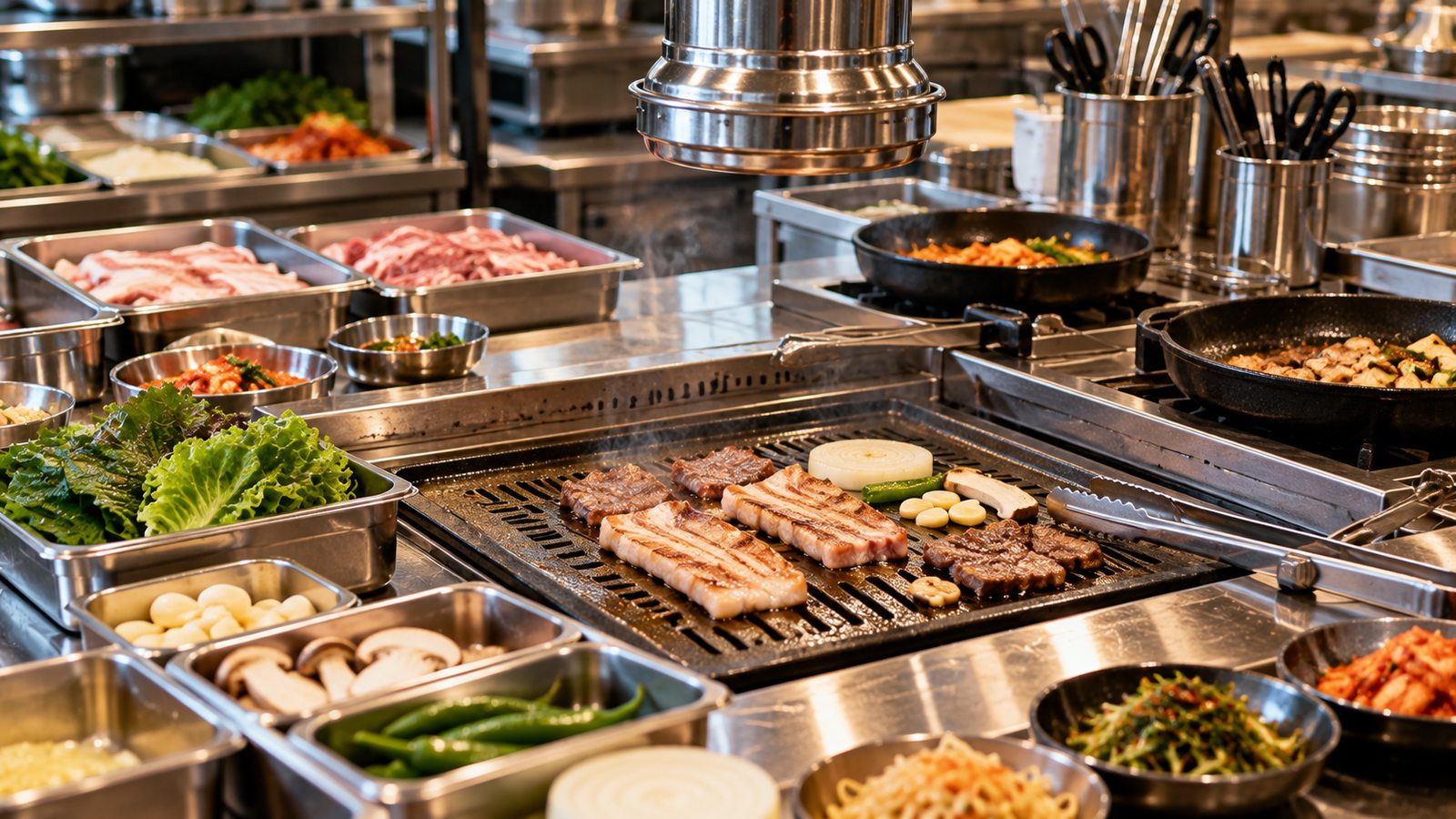
A restaurant may truthfully say that an allergen is not an intentional ingredient while still using shared equipment.
If cross-contact is important for your condition, ask about it separately.
Do not assume that staff saying “there is no peanut in this dish” also means the kitchen is peanut-free.
Korean Barbecue Can Require Extra Checking
Korean barbecue restaurants involve several potential points of contact.
Meat may be marinated in advance, sauces can contain multiple ingredients, side dishes arrive at the same table and several foods may be cooked on one grill.
That does not mean Korean barbecue is automatically unsuitable for someone with an allergy.
It means the restaurant must be evaluated according to the specific allergy and preparation method.
Plain ingredients can sometimes be easier to understand than heavily seasoned or pre-marinated dishes, but never treat that as a safety guarantee.
Ask before ordering.
Convenience Stores Can Be Useful — but Read the Label
Convenience stores can be valuable for travelers who want packaged food with labels they can inspect before eating.
Look for:
- the ingredient list;
- the allergen declaration;
- precautionary manufacturing statements; and
- the exact product variety.
Do not assume two flavors from the same brand have the same ingredients.
And do not rely on an old social-media recommendation. Recipes and packaging can change.
If you cannot confidently understand a label, a translation app may help you identify Korean text, but automated translation should not be treated as a medical guarantee.
Our Korean convenience store guide explains the practical side of shopping, paying and using store facilities.
Be Careful With “May Contain” and Shared-Facility Information
Korean labeling can also include information related to possible allergen mixing or shared manufacturing facilities.
For someone whose medical plan requires avoiding cross-contact, this information may matter as much as the main ingredient list.
Do not ignore a precautionary statement simply because your allergen is absent from the front of the package.
If you are uncertain about whether a packaged product fits the allergy-management plan given to you by your clinician, choose another product rather than guessing.
Should You Rely on Translation Apps?
Translation apps are useful tools, but they have limits.
They work well for tasks such as:
- identifying an ingredient word;
- photographing a label;
- showing a prepared Korean sentence; and
- helping you ask a basic question.
They are less suitable for making a final safety judgment about a complex ingredient list or kitchen process.
A translation may miss context, an ingredient may have several names, and staff may still need to check with the kitchen.
Use technology to improve communication, not to replace it.
What If Restaurant Staff Are Unsure?
Treat uncertainty as useful information.
A staff member saying:
“I’m not sure.”
is better than an unsupported promise.
You can ask whether they can check the packaging, sauce ingredients or preparation method.
If they still cannot confirm what you need to know, choosing another dish or another restaurant may be the safer decision.
Travel plans can be changed. A severe allergic reaction is not worth gambling on a guess.
Vegetarian and Allergy Requirements Are Not the Same
Korea Front Row’s vegetarian guide discusses meat, seafood, broth and other ingredients that matter to vegetarian and vegan travelers.
Food allergies require a different approach.
A vegan dish, for example, is not automatically safe for someone with a peanut, tree-nut, wheat, soybean or other allergy.
Likewise, a dish containing meat may have no relevance to someone’s particular allergen.
If you have both dietary preferences and food allergies, communicate them separately.
Our vegetarian food in Korea guide can help with plant-based dining, but it should not be used as an allergy-safety guide.
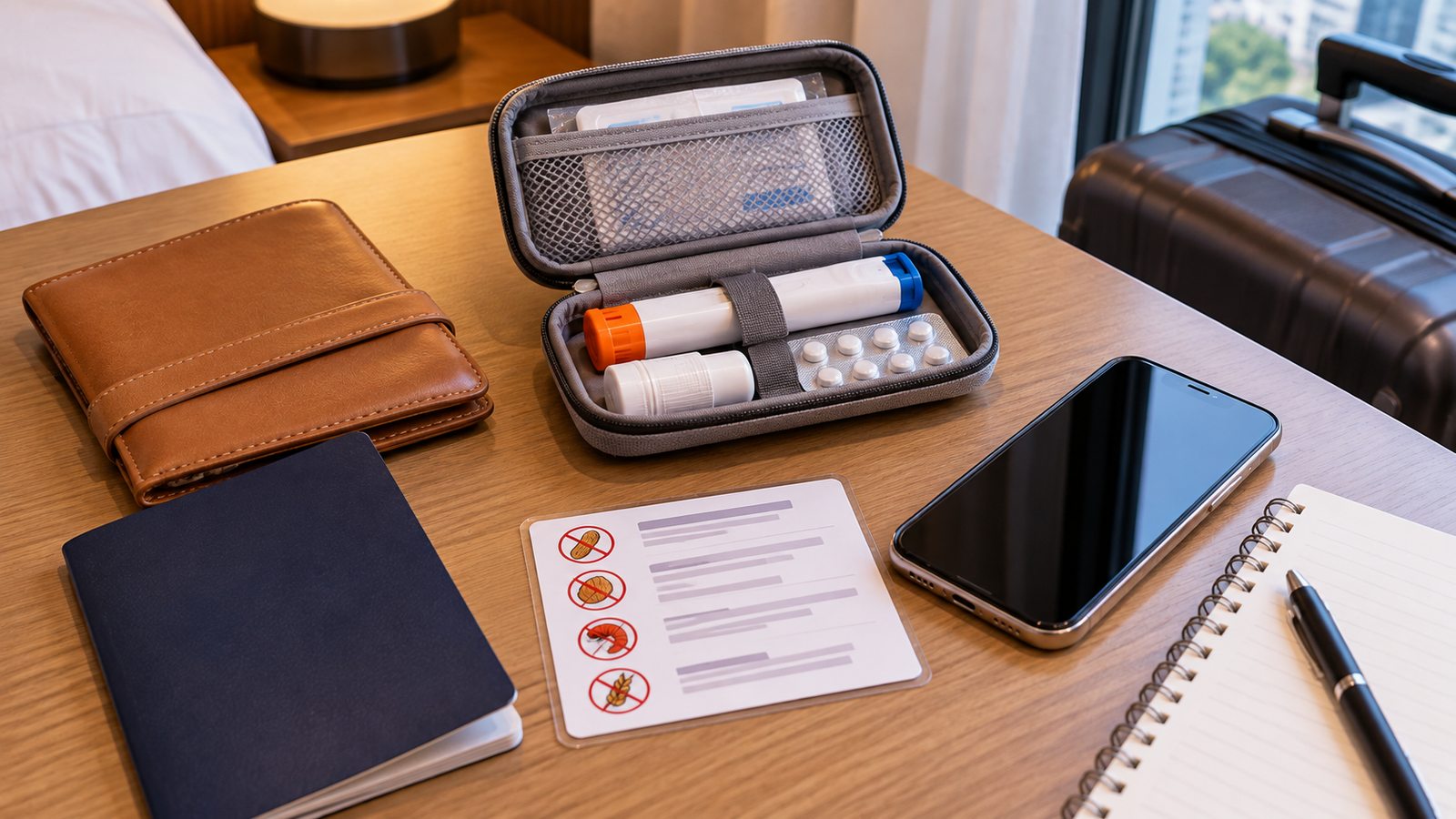
Carry Your Usual Emergency Medication
If you have been prescribed emergency medication for your food allergy, travel with it according to the instructions provided by your healthcare professional.
Do not plan on finding an identical medication immediately after arriving in Korea.
Keep important medication accessible rather than buried at the bottom of checked luggage or left in your hotel while you are eating out.
Travelers carrying prescription medication should also check South Korea’s current entry rules for their specific medicine before departure, particularly for controlled substances.
Our guide to using a pharmacy in Korea explains how pharmacies work for travelers, but a pharmacy visit is not a substitute for emergency medical care during a serious allergic reaction.
What Should You Do During a Serious Allergic Reaction?
Follow the emergency plan given to you by your healthcare professional and use your prescribed emergency medication as directed.
For a medical emergency in South Korea, call 119.
Korea’s official tourism guidance lists 119 for medical emergencies and ambulance assistance.
If you do not speak Korean, current official traveler guidance advises asking for English or an interpreter when connected.
When calling, provide your location as clearly as possible.
A hotel name, restaurant name, nearby building, subway station or smartphone map location can help identify where you are.
Our South Korea emergency numbers guide is worth saving before your trip so you do not have to search for basic emergency information under pressure.
Prepare Before You Fly
A small amount of preparation can remove a great deal of uncertainty.
Before leaving home:
Write down your allergens in Korean.
Include every ingredient you need to avoid.
Prepare an allergy card.
Use wording appropriate for the seriousness of your condition.
Save 119 in your travel notes.
Do not wait until an emergency to learn Korea’s ambulance number.
Carry prescribed emergency medication.
Follow your clinician’s instructions and check entry requirements when necessary.
Save several dining options.
Having alternatives reduces pressure to eat somewhere that cannot answer your questions.
Plan backup food for long travel days.
Airports, train journeys, day trips and late-night arrivals can reduce your options.
Check every product again.
Do not assume a food is unchanged because you ate the same brand earlier in your trip.
A Practical Restaurant Routine
When you arrive at a restaurant, use a consistent process.
First, look at the menu and decide whether the restaurant seems able to accommodate your needs.
Second, show your allergy card before ordering.
Third, ask about the exact dish, including sauces, broths and seasonings.
Fourth, ask about cross-contact if that is relevant to your allergy.
Fifth, if the answer remains unclear, choose another option.
This routine may feel cautious, but it is much easier than trying to solve every question after the food has arrived.
Frequently Asked Questions
Are food allergens labeled in South Korea?
South Korea requires specified allergenic ingredients to be declared on applicable food products under its food-labeling rules. However, travelers should not assume that every restaurant menu provides the same level of allergen information as a packaged-food label.
What allergens are included in Korea’s labeling rules?
The regulated list includes ingredients such as eggs, milk, buckwheat, peanuts, soybeans, wheat, mackerel, crab, shrimp, pork, peaches, tomatoes, certain sulfites, walnuts, chicken, beef, squid, shellfish and pine nuts. Check the latest MFDS rules because regulations can change.
Can I travel to Korea with a peanut or nut allergy?
Travel is possible, but the appropriate level of preparation depends on your individual allergy and medical advice. Learn the Korean name of your allergen, prepare a clear allergy card, check labels and restaurant preparation, carry prescribed emergency medication and know how to call 119.
Is vegetarian food safe for someone with a food allergy?
Not automatically. Vegetarian and vegan labels describe dietary ingredients, not whether a food is free from a particular allergen or cross-contact. Check your specific allergen separately.
Can I use Google Translate or another translation app for food allergies?
Translation apps can help identify words and communicate basic questions, but they should not be treated as a guarantee that a food is safe. For severe allergies, prepare accurate wording before your trip and ask restaurant staff to verify ingredients and preparation.
What number should I call for a severe allergic reaction in Korea?
Call 119 for a medical emergency or ambulance in South Korea. Follow your personal emergency treatment plan and the instructions given by your healthcare professional while emergency help is being arranged.
Sources & Further Reading
Ministry of Food and Drug Safety — Food Labeling Standards, MFDS Notice No. 2026-37
VISITKOREA — Emergency Situations
VISITKOREA — Disaster Safety Services for International Visitors in Korea