
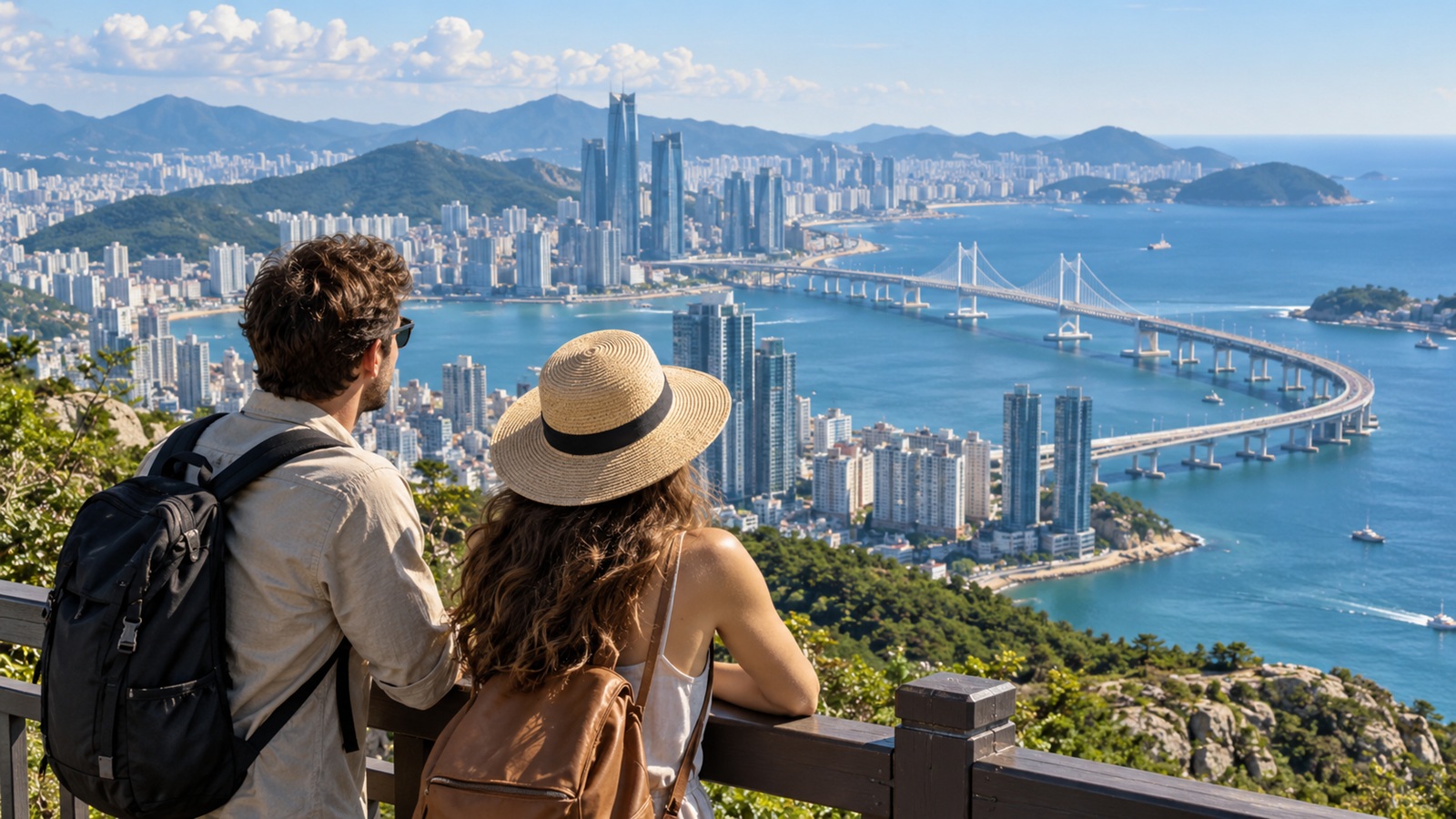
Busan feels very different from Seoul.
Korea’s second-largest city stretches along the southeastern coast, where beaches, mountains, seafood markets, hillside neighborhoods and dense urban districts sit surprisingly close together. But Busan is also much more spread out than many first-time visitors expect.
That makes one question especially important: how should you actually plan your first trip to Busan?
For most travelers, the answer is not to collect as many attractions as possible. It is to choose the right area to stay, group nearby places together and leave enough time to enjoy the coast without spending half the day crossing the city.
Here is what first-time visitors should know before going.
Is Busan Worth Visiting on a First Trip to Korea?
Yes — especially if you have enough time to see more than Seoul.
Busan offers a side of Korea that feels distinctly coastal. Haeundae and Gwangalli bring the city right up to the sea, while areas such as Jagalchi and Nampo-dong preserve a busier market atmosphere. Gamcheon Culture Village adds another perspective with its steep hillside setting and tightly packed homes.
Busan is also becoming increasingly important for international tourism.
According to Busan Metropolitan City, 2,927,674 foreign visitors came to Busan between January and July 2026, up 46.1% from the same period a year earlier.
For travelers, though, Busan’s biggest appeal is simpler: it adds beaches, seafood, waterfront evenings and a different pace to a Korea itinerary that might otherwise revolve almost entirely around Seoul.
If your trip to Korea is only three or four days long, staying in Seoul may be more practical.
If you have a week or longer, Busan becomes much easier to justify.
How Many Days Do You Need in Busan?
For most first-time visitors, two to three full days is a practical starting point.
One day is possible, but you will have to choose one part of the city and accept that much of Busan will remain unseen.
Two days lets you combine the eastern beach districts with the older downtown area.
Three days gives you enough breathing room to explore without treating every subway ride like a race against the clock.
A simple way to think about it is:
| Time in Busan | What It Feels Like |
|---|---|
| 1 day | Possible, but rushed |
| 2 days | Enough for the major highlights |
| 3 days | Better for most first-time visitors |
| 4+ days | Good for slower travel and additional coastal areas |
This is not an official tourism rule. It is a practical way to plan around Busan’s geography.
Unlike central Seoul, many of Busan’s major attractions are separated by substantial travel time. Trying to visit Haeundae, Gamcheon, Jagalchi and several other coastal attractions in a single day can quickly turn your trip into a tour of subway stations.
Where Should First-Time Visitors Stay in Busan?
There is no single best neighborhood for everyone.
The right area depends on what you want your Busan trip to feel like.
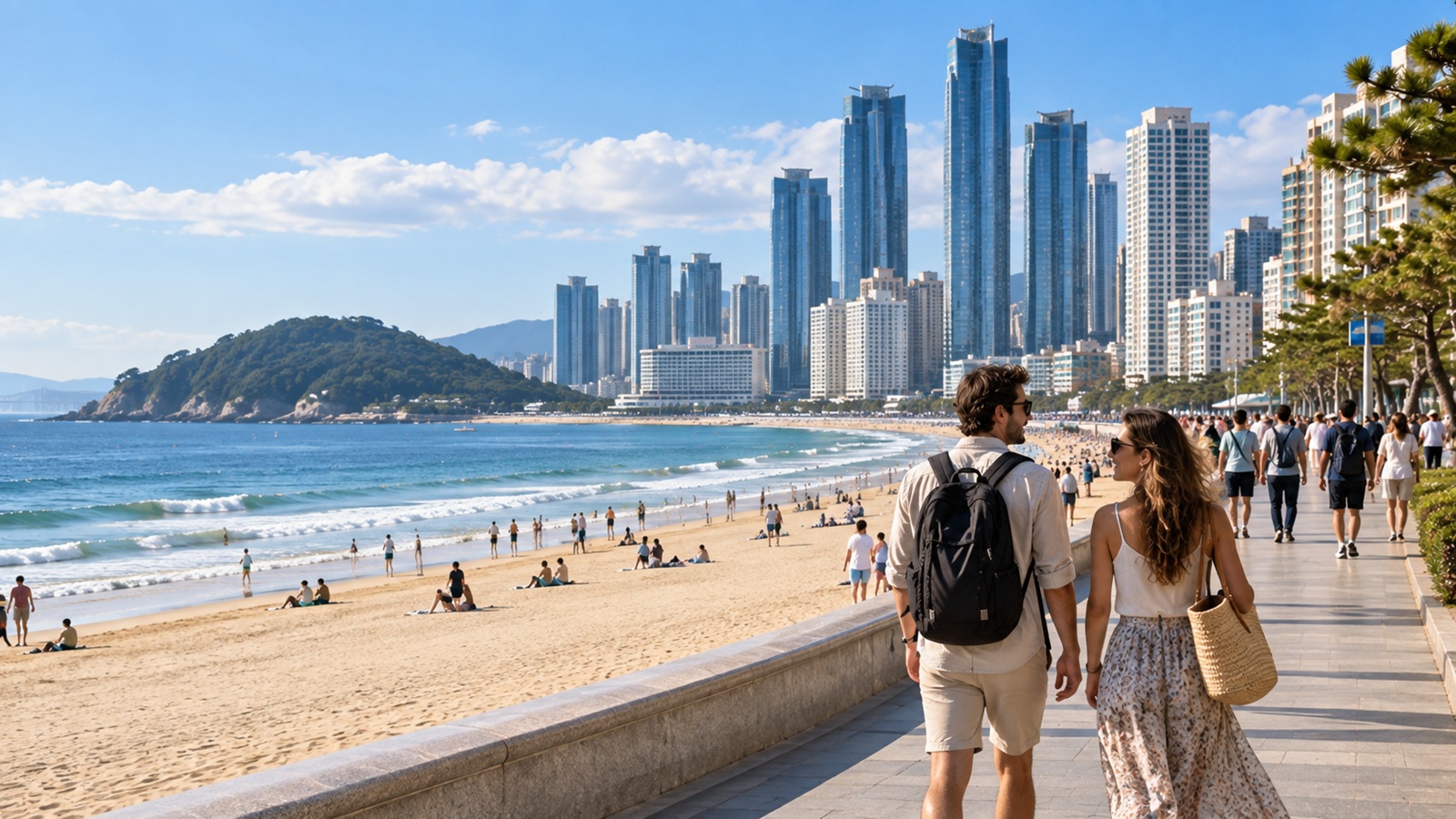
Haeundae: Best for the Classic Coastal Experience
For many first-time visitors, Haeundae is the easiest introduction to Busan.
The district combines a major beach with hotels, restaurants, cafes and convenient access to several attractions along the eastern coastline.
It is especially useful if waking up near the sea is part of the reason you came to Busan in the first place.
The trade-off is distance. Haeundae is not particularly close to Gamcheon, Jagalchi or Nampo-dong, so visiting western Busan requires additional travel time.
Gwangalli: Best for Waterfront Evenings
Gwangalli has a different personality.
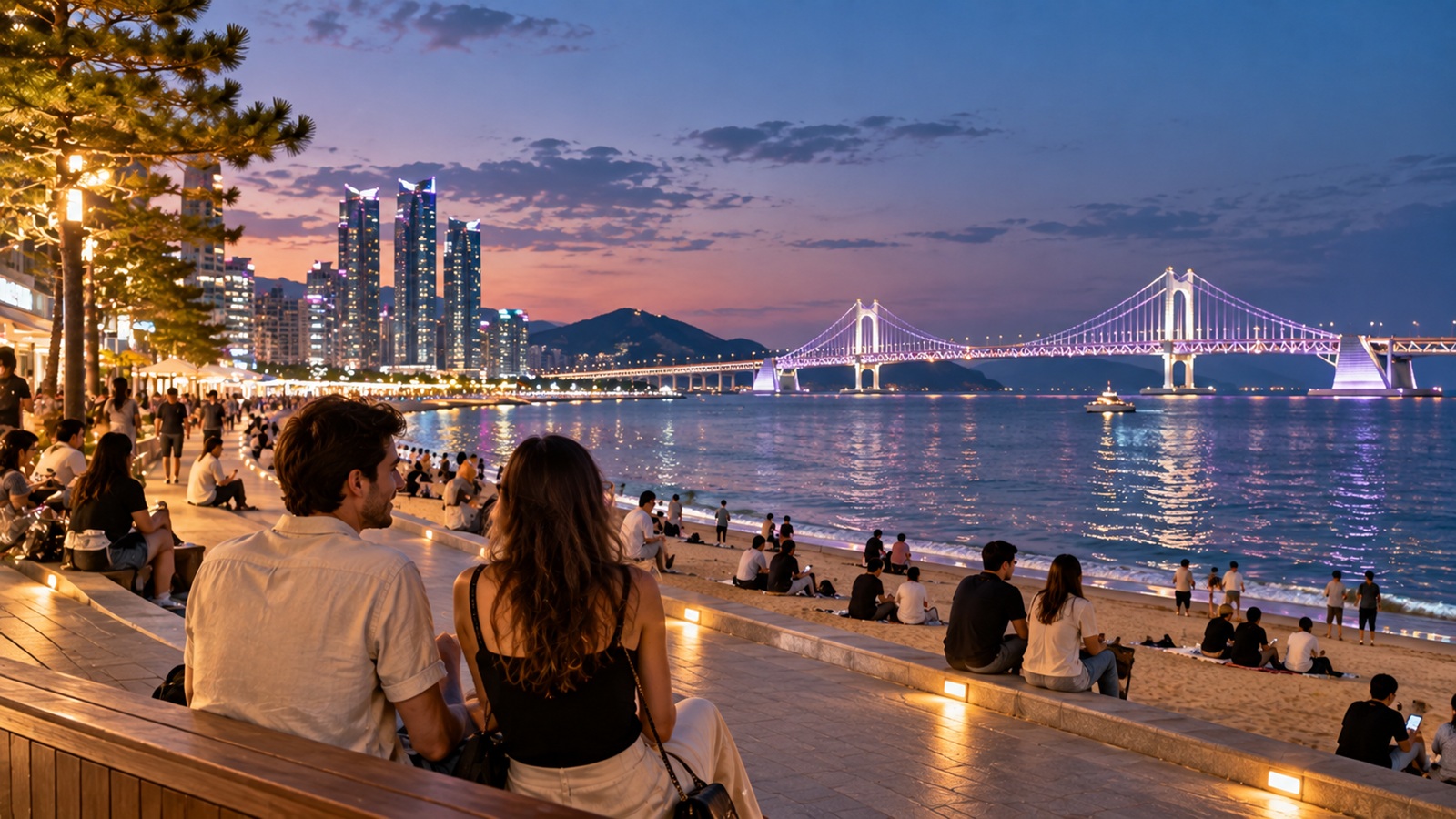
Its biggest visual landmark is Gwangandaegyo Bridge stretching across the water, making the beachfront especially atmospheric after sunset.
The area works well for travelers who want cafes, restaurants and an evening waterfront atmosphere rather than simply being close to the city’s most famous beach.
If your ideal Busan evening involves dinner followed by a slow walk beside the water, Gwangalli is worth considering.
Seomyeon: Best for Transportation and City Convenience
Seomyeon does not offer the same beachfront setting, but its central location can make sightseeing easier.
It is a major commercial and transportation area with extensive dining, shopping and nightlife nearby.
For travelers planning to explore both eastern and western Busan, staying around Seomyeon can reduce some of the cross-city travel.
Think of it as a practical base rather than a seaside escape.
Nampo-dong: Best for Markets and Old Downtown Busan
Nampo-dong puts you close to a very different side of the city.
Jagalchi Market, Gukje Market and the old downtown area are nearby, while Gamcheon Culture Village is much easier to combine with this part of Busan than with Haeundae.
Choose Nampo if markets, local food and older urban neighborhoods interest you more than staying beside the beach.
What Should You See on Your First Trip?
Busan has enough attractions to fill several trips.
For a first visit, it makes more sense to understand the city by area.
Haeundae and the East Coast
Haeundae Beach is one of Korea’s best-known urban beaches and an obvious starting point for first-time visitors.
But the eastern coast is more than one stretch of sand.
Depending on your schedule, you can combine Haeundae with nearby coastal walks, viewpoints, cafes or attractions farther toward Songjeong and Gijang.
The important part is to keep the day geographically focused.
If you are spending the morning around Haeundae, adding another eastern coastal attraction generally makes more sense than immediately crossing the city toward Gamcheon.
Gwangalli
Gwangalli is worth seeing even if you are staying elsewhere.
The beach faces Gwangandaegyo Bridge, and the combination of city lights, water and the illuminated bridge makes this one of Busan’s most recognizable evening scenes.
Late afternoon works particularly well: you can see the coastline in daylight, have dinner nearby and stay as the waterfront changes after dark.
Gamcheon Culture Village
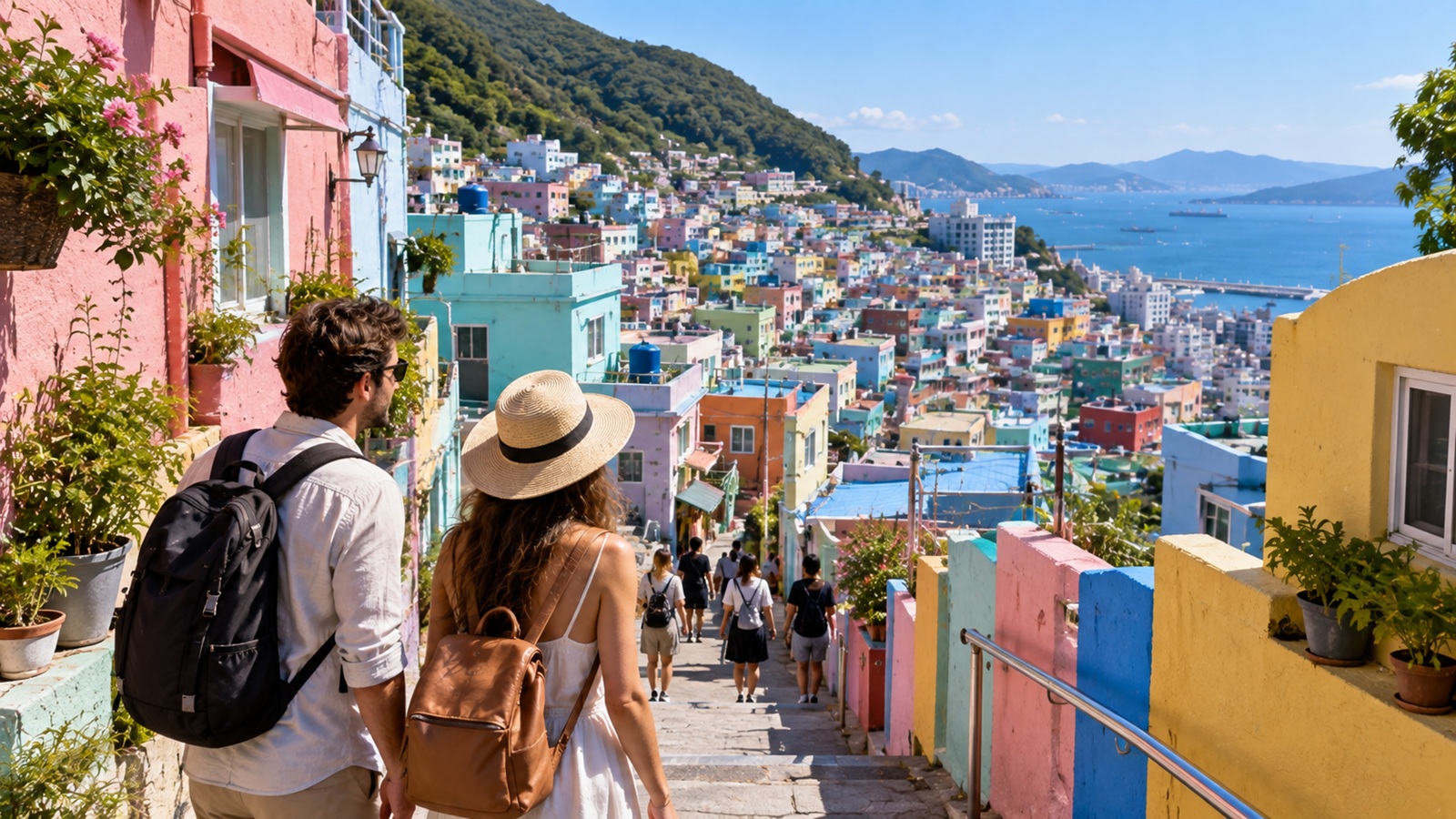
Gamcheon Culture Village sits on a steep hillside in western Busan.
Its layered homes, narrow lanes and views across the surrounding neighborhood have made it one of the city’s most recognizable visitor destinations.
It is still a real neighborhood, however, not an outdoor theme park.
Keep noise down, avoid entering private spaces and follow local signs about restricted areas or photography.
Comfortable shoes also help. The slopes are part of the experience.
Jagalchi and Nampo-dong
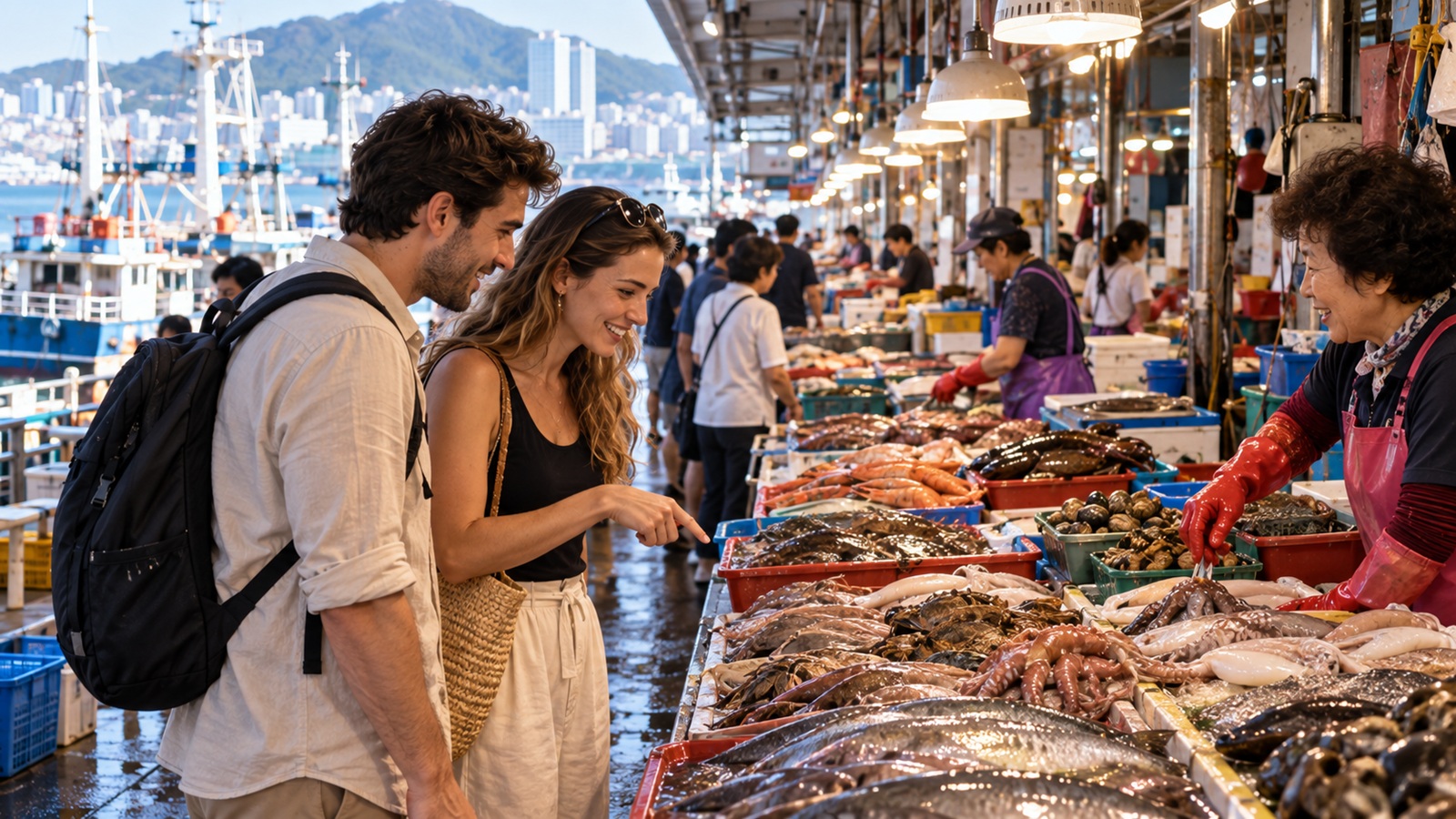
Jagalchi is closely associated with Busan’s identity as a port city.
The surrounding area is particularly useful for travelers who enjoy markets because Jagalchi, Nampo-dong and Gukje Market can be explored as part of the same general section of the city.
Rather than visiting Jagalchi only to take a photograph and leave, give yourself time to walk through the surrounding streets.
This is one of the places where Busan feels least like a generic beach destination.
How to Get Around Busan
Most first-time visitors do not need to rent a car.

Busan has a subway system, city buses and taxis, and public transportation can cover most standard sightseeing itineraries.
A rechargeable Korean transportation card is useful if you will be taking buses and subways regularly.
If you are also spending time in the capital, our Seoul subway and T-money guide explains the basic transit-card system and how visitors can use public transportation in Korea.
The main challenge in Busan is not a lack of transportation.
It is distance.
A route that looks short on a map may involve a longer subway ride, a transfer and then a bus or walk uphill.
For that reason, group your sightseeing geographically whenever possible.
Good combinations include:
Haeundae + eastern coast
Gwangalli + nearby waterfront areas
Gamcheon + Nampo-dong + Jagalchi
This simple approach can save more time than trying to optimize every individual train connection.
Taxis can also be useful when two attractions are awkward to connect by public transport, especially when several people are sharing the fare.
What to Eat in Busan
Busan has several foods strongly associated with the city and southeastern Korea.
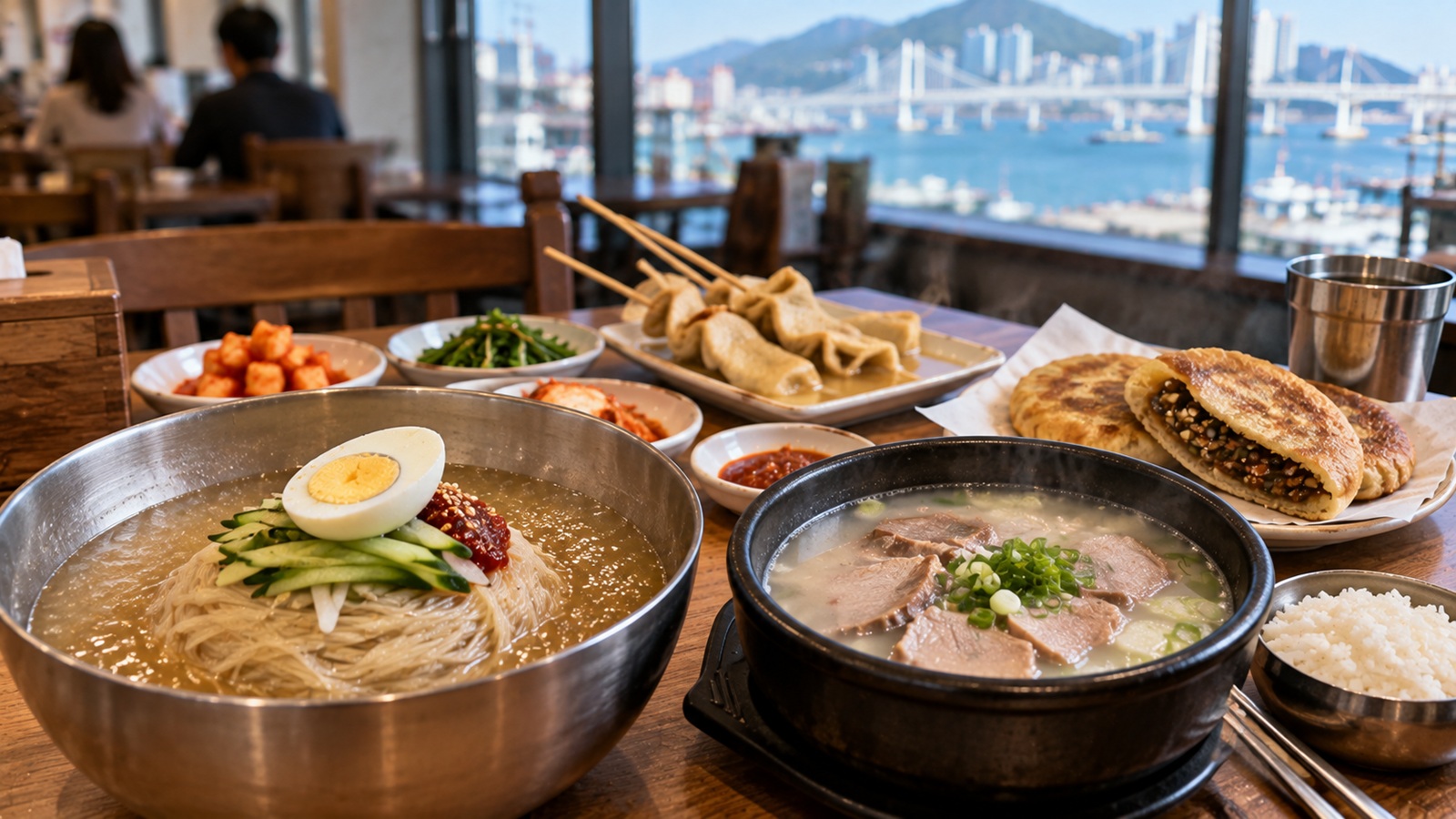
You do not need to chase every famous restaurant. Trying a few regional dishes is enough to make food part of the travel experience.
Dwaeji Gukbap
Dwaeji gukbap is pork soup served with rice and is one of the foods most strongly associated with Busan.
Different restaurants serve it slightly differently, and diners commonly adjust the seasoning at the table.
It is hearty, straightforward and especially satisfying after a long day of walking.
Milmyeon
Milmyeon is a cold noodle dish associated with Busan.
The noodles are typically made with wheat flour and served in a chilled broth or mixed with a spicy sauce.
Its development is closely connected to Busan’s modern history and the movement of people during and after the Korean War.
Eomuk
Korean fish cake is widely available across the country, but Busan has a particularly strong association with eomuk because of its history as a port city.
It is an easy snack to add while exploring markets or shopping areas.
Seafood
Busan’s coastal location naturally makes seafood part of the city’s food identity.
Jagalchi is the most internationally recognizable seafood market, but seafood restaurants and markets can be found across the city.
Check prices before ordering, particularly when seafood is priced by weight or market conditions.
Ssiat Hotteok
Ssiat hotteok is a Busan-style variation of the sweet Korean pancake filled with seeds.
It is particularly associated with the Nampo and BIFF Square area and works well as a simple street-food stop while exploring old downtown Busan.
A Simple 2-Day Busan Itinerary
If you only have two days, resist the temptation to cover everything.
Day 1: Haeundae and Gwangalli
Start around Haeundae and spend the morning exploring the beach and nearby coastal area.
Use the afternoon for another eastern Busan attraction or a slower walk rather than immediately crossing the city.
Later, move toward Gwangalli.
Have dinner nearby and stay long enough to see the waterfront and bridge after dark.
This keeps your first day concentrated on Busan’s modern coastal side.
Day 2: Gamcheon, Nampo-dong and Jagalchi
Start earlier and head toward Gamcheon Culture Village.
After exploring the hillside neighborhood, continue toward Nampo-dong and the Jagalchi area.
Spend the rest of the afternoon exploring markets, local streets and food around old downtown Busan.
This itinerary is deliberately simple.
The point is not to maximize the number of pins you can save on a map. It is to minimize unnecessary cross-city travel.
A Simple 3-Day Busan Itinerary
With a third day, the trip becomes much more flexible.
Day 1
Haeundae and the eastern coastline.
Day 2
Gamcheon Culture Village, Nampo-dong and Jagalchi.
Day 3
Gwangalli plus an additional experience based on your interests.
That extra experience could mean more time by the coast, a spa, another neighborhood, a museum, a coastal attraction or simply a slower cafe-and-food day.
Three days also gives you room to change plans if the weather is poor — something worth considering in a city where so many memorable experiences happen outdoors.
Is the Visit Busan Pass Worth It?
It can be, but not automatically.
The Visit Busan Pass is an official tourist pass for foreign visitors that provides free admission to participating attractions and discounts at additional businesses.
As of September 2026, the official site lists:
- 24-hour pass: KRW 55,000
- 48-hour pass: KRW 85,000
- Big 3 pass: KRW 45,000
- Big 5 pass: KRW 65,000
The official program currently advertises more than 34 free-entry attractions and more than 150 discount benefits.
However, there is an important current update.
The Visit Busan Pass announced that sales of the physical card versions were temporarily suspended from February 10, 2026 until further notice. Mobile versions remain available.
Because availability and participating attractions can change, check the official Visit Busan Pass website before purchasing.
The pass is most useful when several attractions you already want to visit are included.
Do not redesign your entire trip just to make a tourist pass feel worthwhile.
Add up the normal admission prices of the attractions on your actual itinerary and compare that total with the pass price.
That will give you a much better answer than simply asking whether the pass is “good value.”
When Is the Best Time to Visit Busan?
Busan can be visited year-round, but the experience changes significantly by season.
Spring brings mild weather and is comfortable for walking.
Summer is the obvious season for beaches, but it is also hot, humid and busy.
Autumn is generally comfortable for city sightseeing and coastal walks.
Winter is colder and windier, but Busan’s southern coastal location can make it feel somewhat different from winter farther north in Korea.
Weather conditions vary from year to year, so check the forecast shortly before your trip rather than planning around historical averages alone.
If swimming is important to you, also check the official operating period and safety information for the beach you plan to visit.
Practical Tips Before You Go
First, do not underestimate travel time.
Busan looks compact when you see a list of attractions, but the city stretches a long way along the coast.
Second, choose your accommodation based on your itinerary rather than hotel price alone.
Saving a little money on a room may not feel like a bargain if you spend much of each day commuting across the city.
Third, wear comfortable shoes.
Gamcheon has steep slopes, market districts reward walking, and coastal sightseeing often involves more distance than expected.
Fourth, keep some flexibility in your schedule.
A clear evening at Gwangalli or a pleasant morning along the coast can be more memorable than forcing yourself through another three attractions because they were on your original checklist.
Finally, if Busan is the second stop on your Korea itinerary, remember that many international travelers enter Korea through the Seoul area before traveling south. Our Incheon Airport to Seoul guide can help with the first stage of that journey.
Final Takeaway
Busan is easiest to enjoy when you stop treating it like a checklist.
For a first trip, two days can cover the major highlights, while three days gives you a more comfortable introduction.
Choose Haeundae or Gwangalli if the coast is your priority. Consider Seomyeon for transportation convenience or Nampo-dong if markets and old downtown Busan appeal more.
Then build each day around one part of the city.
That is the simplest way to experience what makes Busan different: not just its beaches or markets, but the way a large Korean city unfolds along the sea.
Frequently Asked Questions
How many days do you need in Busan?
Two days is enough to see several major highlights, but three days is more comfortable for most first-time visitors. Busan is geographically spread out, so additional time reduces the need to rush between distant areas.
Is Busan worth visiting on a first trip to Korea?
Yes, particularly for travelers spending a week or more in Korea. Busan offers beaches, seafood markets, coastal neighborhoods and a different urban atmosphere from Seoul. For very short Korea trips, however, adding Busan can create too much transit time.
Where should first-time visitors stay in Busan?
Haeundae is convenient for a classic beach-focused trip, Gwangalli is attractive for waterfront evenings, Seomyeon is practical for transportation, and Nampo-dong works well for travelers interested in markets and older downtown neighborhoods.
Can you visit Busan as a day trip from Seoul?
It is physically possible using Korea’s high-speed rail network, but a day trip leaves limited time once transportation to and from the stations and travel within Busan are included. An overnight stay is much more practical if your schedule allows it.
Do you need a car in Busan?
Most first-time visitors do not. Subways, buses and taxis can cover the main tourist areas. The more important issue is planning geographically sensible routes because some major attractions are far apart.
Is the Visit Busan Pass worth buying?
It depends on your itinerary. Compare the current pass price with the normal admission prices of attractions you already intend to visit. Also check the official website immediately before buying because pass formats, participating attractions and availability can change.
Sources & Further Reading
Busan Metropolitan City — Busan Tourism Statistics
Current foreign visitor statistics and tourism spending data.
Busan Metropolitan City — Busan Welcomes 2.92 Million Foreign Visitors
September 2026 update on international tourism growth in Busan.
Visit Busan Pass — Official Notices
Current notices concerning pass availability and operational changes.