
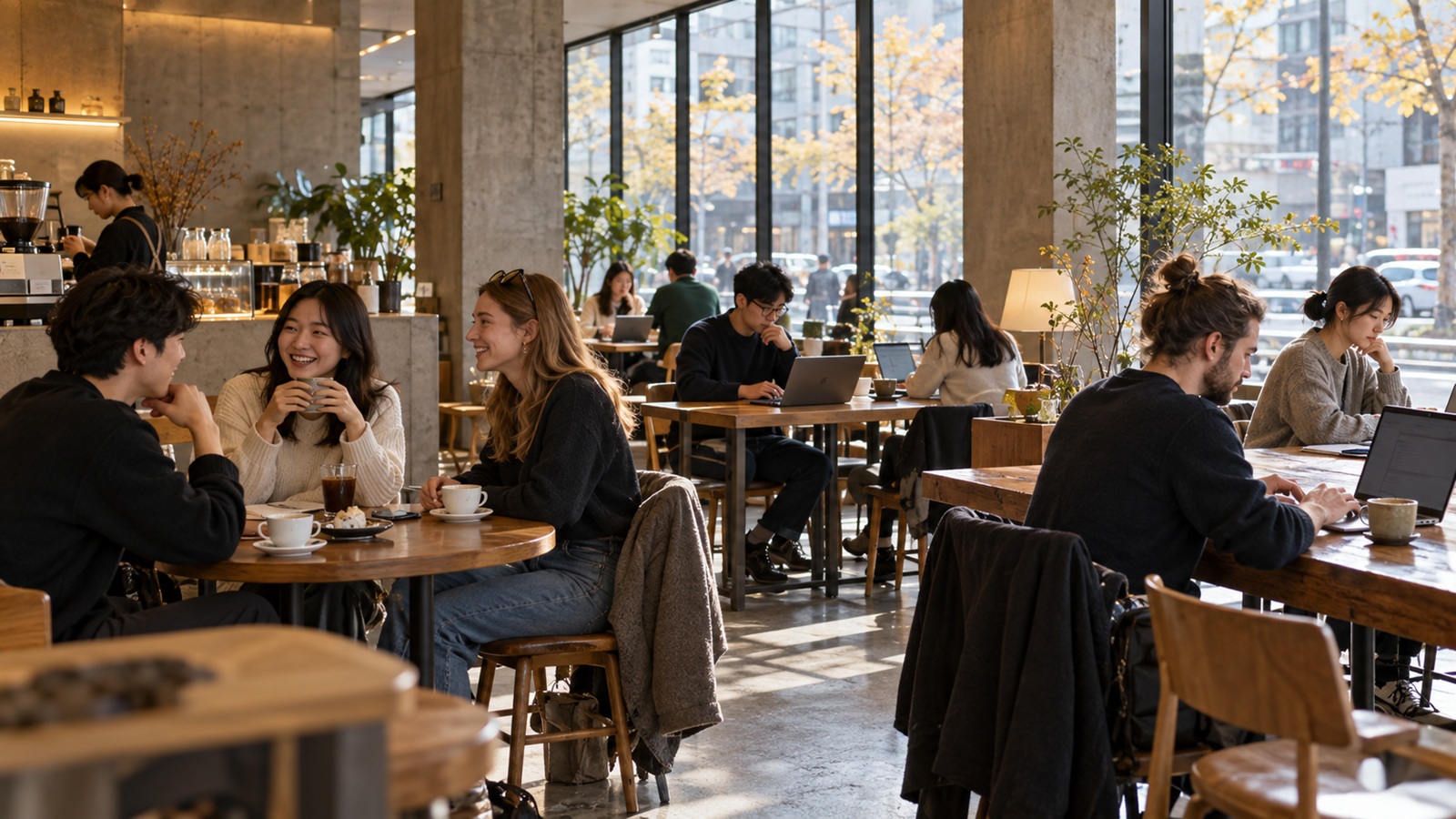
Walk through almost any busy neighborhood in Seoul and one thing quickly becomes obvious: there are a lot of cafes.
Some are tiny specialty coffee shops. Others fill converted houses, warehouses or traditional hanok buildings. There are bakery cafes, book cafes, minimalist espresso bars and enormous destination cafes designed around views, architecture or desserts.
For travelers, this can make Korean cafe culture look like a trend built around photogenic interiors.
But cafes in Korea play a much broader role in everyday life.
They are places to meet friends, go on dates, study, work between appointments, spend time alone and simply take a break from the city.
So why does Korea have so many cafes — and what should you know before walking into one?
Why Are There So Many Cafes in Korea?
The scale of Korea’s coffee industry helps explain why cafes feel almost impossible to avoid.
According to an analysis released in August 2026 by Korea’s Ministry of Agriculture, Food and Rural Affairs and the Korea Rural Economic Institute, the domestic coffee market reached approximately KRW 3.74 trillion in 2024, up 35.6 percent from 2018.
The number of coffee shops had reached 106,452 in 2023, accounting for 13.4 percent of the country’s foodservice establishments.
Those numbers tell only part of the story.
A Korean cafe is not necessarily somewhere you enter, drink a coffee quickly and leave.
Depending on the cafe, it can function almost like an extension of everyday living space.
Friends may meet after lunch and continue talking over coffee. Students may open laptops or textbooks. Couples may make a cafe one stop in a longer date. Someone with an hour between appointments may sit alone with a drink and a phone.
That helps explain why the physical space can matter almost as much as the coffee itself.
What Makes Korean Cafe Culture Different?
There is no single type of “Korean cafe.”
That variety is precisely what makes the culture interesting.
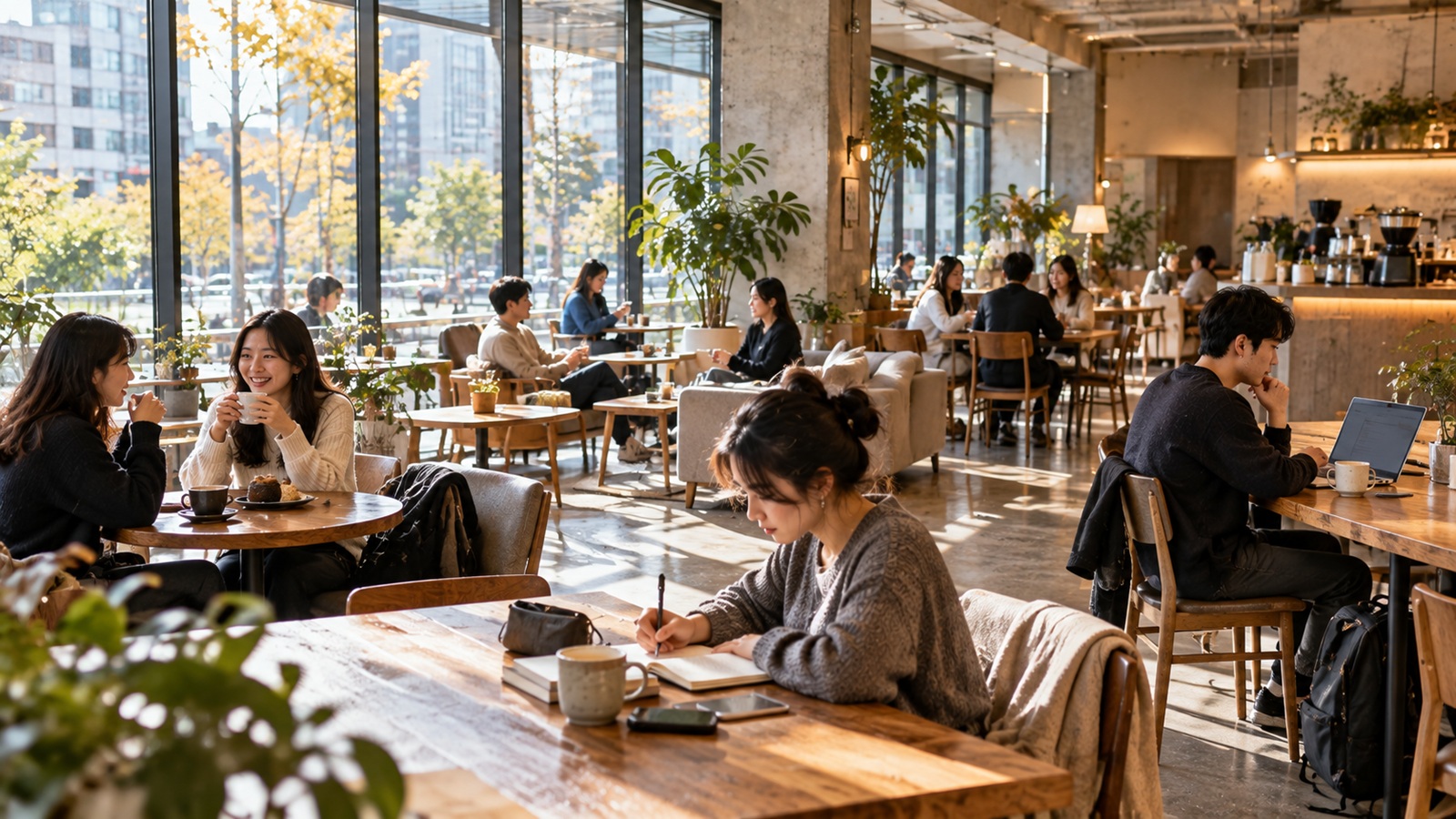
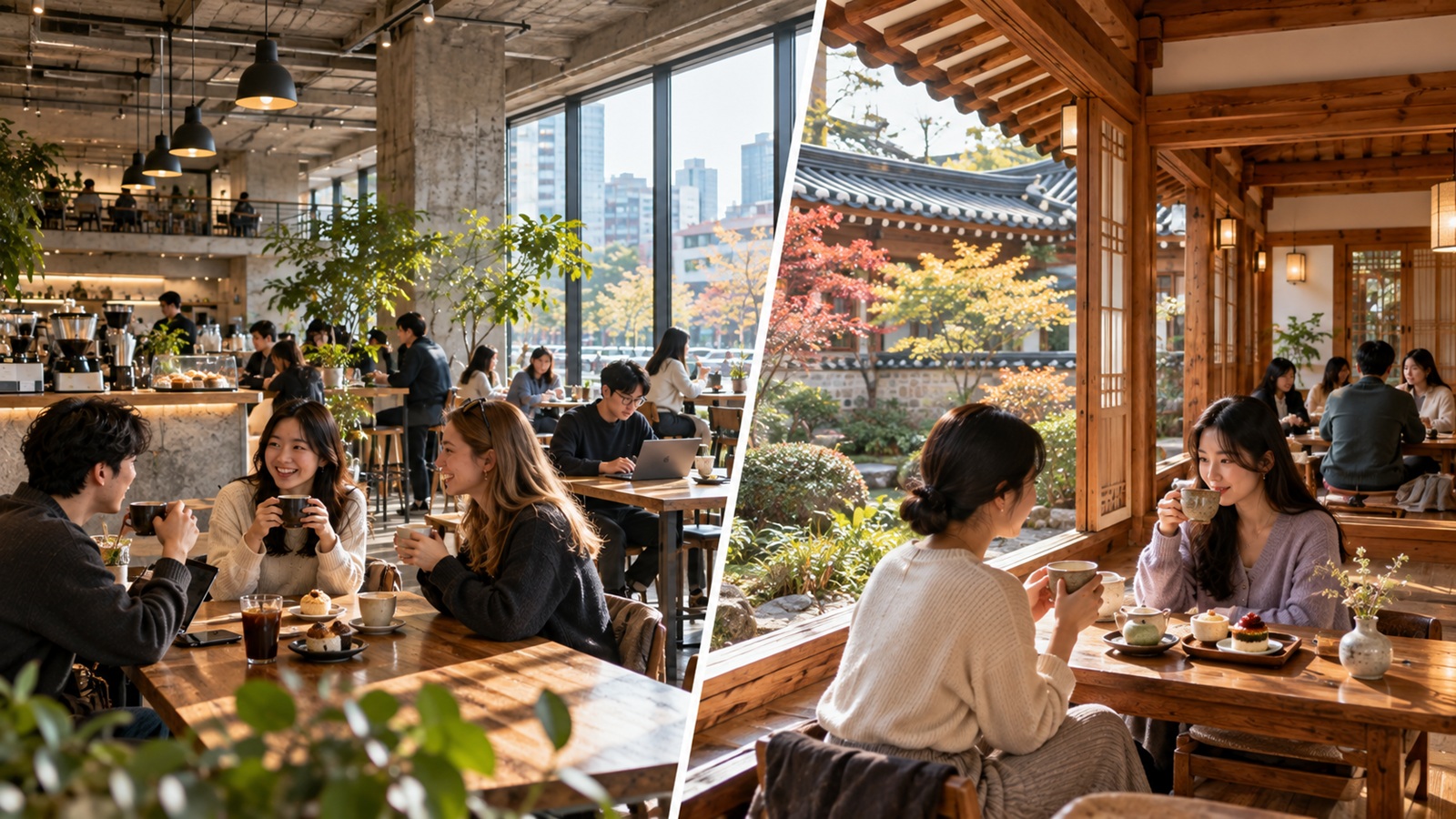
A neighborhood cafe may occupy a renovated house with only a handful of tables. A large bakery cafe may have multiple floors. A hanok cafe may use traditional architecture as part of the experience, while a contemporary cafe in Seoul might emphasize concrete, steel and minimalist design.
Some cafes are built around specialty coffee. Others are better known for cakes, pastries, seasonal drinks, architecture or a particular view.
Seoul’s own tourism information has documented cafe districts with renovated houses, themed spaces, book cafes and cafes that combine coffee with Korean tea and traditional desserts.
For a visitor, this means “going to a cafe” can describe very different experiences.
Why Does the Space Matter So Much?
In many Korean cafes, the room is part of what you are paying for.
Interior design can be central to a cafe’s identity.
This is particularly visible in neighborhoods where older buildings have been repurposed.
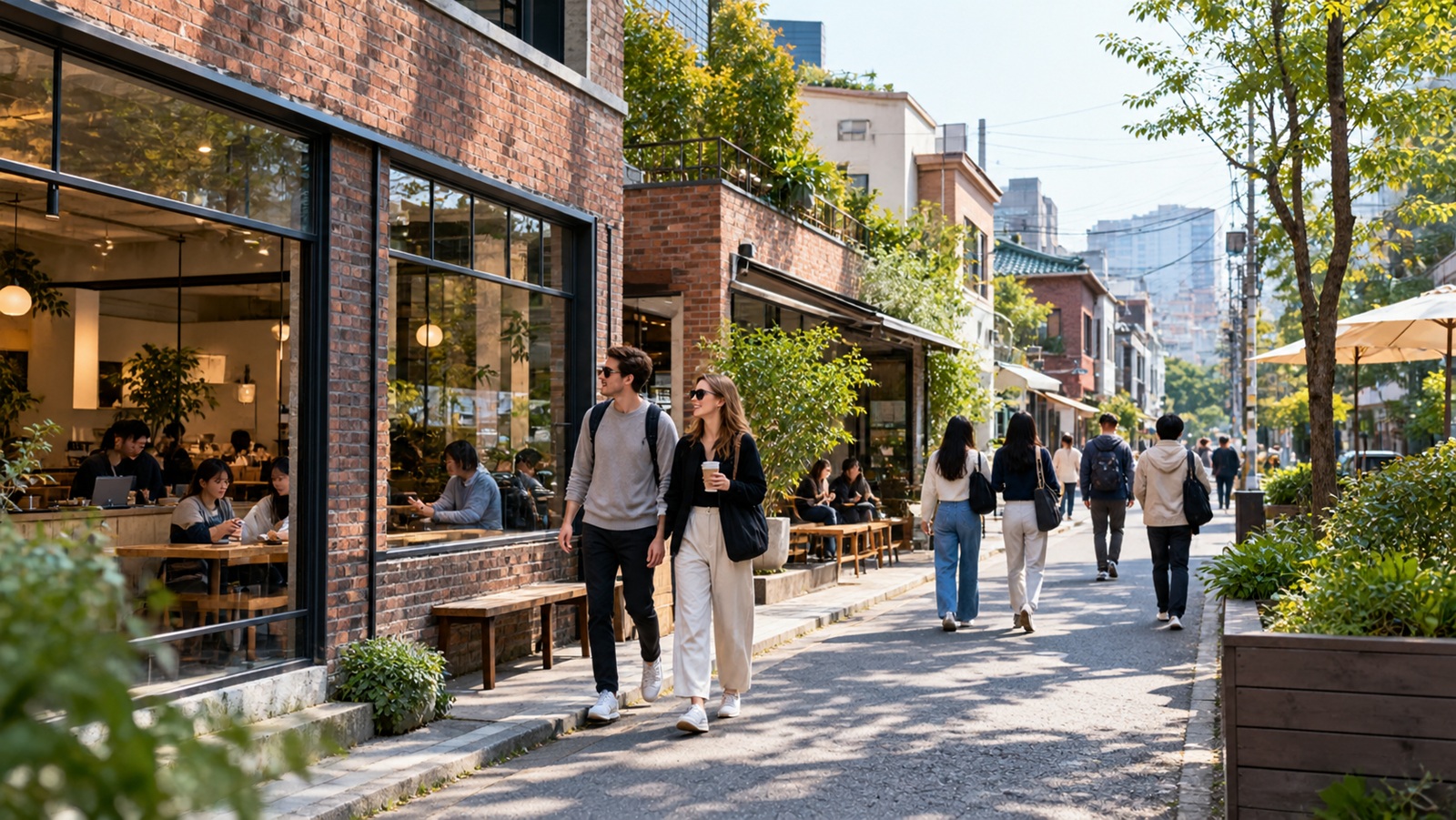
Seongsu-dong is a good example. Former industrial buildings and warehouses now sit beside modern cafes, shops and creative spaces, and the warehouse-cafe aesthetic has become part of the neighborhood’s contemporary identity.
But design-focused cafes are not limited to Seoul.
In other parts of Korea, travelers may encounter cafes built around ocean views, mountain scenery, gardens or unusually large architectural spaces.
The cafe itself can become a destination rather than simply somewhere to buy coffee.
What Do People Order at Korean Cafes?
Coffee menus in Korea will look familiar to many international visitors.
Americanos, lattes and other espresso-based drinks are widely available, but coffee is only one part of the menu at many cafes.
You may also find tea, fruit drinks, ades, matcha-based drinks, smoothies or seasonal specialties.
Desserts can be just as important.
Depending on the cafe, that might mean cakes, pastries, croissants, cookies, shaved ice or desserts influenced by Korean ingredients.
Traditional-style cafes may offer Korean teas or sweets instead.
This variety matters if you do not drink coffee.
You can still participate in Korean cafe culture without ordering an espresso-based drink.
And rather than arriving with a checklist of viral menu items, it is often more useful to see what the individual cafe actually specializes in.
How Do You Order at a Cafe in Korea?
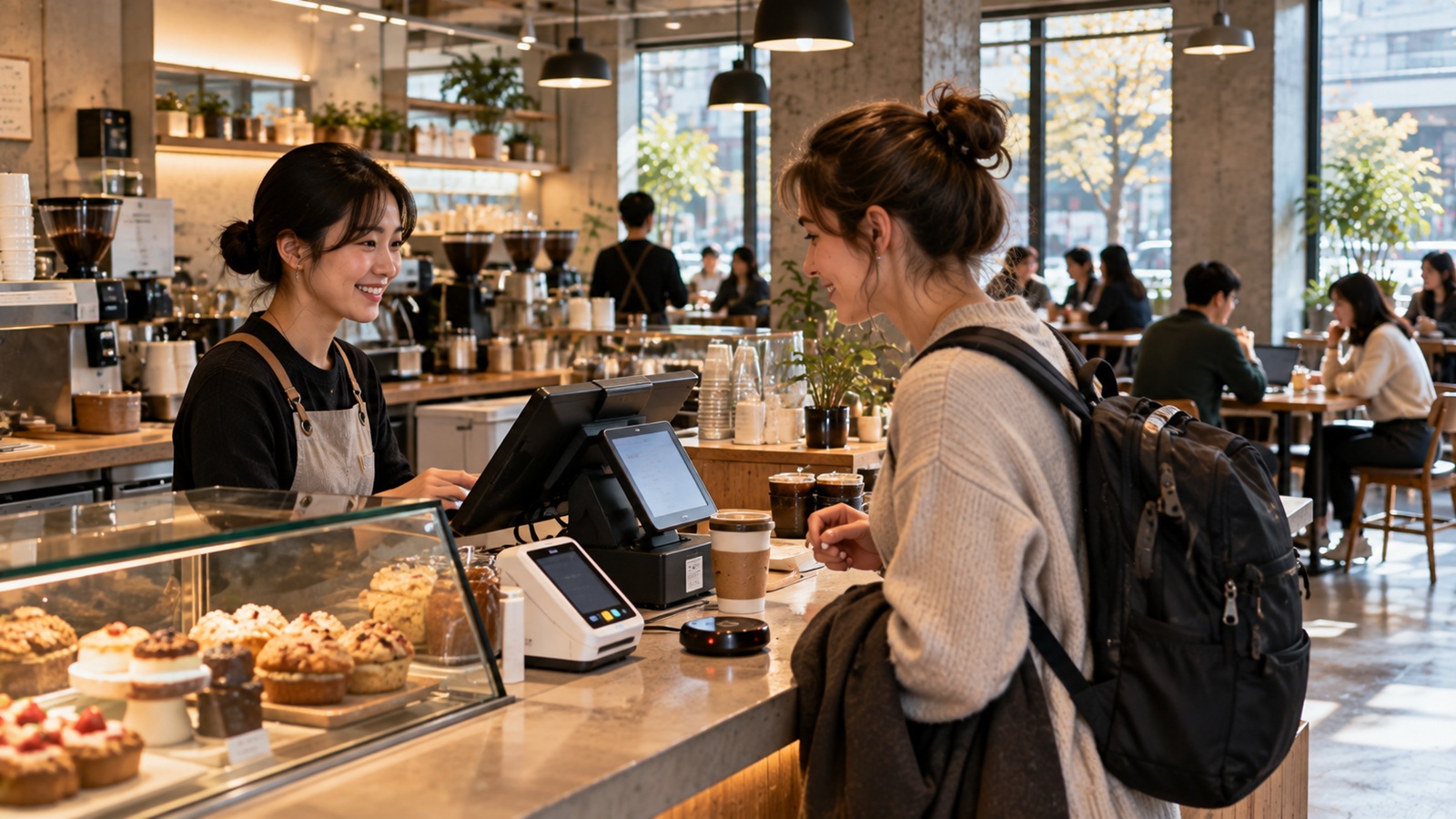
There is no universal ordering system, but many contemporary cafes use a fairly simple self-service process.
You usually order and pay at a counter or kiosk.
Depending on the cafe, you may receive a vibrating pager, receipt number or another signal that tells you when your order is ready.
You then collect the drinks from a pickup counter.
Some cafes also have a designated return station where customers leave trays, cups and dishes when they are finished.
But do not assume every cafe works this way.
Small specialty coffee bars, traditional tea houses, hotel cafes and other venues may provide table service.
The easiest rule is simply to look at what the cafe is asking customers to do.
Does Everyone Need to Order a Drink?
You may encounter a sign reading:
1인 1음료
It means “one drink per person.”
Some cafes instead use a broader one-order-per-person policy, and what counts as an order can vary.
This is especially important in small or busy cafes where seating is limited.
However, it should not be treated as one nationwide rule applying identically to every Korean cafe.
Individual businesses set their own policies.
If you are traveling with someone who does not want coffee, check whether tea, juice, another non-coffee drink or an eligible menu item satisfies the cafe’s policy.
The sign in the actual cafe is more reliable than a general rule found online.
Can You Stay for a Long Time in a Korean Cafe?
Sometimes — but context matters.
It is common to see people studying, working or talking for extended periods in Korean cafes, particularly in larger spaces where laptops and longer stays fit naturally into the environment.
That does not mean every table in every cafe is an unlimited workspace.
A small cafe with six tables on a crowded weekend afternoon is very different from a large cafe with plenty of empty seating.
Some businesses may also set time limits or restrict laptop use in certain areas.
Instead of asking, “How long can I stay in a Korean cafe?” it is better to ask:
What kind of cafe am I in, and what are its rules?
Look for posted notices and pay attention to how the space is being used.
What About Study Cafes?
Visitors sometimes confuse ordinary cafes with Korea’s “study cafes.”
They are not the same thing.
A regular cafe sells drinks and food and may happen to be comfortable for studying or working.
A study cafe is a space specifically designed for concentrated study, typically operating more like a paid study facility than a conventional coffee shop.
So seeing students with laptops in a regular cafe does not mean you have entered a study cafe.
For most travelers, an ordinary cafe is the more relevant experience.
What Cafe Etiquette Should Travelers Know?
Korean cafe etiquette is less complicated than it can appear online.
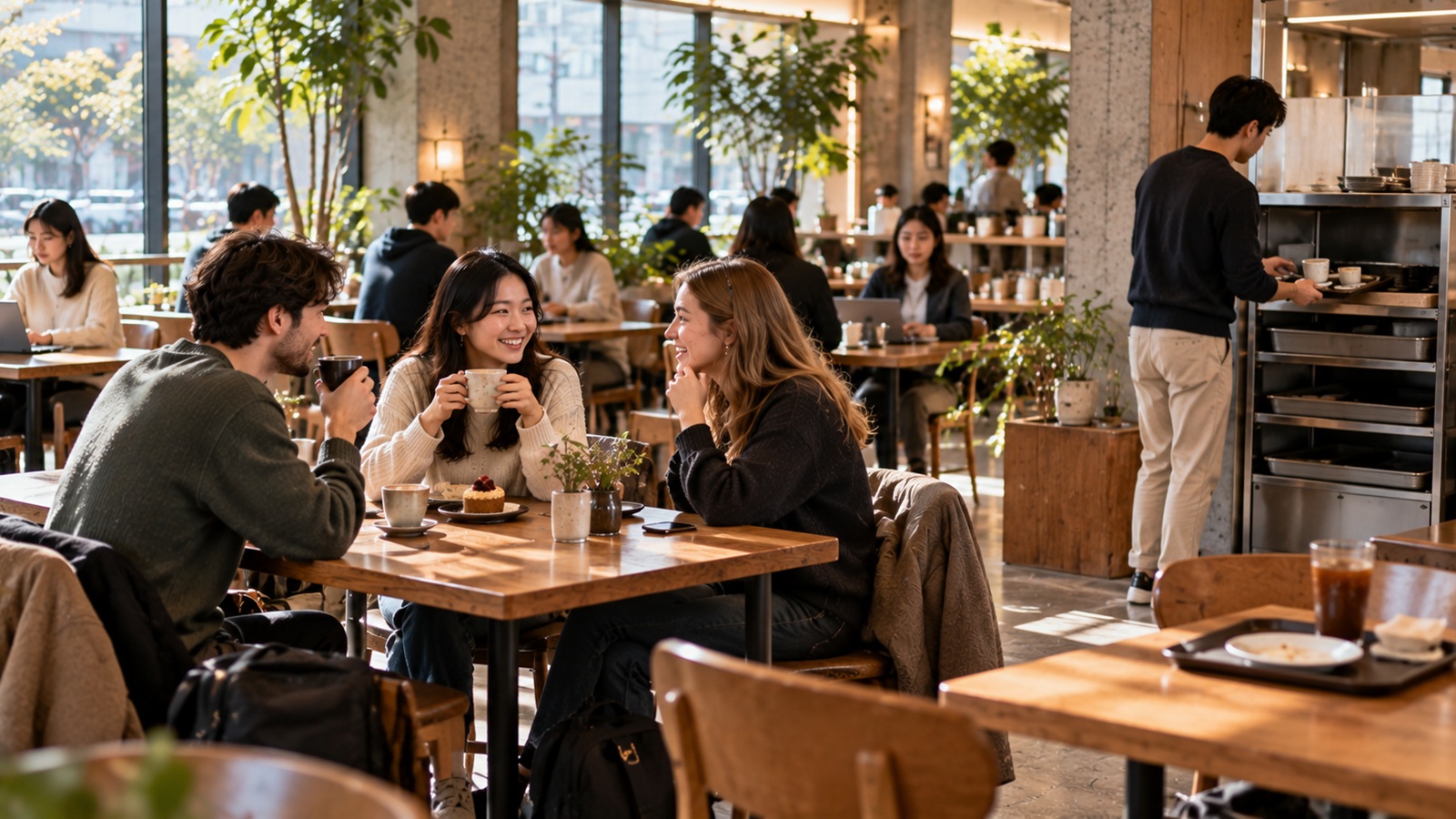
The most useful principle is to follow the individual cafe.
Check whether you should order before taking a seat. Follow any one-drink or one-order policy. Do not occupy extra seats with bags when the cafe is crowded. If a return station is provided, take your tray there when you leave.
If the cafe posts a time limit or laptop restriction, follow it.
Photography also deserves some common sense.
A beautifully designed cafe may invite photos, but other customers are not part of the decor. Avoid photographing strangers closely without permission, and do not block narrow aisles or busy counters to stage a picture.
You do not need to memorize a complicated set of “Korean cafe rules.”
Observe the space and follow the instructions that are actually there.
Where Can Travelers Experience Cafe Culture in Seoul?
You do not need to travel across Seoul searching for one famous cafe.
Different neighborhoods reveal different sides of the culture.
Seongsu-dong
Seongsu is useful for seeing how cafe culture intersects with architecture, design, retail and the reuse of industrial spaces.
Former warehouses and industrial buildings have helped shape the neighborhood’s distinctive cafe aesthetic.
If you want to explore the area beyond coffee, our guide to Seongsu-dong in Seoul explains its warehouse cafes, pop-ups, fashion, K-beauty spaces and Seoul Forest.
Yeonnam-dong
Yeonnam-dong offers a different atmosphere.
The streets around the Gyeongui Line Forest Park became known for smaller independent cafes, converted homes and distinctive concepts.
Rather than visiting only one address, walking through the neighborhood can be part of the experience.
Historic Seoul
Around older parts of central Seoul, cafe culture can overlap with traditional architecture and tea culture.
Hanok-style cafes and traditional tea houses provide a contrast with Seoul’s modern coffee spaces.
In Insadong, for example, visitors can encounter traditional tea houses serving drinks such as jujube, ginger or omija tea alongside the neighborhood’s crafts, galleries and historic atmosphere.
Beyond Seoul
Korean cafe culture is not a Seoul-only phenomenon.
Busan, Jeju and other regions have their own cafe landscapes, often shaped by their surroundings.
A cafe overlooking the coast offers a very different experience from a converted warehouse in Seongsu or a quiet traditional tea house in central Seoul.
That regional variety is another reason not to reduce Korean cafe culture to a list of viral Seoul addresses.
Are Cafes in Korea Expensive?
There is no useful single price for “a coffee in Korea.”
Prices vary significantly depending on the type of cafe, neighborhood, drink and setting.
A budget-focused chain, a small neighborhood espresso bar and a large destination cafe with elaborate architecture are different businesses.
Desserts and specialty drinks can also increase the cost considerably.
For travelers, the safest approach is straightforward: check the displayed menu before ordering.
And remember that at many design-led or destination cafes, you are not choosing only a beverage. The space, view or atmosphere may be part of why people visit.
Do You Need to Visit a Famous Cafe?
In fact, cafe culture may make more sense when you stop treating every cafe as an attraction that needs to be famous.
A neighborhood cafe can show you just as much about everyday Korean life as a highly photographed destination.
Choose one because the room looks comfortable, because the dessert looks interesting or simply because you need somewhere to sit after walking for two hours.
That ordinary use of cafes is part of the culture too.
Why Is Korean Cafe Culture Worth Experiencing?
Palaces, markets and museums can explain Korea’s history.
Cafes can reveal something about how contemporary Korean cities are actually used.
They show how people create social space, how old buildings find new purposes, how design becomes part of everyday consumption and how a simple coffee break can stretch into an afternoon with friends.
You do not need to visit ten cafes in one day.
One well-chosen stop can be enough.
Sit down, order something you actually want, look around and notice how the space is being used.
Sometimes understanding Korea begins with something as ordinary as taking a coffee break.
Frequently Asked Questions
Why are there so many cafes in Korea?
Cafes in Korea serve more purposes than simply buying coffee. They are commonly used for meeting friends, dates, studying, working, resting between activities and enjoying desserts or designed spaces. Official Korean government data counted more than 106,000 coffee shops in 2023.
Do you have to order one drink per person at Korean cafes?
Not everywhere. Some cafes post a “one drink per person” or one-order-per-person policy, particularly when seating is limited. It is a business policy rather than a universal rule, so check the individual cafe’s signs.
Can tourists stay a long time in Korean cafes?
Longer stays are common in many cafes, especially larger ones, but policies vary. Small or crowded cafes may impose time limits or restrictions on laptop use. Follow posted rules and be considerate when seating is in demand.
Can I visit Korean cafes if I do not drink coffee?
Yes. Many cafes offer tea, fruit drinks, ades, smoothies and other non-coffee options. Traditional-style cafes may also serve Korean teas and desserts.
What is the difference between a cafe and a study cafe in Korea?
A regular cafe is primarily a food-and-beverage business, although customers may study or work there. A study cafe is a dedicated paid space designed specifically for studying or concentrated work.
Which Seoul neighborhoods are good for experiencing cafe culture?
Seongsu-dong is known for converted industrial and warehouse-style cafes, while Yeonnam-dong has smaller neighborhood cafes and converted residential spaces. Historic areas can offer hanok cafes and traditional tea houses. The experience varies significantly by neighborhood.
Sources & Further Reading
2. Seoul Metropolitan Government — Café Culture in Seoul, Korea