

If you follow Korean skincare, you may have noticed four letters appearing everywhere lately: PDRN.
Serums, creams, toners and hydrogel masks featuring PDRN have become increasingly visible across the Korean beauty market. Now, the ingredient is showing up far beyond Korea, with international beauty publications and retailers paying attention to what is often described online as “salmon DNA skincare.”
But that nickname can make PDRN sound stranger — and perhaps more miraculous — than it really is.
So what exactly is PDRN? Why did it become such a major K-beauty trend? And does putting PDRN in a serum offer the same benefits associated with treatments used in clinics?
Here is what you should know.
What Is PDRN?
PDRN stands for polydeoxyribonucleotide.
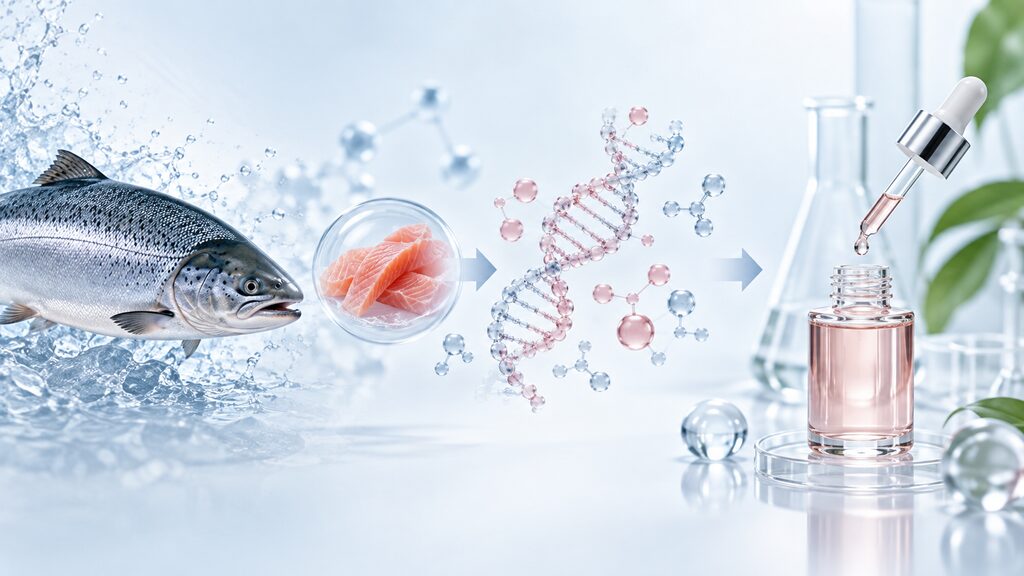
In simple terms, it consists of fragments of DNA. Traditionally, PDRN used in medical and aesthetic applications has often been derived from purified DNA associated with salmon or trout.
This is where the viral phrase “salmon DNA” comes from.
However, scrolling through social media can easily create the wrong impression. PDRN is not simply raw salmon material being added to a face cream.
It is a processed ingredient, and the source, molecular characteristics, concentration and formulation can differ between products.
That distinction becomes particularly important when evaluating skincare claims.
Why Did PDRN Become So Popular in Korea?
To understand the PDRN boom, it helps to look at a broader shift in Korean beauty.
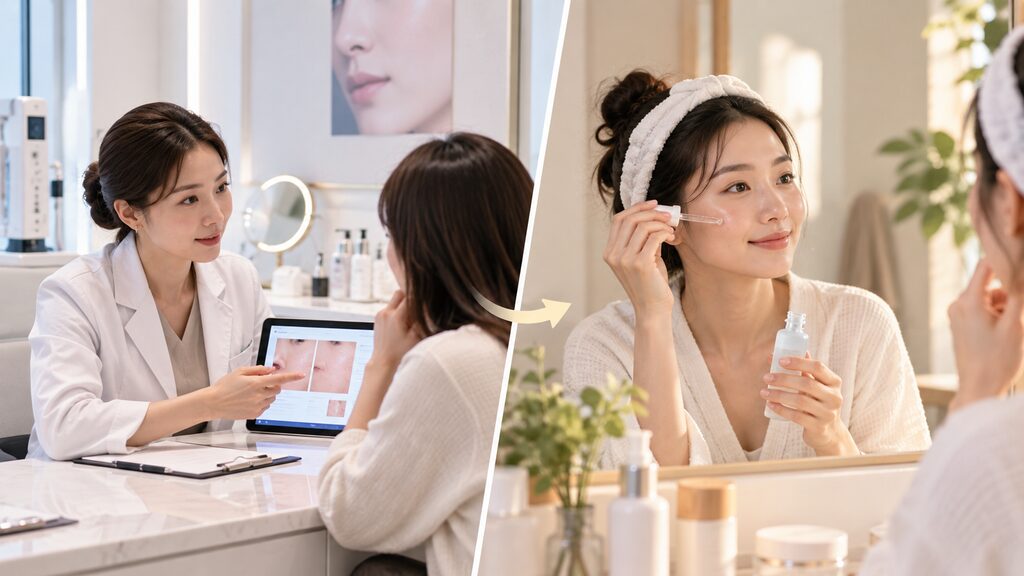
K-beauty has increasingly blurred the line between the dermatology clinic and the bathroom shelf. Ingredients and concepts associated with professional aesthetic care are increasingly being adapted into products designed for everyday skincare routines.
PDRN fits that trend particularly well.
The term was already familiar to many Korean consumers through dermatology and aesthetic treatments before PDRN serums, creams and masks became widely marketed for home skincare.
That familiarity gave beauty brands a powerful concept: everyday skincare built around an ingredient consumers already associated with professional skin care.
PDRN has since expanded across multiple product categories, including ampoules, creams, masks and toners.
PDRN is also part of a wider shift in Korean beauty shopping, as international visitors increasingly explore Korean pharmacy skincare during trips to Seoul.

From Clinic-Inspired Beauty to Everyday Skincare
The rise of PDRN also reflects something larger happening in Korea’s beauty industry.
Korean consumers are increasingly exposed to skincare terminology through dermatology clinics, beauty devices, social media and highly competitive cosmetic retail channels.
As a result, ideas once associated mainly with professional aesthetic care can quickly enter the home-skincare market.
That does not mean a cosmetic product performs the same way as a professional treatment.
It does help explain why clinic-inspired ingredients can become mainstream beauty trends so quickly in Korea.
PDRN Is No Longer Just a Korean Trend
What makes the current PDRN story particularly interesting is that the trend has travelled beyond Korea.
International beauty publications and retailers have increasingly introduced PDRN to consumers outside the country, often using the memorable phrase “salmon DNA skincare.”
Korean beauty brands have also helped bring PDRN products to a much larger international audience.
This follows a familiar K-beauty pattern: a beauty concept gains momentum in Korea, international beauty enthusiasts discover it, social media accelerates awareness, and eventually retailers and publications begin explaining it to mainstream consumers.
PDRN appears to be moving through that cycle now.
PDRN isn’t the only Korean skincare innovation attracting global attention. Another emerging trend is spicule skincare, which uses microscopic needle-like structures and is sometimes described as “liquid microneedling.”
Does PDRN Skincare Actually Work?
This is where the story becomes more complicated.
There is scientific interest in PDRN and related polynucleotide-based treatments, particularly in areas such as tissue repair, wound healing and skin rejuvenation.
A 2026 systematic review examined polynucleotide and PDRN therapies in dermatology. However, the publicly available PubMed record does not include an abstract, so its detailed findings should not be treated as evidence that PDRN cosmetics as a category are effective.
Research involving professional treatments also needs to be distinguished from studies of products applied directly to the skin.
Research on topical PDRN is developing. A 2026 study investigated a specific medium-length PDRN preparation using laboratory and skin-model experiments, alongside a 28-day clinical study comparing a 0.1% PDRN eye cream with a 0.1% retinol product.
The findings are relevant to that studied formulation and treatment period. They do not establish that every PDRN serum, cream or mask will deliver the same results.
Formulation matters. Concentration matters. Delivery matters.
Evidence from a particular studied formulation cannot automatically be applied to every PDRN cosmetic on the market.
PDRN Skincare Is Not the Same as a PDRN or Polynucleotide Injection
This may be the most important distinction for consumers.
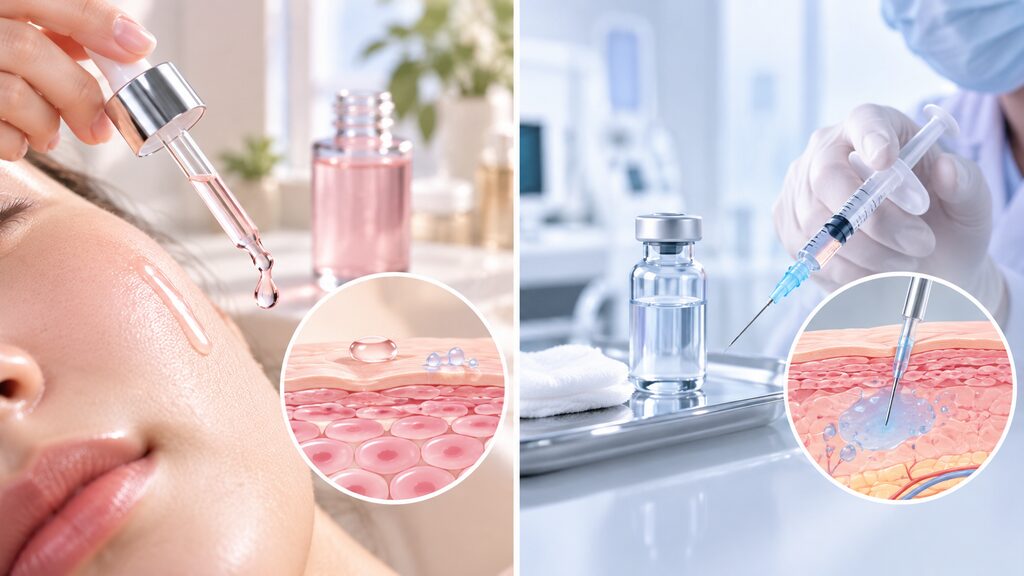
A topical skincare product interacts with the skin differently from a substance delivered through a professional procedure.
That may sound obvious, but online discussions can easily blur the two.
Research involving injectable PDRN or polynucleotide treatments should not automatically be treated as proof that a topical PDRN serum produces identical effects.
A serum sold for home use and a professional treatment performed in a clinic are not interchangeable simply because they share related terminology.
This distinction is especially important when you encounter marketing that suggests a cosmetic can reproduce the effects of a professional treatment “in a bottle.”
Treat those claims cautiously.
What About the FDA?
There is another common misunderstanding among U.S. consumers: the phrase “FDA-approved skincare.”
Most cosmetics in the United States do not go through FDA premarket approval in the same way that prescription drugs do. There are limited exceptions, including certain color additives.
Cosmetic companies are responsible for ensuring that their products are safe when used as intended and properly labeled.
The FDA also distinguishes cosmetic claims from drug claims. Claims that a product treats disease or affects the structure or function of the body can affect how the product is regulated.
So seeing a PDRN cosmetic sold in the United States should not be interpreted as proof that the FDA has clinically validated its anti-aging or regenerative effects.
Why Are There So Many Different PDRN Products?
Once an ingredient becomes popular in Korea, product development can move extremely quickly.
That is part of what makes K-beauty exciting, but it is also why consumers need to look beyond the headline ingredient.
You may encounter PDRN in serums, ampoules, moisturizers, toners, hydrogel masks, eye products and other skincare formats.
But two products labeled “PDRN” can have very different formulas.
A PDRN serum containing established moisturizing ingredients, for example, may make skin feel more hydrated and plump even when it is difficult for a consumer to determine exactly how much of that visible result comes from PDRN itself.
The entire formula matters more than the trendiest word on the bottle.
What Should You Look for Before Buying PDRN Skincare?
Start by checking the complete ingredient list rather than relying only on the front label.
Consider what you actually want the product to do.
If your main concern is hydration, ingredients with established moisturizing functions may be just as important as PDRN. If you have sensitive skin, the rest of the formulation — including fragrance and other active ingredients — deserves attention too.
Most importantly, be skeptical of products that imply dramatic medical-style regeneration from an ordinary cosmetic.
PDRN is an interesting skincare development.
It does not need exaggerated claims to be interesting.

Is “Salmon DNA Skincare” Vegan?
Not necessarily.
Traditional PDRN can be derived from DNA associated with salmon or trout, so consumers following vegan skincare standards should not assume that every PDRN product is vegan.
At the same time, brands and ingredient suppliers may use different sources or technologies, and terminology can vary.
Consumers concerned about animal-derived ingredients should therefore check the manufacturer’s ingredient and sourcing information for the specific product rather than relying on the word “PDRN” alone.
Is PDRN the Next Snail Mucin?
There are some similarities.
Snail mucin became one of K-beauty’s most recognizable ingredients internationally because it combined an unusual origin story with an easy-to-understand skincare narrative.
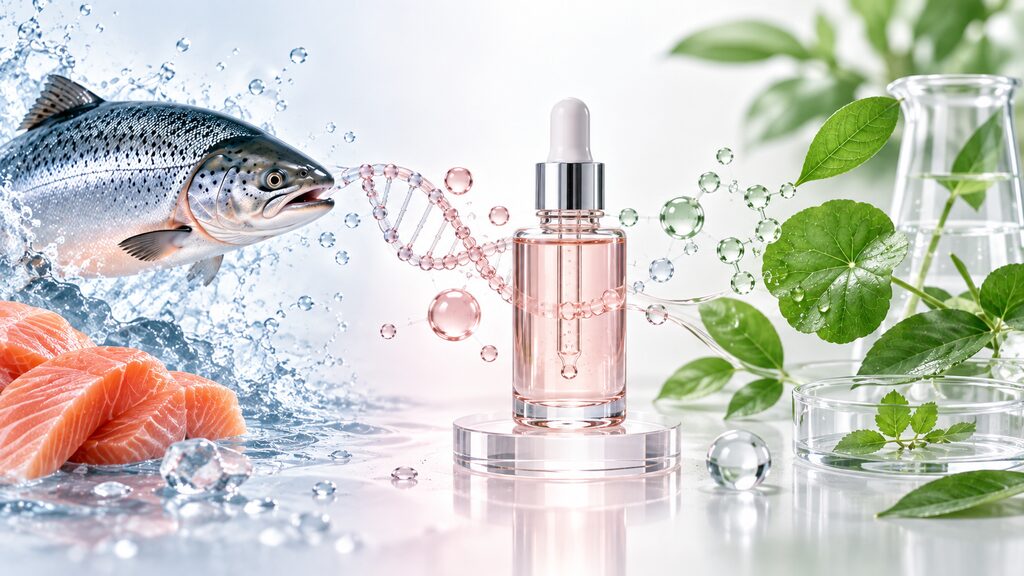
PDRN has some of the same qualities that can drive a beauty ingredient viral: an unusual origin story, strong connections to Korean beauty culture and the instantly clickable phrase “salmon DNA.”
But there is an important difference.
PDRN is arriving during a broader movement toward clinic-inspired skincare — cosmetics borrowing ingredients, terminology and ideas that consumers associate with dermatology and aesthetic medicine.
That may make PDRN more than a single viral ingredient.
It may also tell us something about where part of K-beauty is heading next.
Korea’s beauty influence is also expanding beyond skincare, with K-Fragrance emerging as another Korean lifestyle category attracting international attention.
The Korea Front Row Take
From Korea, the most interesting part of the PDRN trend is not the “salmon DNA” shock factor.
It is how quickly Korea’s beauty market can turn a concept familiar from professional skin care into an everyday consumer skincare category — and then export that category to beauty shoppers around the world.
PDRN is a real and scientifically interesting substance, and there is emerging research worth following.
But there is a significant difference between saying “PDRN is scientifically interesting” and saying “every PDRN cosmetic will regenerate your skin.”
Those are not the same claim.
For international K-beauty shoppers, a sensible approach is simple: enjoy the innovation, examine the complete formula, and keep expectations proportional to the evidence.
That is usually more useful than chasing the loudest skincare claim on social media.

Frequently Asked Questions
What does PDRN stand for?
PDRN stands for polydeoxyribonucleotide, a substance composed of DNA fragments. PDRN used in medical and beauty applications has traditionally often been associated with purified DNA derived from salmon or trout.
Is PDRN really made from salmon DNA?
Some PDRN ingredients are derived from salmonid DNA, which explains the popular phrase “salmon DNA skincare.” However, sourcing and formulations can vary, so consumers should check information provided by the manufacturer for a specific product.
Does PDRN skincare work?
Research into PDRN and polynucleotides shows promising potential in dermatology, and research into topical formulations is developing. However, evidence from professional treatments cannot automatically be applied to every cosmetic serum, cream or mask containing PDRN.
Is PDRN serum the same as a PDRN injection?
No. Topical cosmetics and professional injectable treatments use fundamentally different delivery methods and should not be considered equivalent.
Is PDRN skincare vegan?
Not always. Traditional PDRN may be derived from salmon or trout. Consumers seeking vegan products should verify the source of the ingredient with the individual manufacturer.
Is PDRN FDA approved?
Cosmetics in the United States generally do not receive FDA premarket approval, with limited exceptions such as certain color additives. Therefore, the sale of a PDRN cosmetic should not be interpreted as FDA confirmation of its claimed anti-aging or regenerative effects.
Sources & Further Reading
U.S. Food and Drug Administration — Cosmetics Labeling Claims
U.S. Food and Drug Administration — Does FDA approve cosmetics before they go on the market?
PubMed — 2026 research on a topical PDRN formulation and photodamaged skin
Allure — PDRN and the rise of “salmon DNA” skincare
British Vogue — PDRN skincare coverage
Boots — Guide to PDRN skincare
This article is for general informational purposes only and is not medical advice. If you have a skin condition, allergies, or questions about professional injectable treatments, consult an appropriately qualified healthcare professional.