
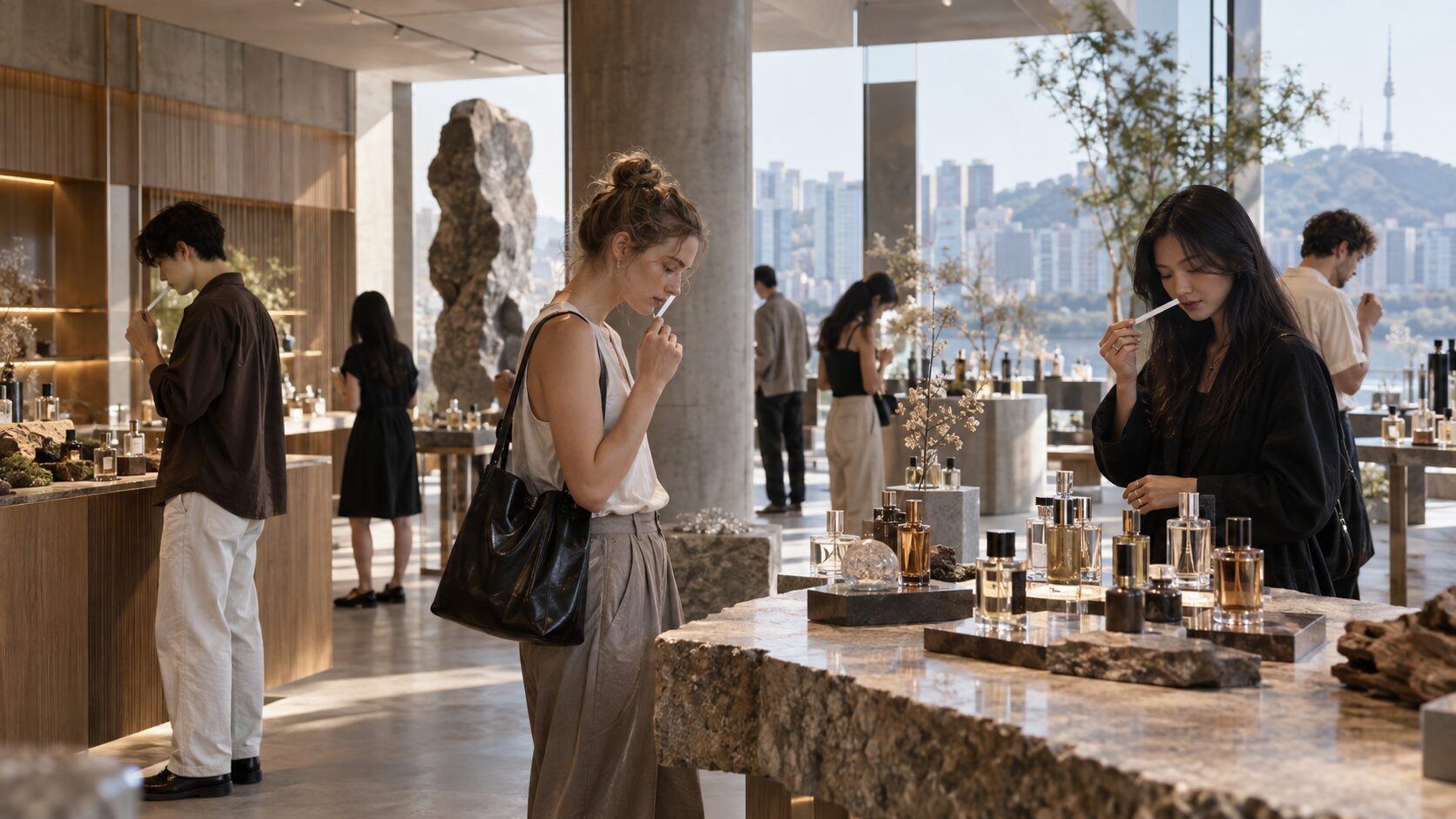
K-Beauty has already transformed skincare routines around the world. Now another Korean beauty category is beginning to travel: fragrance.
In Seoul, Korean perfume brands are no longer confined to a small niche. Fragrance boutiques have become part of the shopping landscape in trend-driven neighborhoods such as Seongsu, while international beauty publications are paying closer attention to Korean scents.
There is also real business momentum behind the trend. Korea’s perfume exports rose sharply in the first five months of 2026, adding weight to the idea that K-Fragrance could become one of the next Korean lifestyle categories to find a larger global audience.
But what exactly is K-Fragrance — and does Korean perfume really have a distinctive style?
What Does “K-Fragrance” Actually Mean?
K-Fragrance is a convenient term for the growing world of Korean fragrance brands, perfume culture and scent-focused lifestyle products.
It does not describe one official category or a single type of perfume.
That distinction matters.
Just as K-Beauty includes everything from minimalist skincare to experimental cosmetic formulas, Korean fragrance brands can have very different identities.
Some emphasize clean musks, airy textures and scents designed to stay relatively close to the skin. Others are darker, sweeter, woodier or deliberately unconventional.
What increasingly connects them is not necessarily one smell, but a broader approach to fragrance as part of everyday lifestyle, personal atmosphere, visual design and storytelling.
That makes K-Fragrance more interesting than simply asking what a “Korean scent” smells like.
Why Is K-Fragrance Taking Off in 2026?
The numbers suggest something more substantial than a social-media microtrend.
According to Korea Customs Service trade statistics reported by Edaily, South Korea exported $33.62 million worth of perfume from January through May 2026, up 71.8 percent from the same period a year earlier.
April alone reached $8.39 million, a monthly record since the relevant statistics began in 1988.
At the same time, international beauty media have started treating Korean fragrance as a category worth watching rather than an extension of skincare.
British Vogue highlighted Korean fragrance in May 2026, while Vogue in the United States pointed to Korean label Nonfiction’s arrival stateside as part of a broader shift toward independent and niche fragrance brands.
This is important because K-Fragrance is developing with an advantage that earlier Korean beauty categories did not always have: global consumers are already familiar with Korea as a source of beauty, fashion, music and lifestyle trends.
Perfume does not have to introduce Korea from scratch.
Does Korean Perfume Have a Distinctive Scent?
There is no single scent that defines Korean perfume.
Still, some recurring preferences have attracted attention overseas.
Clean musk, soft woods, citrus, tea-like accords and fresh, skin-like compositions frequently appear in discussions of contemporary Korean fragrance. Some brands also offer scents designed to feel intimate rather than project strongly across a room.
That fits a broader approach to fragrance as something that can become part of a person’s immediate atmosphere rather than announcing itself from a distance.
But this should not become another stereotype.
Not every Korean fragrance is soft, clean or minimalist.
Korea also has perfume houses exploring stronger gourmands, unusual combinations, provocative concepts and bolder niche perfumery.
The diversity may ultimately be more important than any single “Korean” scent profile.

K-Fragrance Is About More Than Perfume
One reason Korean fragrance culture feels distinctive is that scent often extends beyond the traditional perfume bottle.
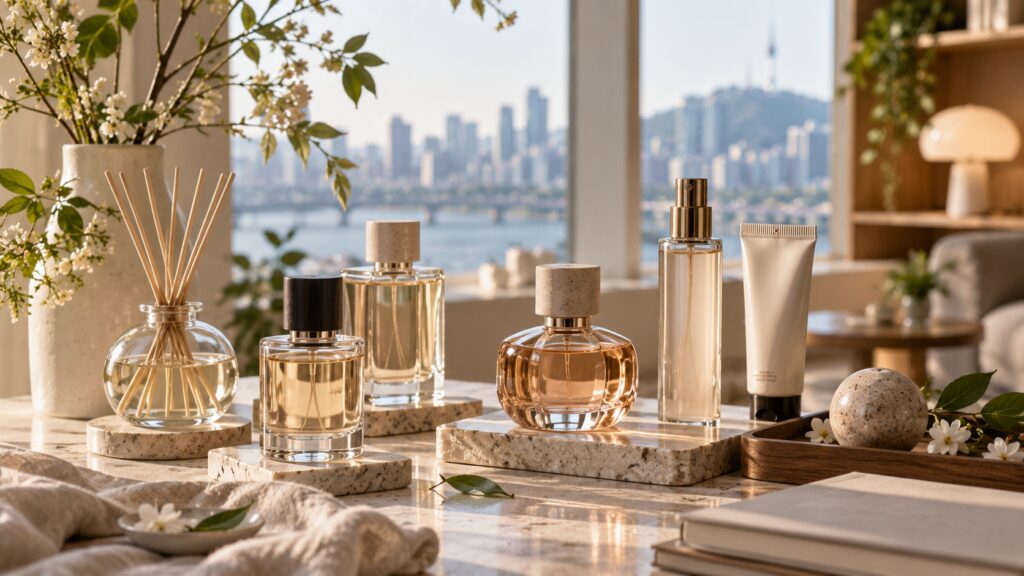
Hand creams, hair mists, body products, fabric sprays, diffusers and other scented lifestyle products can all become part of the same fragrance experience.
For consumers already familiar with Korean beauty, that approach may feel surprisingly natural.
Skincare made the daily routine itself important. K-Fragrance can do something similar with scent: rather than reserving perfume only for a final spray before leaving home, fragrance can appear throughout the day in smaller, more personal forms.
This also helps explain why some Korean brands develop fragrance identities across several product categories instead of relying only on eau de parfum.

Korean Fragrance Brands to Know
The growing international coverage of K-Fragrance has brought several Korean names into focus.
Nonfiction
Nonfiction combines fragrance with body care and lifestyle products, using understated visual design and scent-centered storytelling. Its growing availability outside Korea also makes it one of the clearest examples of a Korean fragrance label moving toward a wider international audience.
Tamburins
Tamburins approaches fragrance through fashion, art and highly designed retail environments. Its stores have become destinations in their own right, helping show why shopping for Korean fragrance in Seoul can feel different from simply picking a bottle from a department-store shelf.
Granhand
Granhand has developed a strong identity around scent as part of everyday life, with fragrances and related products presented through an approachable, lifestyle-oriented aesthetic.
BORNTOSTANDOUT
BORNTOSTANDOUT is a useful reminder that K-Fragrance should not be reduced to “clean and subtle.” Its bold concepts and unconventional scent combinations represent a more provocative side of contemporary Korean perfumery.
These brands do not all smell alike — and that is precisely the point.
K-Fragrance is becoming a category because Korean fragrance culture is expanding, not because every Korean perfume follows the same formula.
Why Seoul Is Part of the K-Fragrance Experience
To understand K-Fragrance, it helps to look beyond the bottles.
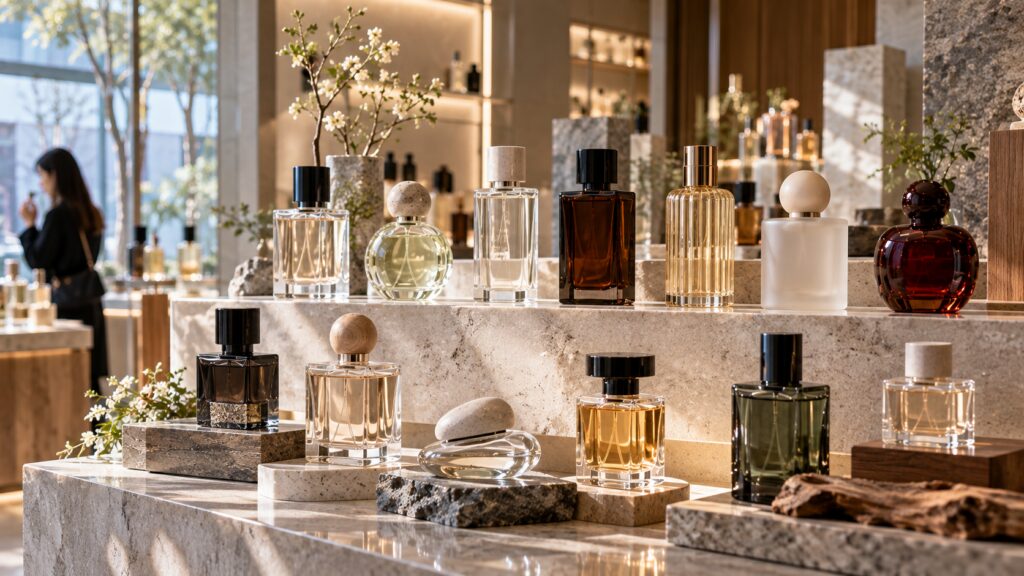
In Seoul, particularly in neighborhoods known for fashion and lifestyle trends, fragrance stores increasingly function as immersive brand spaces.
Seongsu is an important example.
The neighborhood has become known for concept stores, pop-ups, cafés, fashion and beauty retail, and fragrance fits naturally into that environment.
For a broader look at the neighborhood beyond fragrance, our Seongsu-dong Seoul guide explains its warehouse cafés, pop-ups, K-beauty spaces, shopping and nearby Seoul Forest.
Visitors may encounter sculptural interiors, carefully controlled lighting, unusual materials and scent installations designed to make the physical store part of the product story.
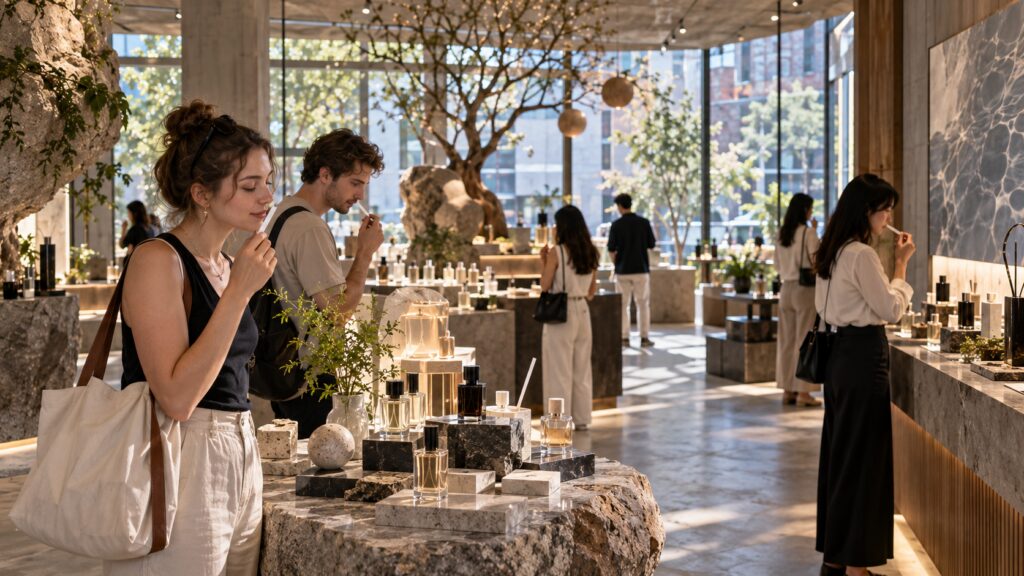
Recent Korean reporting has also documented growing interest from international visitors in these fragrance spaces.
That gives K-Fragrance a connection to tourism that skincare does not always have.
A bottle bought in Seoul can function as both a beauty product and a sensory souvenir — something connected to a particular neighborhood, store and travel memory.
Is K-Fragrance the Next K-Beauty?
It is too early to say that K-Fragrance will become as globally influential as K-Beauty.
Korean skincare has built an enormous international ecosystem involving retailers, creators, product innovation and years of consumer education. Fragrance is starting from a much smaller base.
But the direction is worth watching.
Exports are rising. International beauty publications are paying attention. Korean brands are reaching overseas retailers, and fragrance boutiques are becoming part of how some international visitors experience Seoul.
Perhaps the most interesting part is that K-Fragrance does not need to copy the K-Beauty playbook.
Its opportunity may lie somewhere else: between perfume and lifestyle, between product and place, and between contemporary design and the growing global curiosity about how people in Korea live, shop and express personal taste.
K-Fragrance is still being defined.
And that may be exactly why 2026 is such an interesting time to discover it.
Frequently Asked Questions
What is K-Fragrance?
K-Fragrance is a broad term used for Korea’s growing fragrance culture and Korean perfume brands. It does not refer to one specific scent style and can include perfume, body products, hair mists and other scented lifestyle products.
What does Korean perfume smell like?
There is no single Korean perfume scent. Clean musks, soft woods, citrus and fresh or skin-like fragrances are common in parts of the market, but Korean brands also produce bold gourmands, woody scents and experimental niche perfumes.
Why is Korean perfume becoming popular?
Growing global interest in K-Beauty and Korean lifestyle culture has given Korean fragrance brands greater visibility. Korea’s perfume exports also increased sharply during the first five months of 2026.
What Korean perfume brands should I know?
Nonfiction, Tamburins, Granhand and BORNTOSTANDOUT are among the Korean fragrance names receiving international attention. They represent different styles, from understated lifestyle fragrance to more experimental niche perfumery.
Where can I explore Korean fragrance in Seoul?
Seoul neighborhoods such as Seongsu have become particularly associated with concept stores and experience-focused beauty and fragrance retail. Individual store locations and opening hours should always be checked before visiting because retail locations can change.
Is K-Fragrance the next K-Beauty?
It is too early to know whether Korean fragrance will reach K-Beauty’s global scale. However, rising exports, overseas retail expansion and growing international media coverage indicate that Korean fragrance is developing into a recognizable category of its own.
Sources & Further Reading
Edaily — Korean perfume exports surge 71.8% in the first five months of 2026
British Vogue — Korean Fragrance Is Quiet Luxury In Scent Form
Vogue — The 5 Fragrance Trends That Will Define 2026
Korea JoongAng Daily — K-Fragrance Draws Foreign Shoppers With Seoul Scents and Immersive Stores