
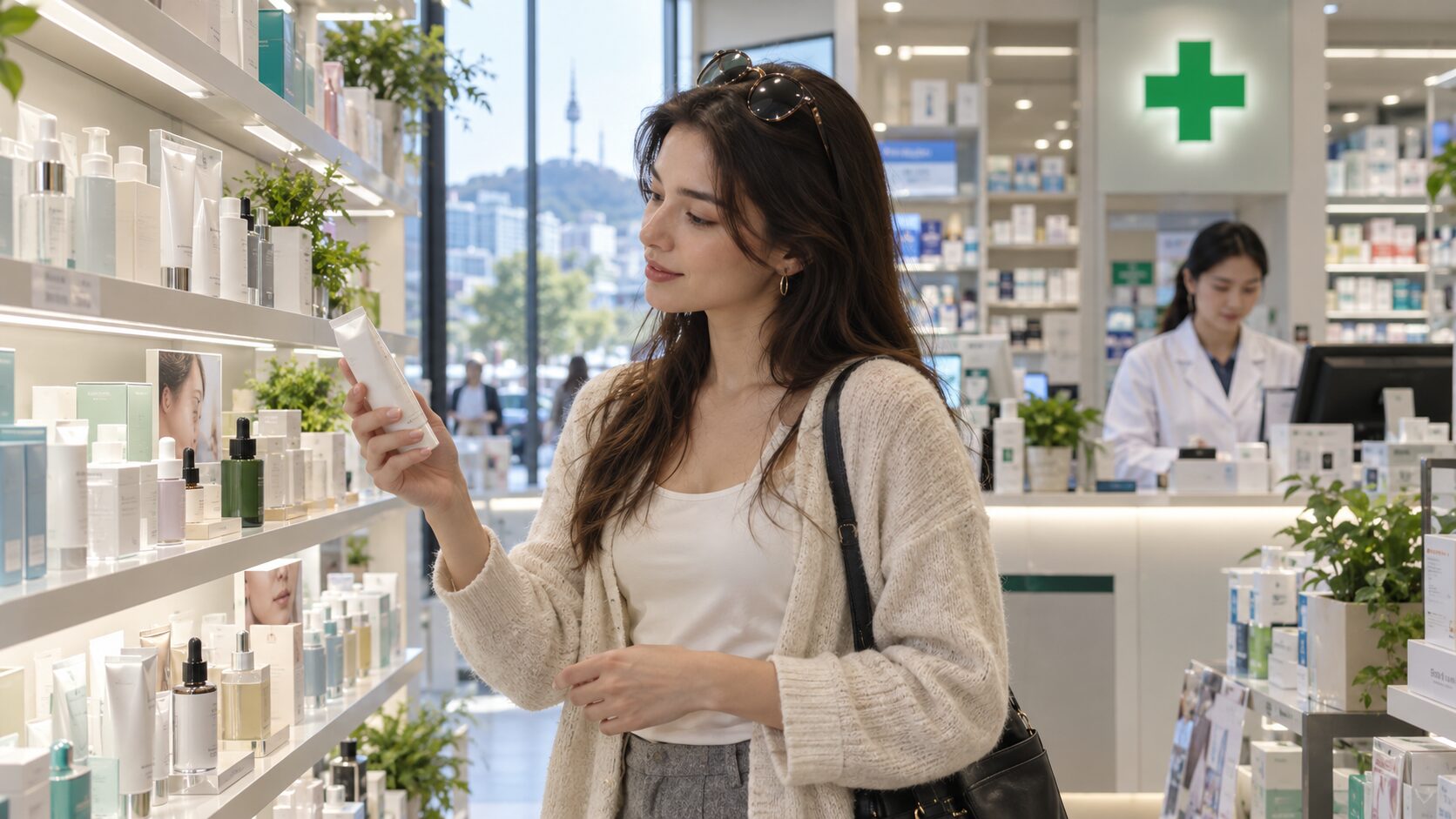
For years, international beauty shoppers visiting South Korea had one obvious stop: Olive Young.
But in 2026, another destination is becoming part of the K-beauty itinerary — the Korean pharmacy.
In popular Seoul neighborhoods such as Myeongdong, Hongdae, Gangnam and Seongsu, pharmacies are increasingly attracting international visitors looking beyond everyday cosmetics. Some arrive after dermatology appointments. Others come with screenshots and shopping lists saved from TikTok, Instagram, YouTube or Xiaohongshu.
What makes this trend especially interesting is that it is not simply about finding another place to buy Korean skincare.
It reflects a broader change in the way international visitors experience K-beauty in Korea.
Why Are Tourists Suddenly Shopping at Korean Pharmacies?
The numbers help explain why Korean pharmacies are getting attention.
Korean tourism data shows that pharmacies have become a more significant part of international visitors’ spending. According to a June 2026 report by Yonhap News Agency citing Korea Tourism Organization data, pharmacies accounted for 12.9% of foreign visitors’ estimated medical spending in May, compared with 4.9% in January 2025.
The figures are based on estimates using foreign visitors’ Shinhan Card spending, rather than a complete count of every tourist purchase. They nevertheless show how pharmacies are becoming more prominent alongside dermatology clinics and other health-related stops on a Korean travel itinerary.
At the same time, beauty tourism in Seoul has expanded beyond simply buying cosmetics.
Some international visitors now combine several experiences during the same trip:
Olive Young → Dermatology → Pharmacy
A visitor might discover Korean skincare products at a beauty retailer, receive a skin treatment at a clinic, and then visit a nearby pharmacy to ask about aftercare or other skin-related products.
That makes the pharmacy a new piece of the wider K-beauty travel experience.
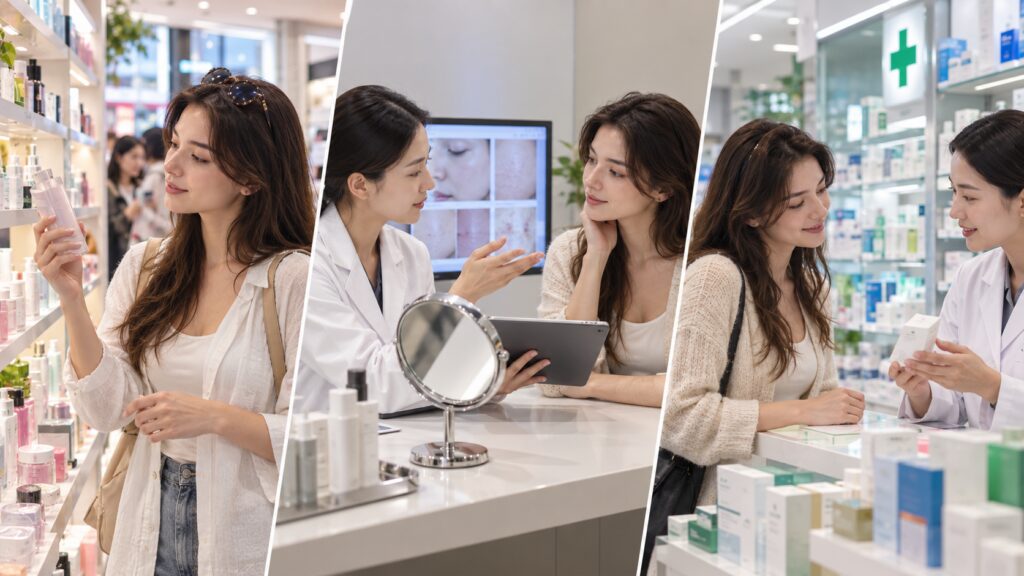
What Does “Korean Pharmacy Skincare” Actually Mean?
This is where an important distinction needs to be made.
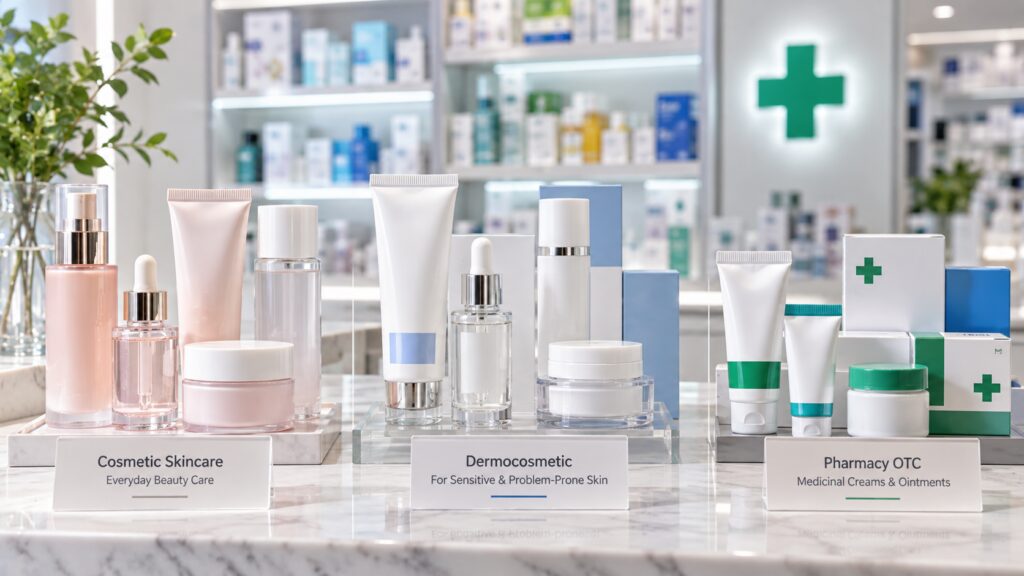
“Korean pharmacy skincare” is a useful search term and social-media phrase, but it is not a single official product category in Korea.
Products found in a Korean pharmacy may include cosmetics and dermocosmetics, while other skin-related products may be over-the-counter medicines or belong to different regulated categories.
That means a tube that looks like a skincare cream should not automatically be treated like an ordinary cosmetic moisturizer or serum.
This is one of the biggest differences between watching a viral pharmacy haul online and actually shopping at a pharmacy in Korea.
When a product is a medicine, its intended use, directions and precautions matter.
If you are unsure what a product is, asking the pharmacist is more useful than choosing it simply because it appeared in a viral video.
Why Korean Pharmacies Feel Different From Olive Young
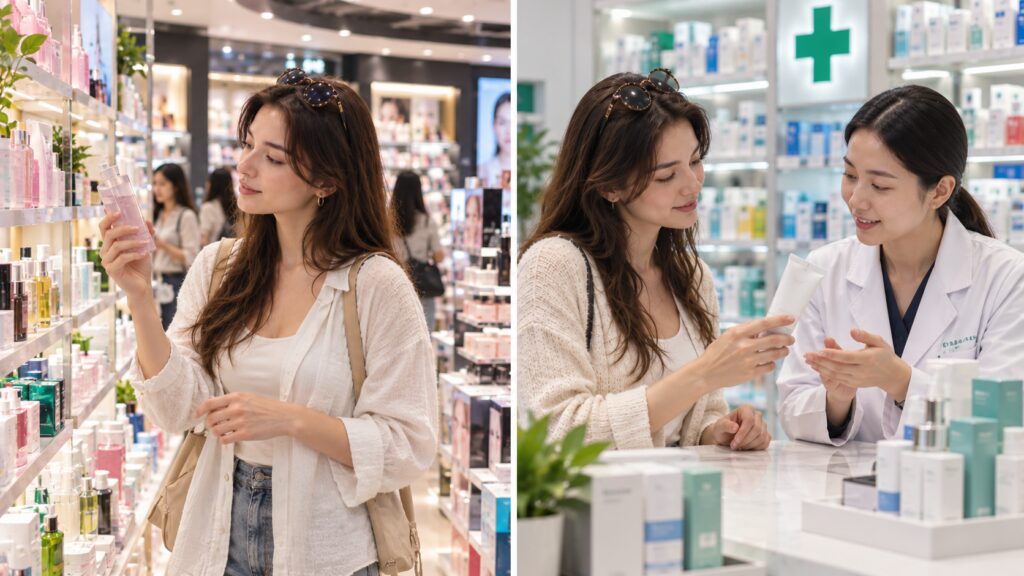
Olive Young and Korean pharmacies can both appear on a K-beauty shopping itinerary, but they serve different purposes.
A beauty retailer is designed primarily for browsing cosmetics, comparing brands, testing textures and discovering trending products.
A pharmacy is a healthcare setting where a licensed pharmacist can help customers understand medicines and other products sold there.
This distinction is important.
At a beauty store, you might ask:
“What serum is popular right now?”
At a pharmacy, a more useful question may be:
“What type of product is this, and how should it be used?”
That difference is one reason pharmacy shopping has become interesting to international beauty travelers. It adds a more specialized layer to the Korean beauty-shopping experience.
For the other side of that comparison, our Olive Young Korea guide explains what first-time visitors can expect from Korea’s best-known health and beauty retailer, from product categories to major Seoul shopping locations.
What Are International Visitors Looking For?
The exact products vary, but several skin-related categories repeatedly appear in Korean media coverage and international social-media discussions.
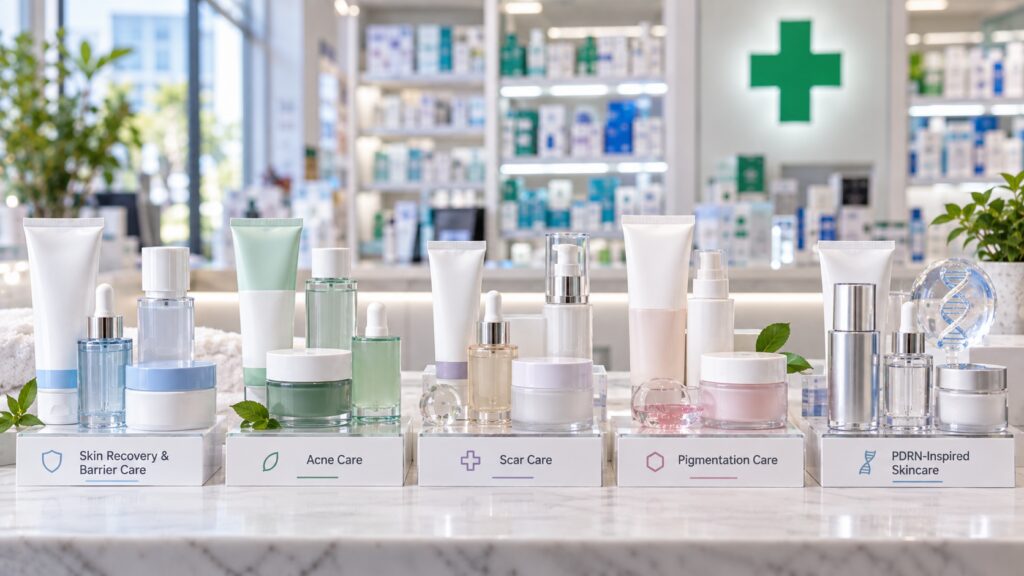
1. Skin Recovery and Barrier Care
Visitors interested in intensive skincare often look for products associated with dry, irritated or stressed skin and post-treatment care.
This category has become particularly visible as Korean dermatology tourism has grown.
However, “recovery cream” is a broad description. Products can differ significantly in ingredients, classification and intended use.
2. Acne-Related Products
Acne creams and other blemish-related products are another frequently discussed pharmacy category.
But acne can have many causes and levels of severity, and a viral product is not automatically appropriate for every person.
If you are buying an OTC medicine rather than a cosmetic, ask the pharmacist about its intended use and directions.
3. Scar and Wound-Care Products
Scar gels, ointments and wound-care products are among the categories that often appear in Korean pharmacy shopping content.
Here, the distinction between products becomes especially important.
A product intended for a minor wound may not serve the same purpose as a product intended for a healed scar.
Rather than asking only for “the famous Korean scar cream,” explain what you actually need to the pharmacist.
4. Pigmentation-Related Products
Products associated with pigmentation and dark spots have also attracted international attention.
Again, some may not be ordinary cosmetics.
Check the product classification and directions instead of assuming that every cream sold for a skin concern can simply be added to a daily skincare routine.
5. PDRN and Regeneration-Focused Skincare
PDRN is another reason Korean pharmacy skincare has caught the attention of international beauty shoppers.
The ingredient has become increasingly visible across Korean skincare, professional beauty treatments and beauty discussions overseas.
If you have been following K-beauty recently, you may already have seen PDRN described as one of Korea’s most talked-about skincare ingredients.
Related: Read our guide to PDRN skincare to understand what PDRN is, why it became popular in Korea, and what consumers should know before buying it.
PDRN Is a Good Example of Why the Details Matter
The popularity of PDRN also shows why consumers should pay attention to terminology.
A cosmetic containing PDRN-related ingredients is not the same thing as an injectable treatment performed at a medical clinic.
Packaging, social-media videos and marketing language can sometimes make different products sound more similar than they actually are.
When shopping in Korea, check whether you are looking at a cosmetic, an OTC product or something associated with a professional medical procedure.
The same principle applies to other trending Korean skincare ingredients.
A popular ingredient name alone does not tell you everything about how a product should be used.
The same caution applies to spicule skincare, another Korean beauty trend where cosmetic products are sometimes compared with professional microneedling even though the two are not equivalent.
Seoul Pharmacies Are Changing Too
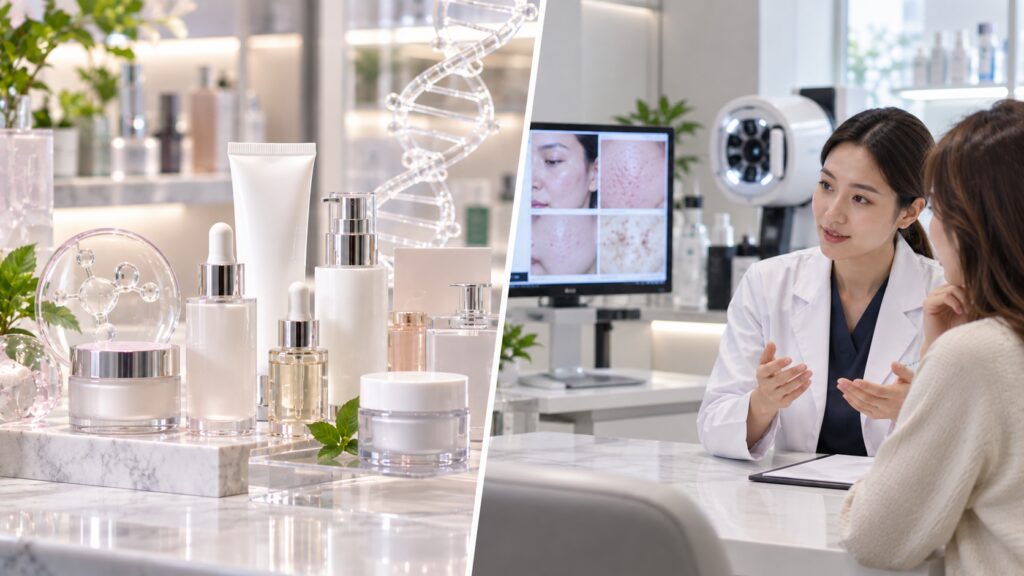
The pharmacy itself is also evolving.
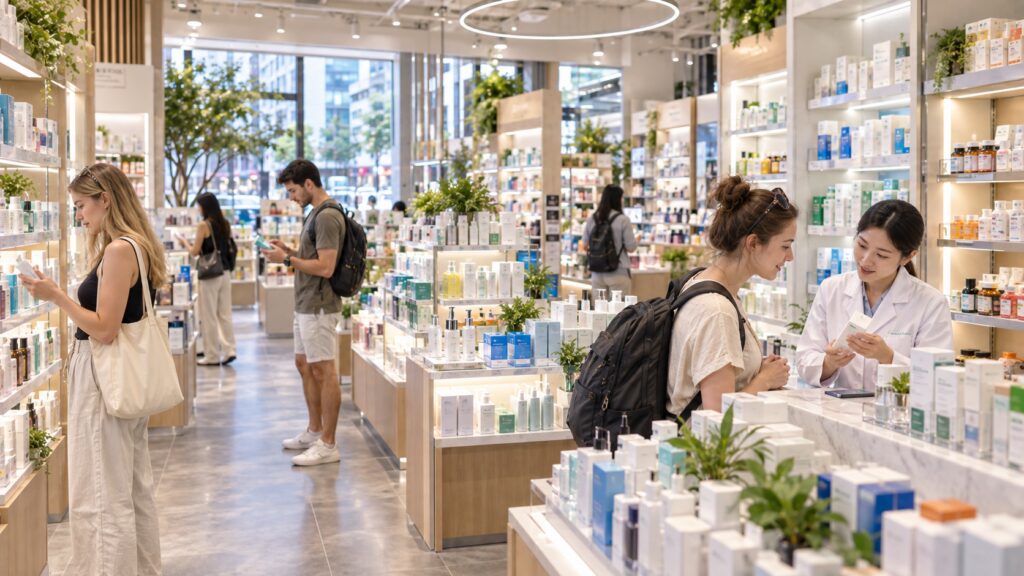
In areas popular with international visitors, some Korean pharmacies are becoming much more beauty-focused than the small neighborhood pharmacies travelers may expect.
Seoul’s official tourism guide features Ready Young Pharmacy in Seongsu as an example of this newer pharmacy-shopping format. It offers pharmacist-guided pharmaceutical products alongside selected K-beauty cosmetics and dermocosmetics. The tourism guide also describes an AI-based skin-analysis service used to recommend cosmetics suited to a customer’s skin type. This cosmetic recommendation service should not be confused with a medical diagnosis.
Other large pharmacy concepts are also combining traditional pharmacy products with supplements and trendy K-beauty items.
This helps explain why the “K-pharmacy” trend feels different in 2026.
The change is happening on both sides:
Tourists are treating pharmacies as beauty-shopping destinations, while some pharmacies are adapting to beauty-focused and international customers.
For travelers who want a concrete example, Ready Young Pharmacy is listed at 47 Seongsuil-ro 6-gil, Seongdong-gu, Seoul, near Exit 4 of Seongsu Station on Subway Line 2. Seoul’s tourism guide lists daily opening hours of 10 a.m. to 11 p.m. and services for international visitors. Check the official listing before visiting, as operating hours and services may change.
Where Can Travelers Find Korean Pharmacy Skincare in Seoul?
You do not need to travel to one specific “famous” pharmacy to experience this trend.
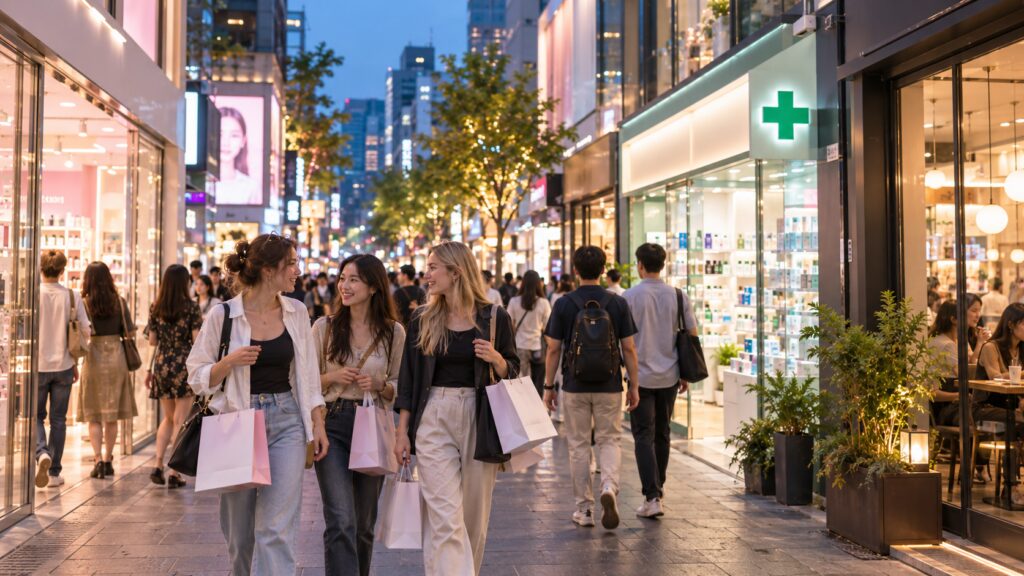
Pharmacies can be found throughout Seoul, but major visitor districts make the trend particularly easy to see.
Myeongdong
Myeongdong combines cosmetics stores, pharmacies, hotels, restaurants and beauty clinics within a relatively compact area.
For first-time visitors already planning a K-beauty shopping day, it is one of the easiest areas to compare traditional beauty retail with pharmacy shopping.
Hongdae
Hongdae attracts a younger international crowd and has a dense mix of shopping, beauty services and pharmacies.
The area has also appeared repeatedly in Korean reporting about foreign visitors buying skin-related products after beauty treatments.
Gangnam
Gangnam and nearby beauty districts have a particularly strong connection to Korea’s dermatology and aesthetic-treatment industry.
For visitors receiving professional treatments, pharmacies may become part of the aftercare journey.
Seongsu
Seongsu is one of Seoul’s most interesting neighborhoods for watching new Korean beauty and lifestyle trends develop.
Flagship stores, pop-ups, fashion, cafés and increasingly beauty-focused pharmacy concepts can all become part of the same neighborhood experience.
Before You Buy: 5 Things to Check
Korean pharmacy skincare can be interesting to explore, but a viral shopping list should not replace basic product checks.
First, ask whether the product is a cosmetic or a medicine.
Second, explain what you want the product for instead of simply showing a viral screenshot.
Third, ask how the product should be used and whether there are important precautions.
Fourth, do not assume that a higher concentration or stronger formula automatically makes a product better for your skin.
Finally, if you have a persistent, severe or worsening skin problem, pharmacy shopping should not replace appropriate medical care.
This is especially important for international travelers who may be unfamiliar with Korean product classifications or packaging.
Useful Korean Phrases at a Pharmacy
You do not need to speak fluent Korean to ask a few useful questions.
이거 화장품인가요, 의약품인가요?
Igeo hwajangpum-ingayo, uiyakpum-ingayo?
Is this a cosmetic or a medicine?
처방전이 필요한가요?
Cheobangjeoni piryohan-gayo?
Do I need a prescription?
어떻게 사용해요?
Eotteoke sayonghaeyo?
How do I use this?
민감한 피부에도 사용할 수 있나요?
Min-gamhan pibuedo sayonghal su innayo?
Can this be used on sensitive skin?
If pronunciation feels difficult, simply show the Korean sentence on your phone.
Is Korean Pharmacy Skincare Worth Exploring?
For beauty travelers, yes — but probably not for the reason social media sometimes suggests.
The interesting part is not that Korean pharmacies contain a secret shelf of miracle products.
It is that Korea’s beauty culture is expanding beyond conventional cosmetics shopping.
Beauty retailers, dermatology clinics, pharmacies, pop-up stores and beauty-focused neighborhoods are increasingly becoming connected parts of the same travel experience.
That wider shift is also fueling the rise of K-beauty tourism in Korea, where skincare shopping, personal color, fragrance, wellness and other beauty experiences are becoming part of the travel itinerary.
That is what makes Korean pharmacy skincare one of the more interesting K-beauty trends to watch in 2026.
Olive Young is not disappearing from the itinerary.
The itinerary is simply getting longer.
And in Seoul, the next stop may have a familiar Korean sign above the door:
약국 — Pharmacy.
FAQ
Is Korean pharmacy skincare the same as K-beauty cosmetics?
Not necessarily. “Korean pharmacy skincare” is a broad informal term. A pharmacy may sell cosmetics and dermocosmetics, but some skin-related products may be OTC medicines or belong to other categories. Always check the individual product.
Can tourists buy skincare products at Korean pharmacies?
Yes. International visitors can shop at Korean pharmacies, but whether a particular medicine requires a prescription depends on the product. Ask the pharmacist if you are unsure.
Is Korean pharmacy skincare better than Olive Young skincare?
They should not be treated as direct substitutes. Olive Young primarily offers beauty and personal-care products for consumer retail, while pharmacies also sell medicines and provide access to a licensed pharmacist. The better option depends on what you are looking for.
Why are Korean pharmacies popular with tourists in 2026?
The trend is connected to the international popularity of K-beauty, Korean dermatology, social-media pharmacy hauls and growing interest in specialized skin-related products. Korean tourism spending data and media reports show significant growth in pharmacy spending by foreign visitors in 2026.
Where should tourists look for pharmacies in Seoul?
Pharmacies are found throughout the city. Myeongdong, Hongdae, Gangnam and Seongsu are especially convenient for travelers because pharmacies can be combined with beauty shopping, dining and other sightseeing.
Do I need a prescription at a Korean pharmacy?
It depends on the product. Some medicines require prescriptions while others can be supplied without one. Cosmetics do not require prescriptions. If you cannot identify the product category, ask the pharmacist before purchasing.
Sources & Further Reading
- Yonhap News Agency — Foreign visitors’ medical spending and the growing share of Korean pharmacies, June 2026
- Visit Seoul — Seongsu Ready Young Pharmacy: products, visitor services and location
What’s trending in Korea, explained from Korea.
Korea Front Row