

Seoul’s subway system can look intimidating on a map, but for most visitors, it quickly becomes one of the easiest ways to explore the city.
The bigger question is often not which train to take, but how to pay for it.
Should you buy a T-money card? Is the Climate Card better for a short trip? Can you use an international credit card? And what happens when your airport train connects with the subway?
This Seoul subway guide explains the basics for international visitors, including T-money, the tourist-friendly Climate Card short-term pass, transfers, fares and a few details that are easy to miss on a first trip.
Is the Seoul Subway Easy for Tourists?
For most travelers, yes.
Seoul has an extensive subway network connecting major sightseeing areas, shopping districts, traditional neighborhoods and hiking access points. Station names and route information are generally displayed in Korean and English, and major stations also use Chinese and Japanese.
The Seoul Metropolitan Government also provides the Seoul Subway app, which includes route information, station directions and nearby attractions.
The part that may take a little getting used to is the scale of the system. Some transfer stations are enormous, and two stations that look close on a map can involve a surprisingly long walk underground.
Before entering the gate, check three things:
- the line number or name;
- the station number; and
- the direction of travel, usually indicated by the next major station.
Once you understand those basics, using the system becomes much easier.
T-money vs Climate Card: Which One Should You Use?
For most short-term visitors, the practical choice comes down to T-money or the Climate Card Short-Term Pass.
They work differently.
| Comparison | T-money | Climate Card Short-Term Pass |
|---|---|---|
| Payment style | Pay as you travel | Unlimited travel within the covered network during the pass period |
| Best for | Flexible travel and trips beyond central Seoul | Frequent public transport use while sightseeing in Seoul |
| Validity | Continue using while the card has sufficient balance | 1, 2, 3, 5 or 7 days |
| Travel area | Widely accepted on public transport in Korea | Limited to the designated Climate Card service area |
| Main consideration | You need to maintain a balance | You need to check whether your routes are covered |
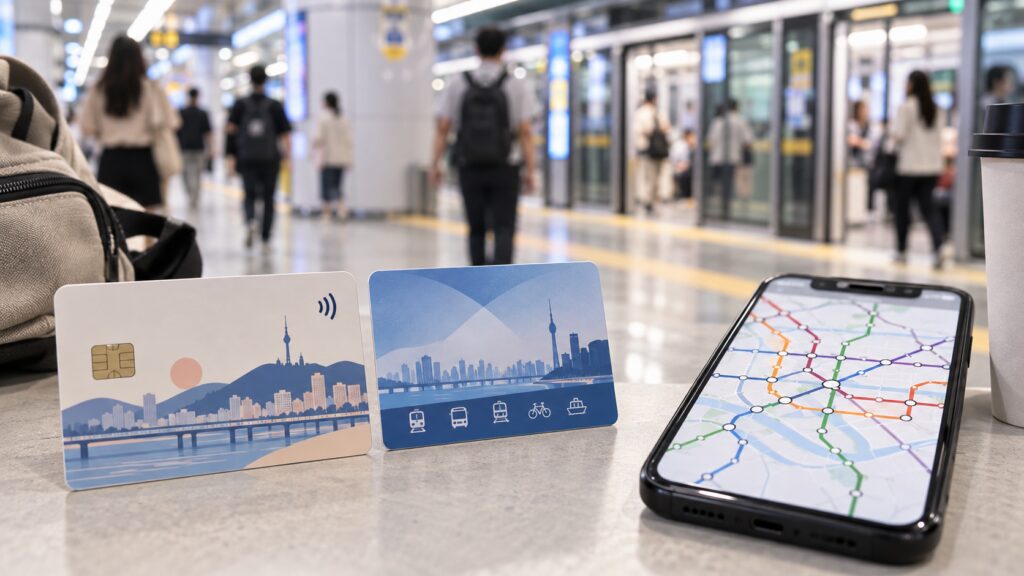
There is no single card that is automatically cheaper for every visitor.
If you plan to make only a few subway trips each day or travel outside Seoul, T-money is often the simpler option.
If you expect to use Seoul public transportation repeatedly throughout the day, a Climate Card short-term pass may be worth comparing with your expected pay-as-you-go fares.
What Is a T-money Card?
T-money is a rechargeable prepaid transportation card widely used in Korea.
Instead of buying a ticket for every subway ride, you add money to the card and tap it at the subway gate. The appropriate fare is deducted according to your journey.
T-money can also be used on many buses and other participating transportation services, making it useful if your Korea itinerary extends beyond Seoul.
If your trip also includes Korea’s second-largest city, our Busan travel guide for first-time visitors explains where to stay, how to get around and how to plan a two- or three-day itinerary.
Cards are commonly available at convenience stores and transportation facilities.
One point is especially important for international visitors: do not assume that an overseas credit card can be used everywhere to purchase or recharge a standard T-money card.
According to current Korea Tourism Organization guidance, standard prepaid T-money purchases and top-ups generally require cash at the usual convenience-store and station locations.
Keeping some Korean won available for transportation can therefore still be useful.
For payment options beyond subway fares, our guide to paying in Korea as a tourist compares overseas bank cards, cash and transportation payments.
What Is the Climate Card Short-Term Pass?
Seoul’s Climate Card has a separate short-term option designed for visitors who want unlimited use of eligible public transportation for a fixed period.
Current short-term prices are:
- 1 day — KRW 5,000
- 2 days — KRW 8,000
- 3 days — KRW 10,000
- 5 days — KRW 15,000
- 7 days — KRW 20,000
A physical Climate Card costs an additional KRW 3,000.
One detail is easy to overlook: a short-term pass begins on the day it is loaded.
You cannot load it several days in advance and choose a later activation date.
If you load a one-day pass today, for example, its validity runs through the final eligible service that day rather than for a rolling 24-hour period.
The Climate Card system has also been changing in 2026. Seoul has moved its resident-focused monthly program toward a new system, while the 1-, 2-, 3-, 5- and 7-day short-term passes for tourists continue to be offered.
For visitors, it is therefore more useful to focus on the short-term pass rather than older information about the former 30-day prepaid Climate Card.
Where to Buy and Recharge a T-money Card
For many visitors, the easiest place to buy a standard T-money card is a convenience store.
Look for major Korean convenience-store chains near your accommodation, airport transportation area or subway station.
After buying the card, add enough balance for your first several journeys.
Subway stations also have transportation-card facilities, but payment options can vary depending on the machine and the type of card.
This distinction has become more important in 2026 because Seoul has expanded international card payment at its newer ticket machines — but that does not mean every T-money machine now accepts every overseas card.
If you are using standard T-money, having some Korean cash remains a practical backup.

How to Use the Seoul Subway Step by Step
Once you have a transportation card, riding the subway is straightforward.
1. Find Your Route
Check your starting station, destination and line.
Seoul’s subway lines are identified by colors, numbers or names. Station numbers can be particularly helpful when Korean place names look unfamiliar.
For routes involving a transfer, check the transfer station before entering.
2. Check the Direction
A common first-time mistake is entering the correct line in the wrong direction.
Instead of relying only on the final destination of the line, look at the name or number of the next station shown on the platform signs.
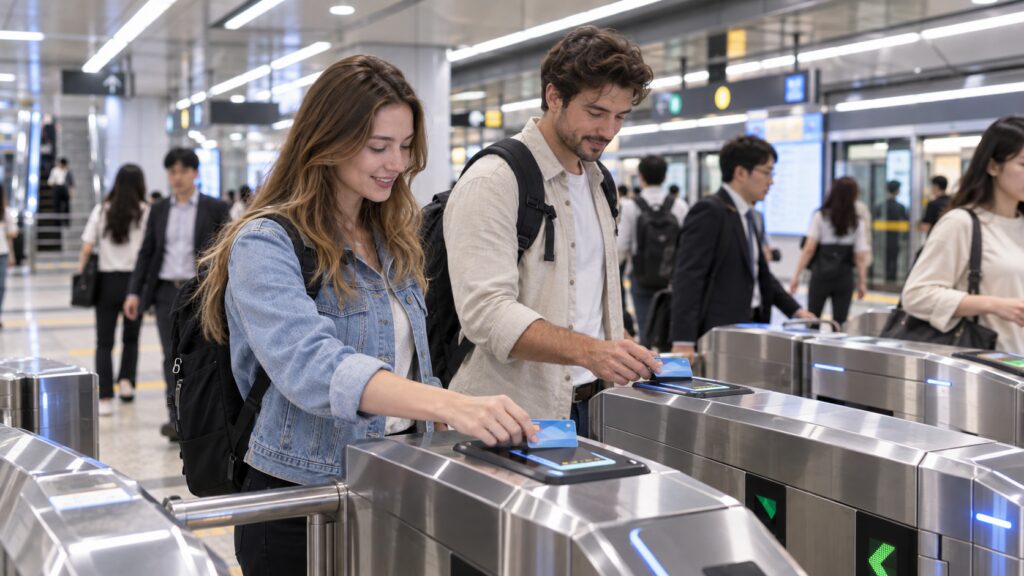
3. Tap In
Place your T-money or eligible transportation card on the reader at the gate.
The screen will display information such as the fare or remaining balance, depending on the card.
Wait for the gate to open and enter.
4. Follow the Transfer Signs
If your route requires another subway line, follow the clearly marked transfer signs inside the station.
You normally do not need to leave the paid area to transfer between subway lines.
Some major transfer stations involve a substantial walk, so allow extra time if you are carrying luggage or traveling with children.
5. Tap Out at Your Destination
Tap your card again when leaving through the exit gate.
With a standard transportation card, this allows the system to calculate the correct distance-based fare and is also important when connecting to buses under the integrated transfer system.
How Subway and Bus Transfers Work in Seoul
Seoul uses an integrated public transportation fare system.
With an eligible transportation card, subway-to-bus, bus-to-subway and other qualifying transfers can be calculated as part of the same journey rather than automatically charging a completely new base fare each time.
According to Seoul’s current rules, qualifying transfers generally need to take place within 30 minutes after tapping out, with the window extended to 60 minutes between 9 p.m. and 7 a.m.
This is why tapping when you get off a bus matters.
Visitors sometimes see locals tapping their card at the rear door and assume it is optional. It is not something you should casually skip if you want the correct transfer calculation.
How Much Does the Seoul Subway Cost?
As of the current Seoul fare schedule, the adult base subway fare using a transportation card is KRW 1,550.
A single-journey ticket starts at KRW 1,650 for an adult.
Longer journeys can cost more because Seoul’s integrated transit system uses distance-based additional fares beyond the base distance.
For most tourists, the practical point is simple: you do not need to calculate every fare manually when using T-money. Tap in and tap out correctly and the system calculates the fare.
Can Tourists Use Foreign Credit Cards for Subway Tickets?
This changed significantly in 2026.
Starting March 17, 2026, Seoul introduced international credit and debit card payments at 440 new transportation-card vending machines across 273 stations on Seoul Metro Lines 1–8.
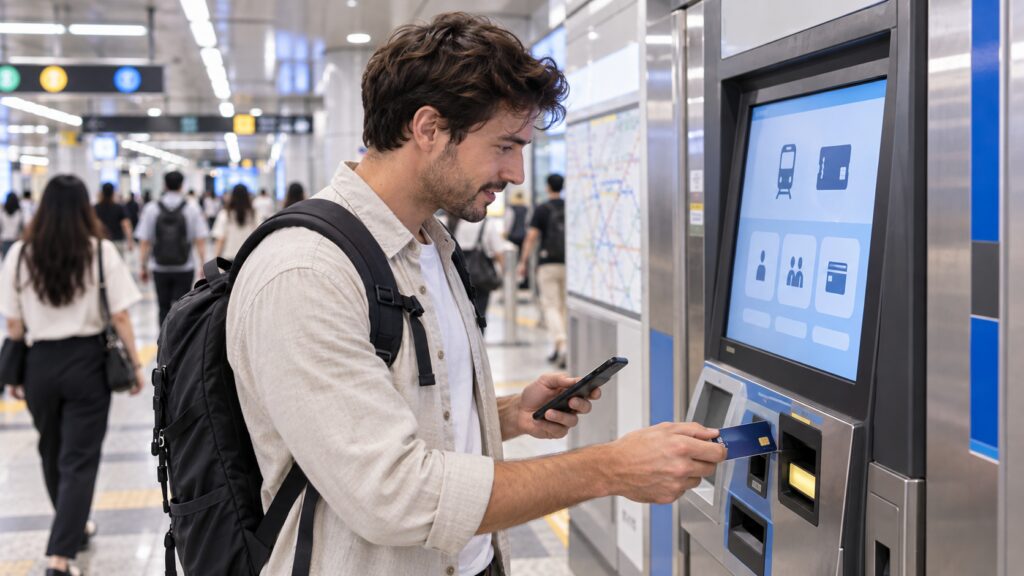
These machines allow international visitors to use eligible overseas cards and mobile payments to purchase or recharge Climate Card short-term passes and to purchase single-journey subway tickets.
That is a major improvement for visitors who arrive without Korean cash.
Seoul Metropolitan Government says payments made with internationally issued credit or debit cards at these machines are subject to an average service fee of approximately 3.7%.
But there is an important distinction.
It does not mean that you can simply tap any foreign Visa or Mastercard at every Seoul subway gate. Seoul has been working toward broader open-loop payment, but standard foreign-card tap-to-ride should not be assumed across the entire network.
It also does not mean every standard T-money purchase or top-up location accepts foreign cards.
Think of these as three separate things:
T-money — a prepaid transportation card.
Climate Card Short-Term Pass — an unlimited-use pass for eligible routes during a fixed number of days.
Single-journey ticket — a ticket for one subway journey.
Keeping those categories separate makes Seoul’s payment system much easier to understand.
Where Does the Climate Card Work?
This is the part of the Climate Card that travelers should check most carefully.
The pass is designed primarily around Seoul’s public transportation network, and not every railway line or station in the wider metropolitan region is automatically included.
The rules are also changing.
From October 1, 2026, the short-term Climate Card service area is scheduled to focus on travel within Seoul, while still allowing eligible journeys ending at Incheon International Airport.
This matters because the subway map extends far beyond Seoul’s administrative boundary into Gyeonggi Province and Incheon.
A station appearing on a Seoul metropolitan subway map does not automatically mean that every Climate Card journey to that station is covered.
If your itinerary includes destinations outside Seoul, check the latest official Climate Card service area before relying on the pass.
T-money is generally the more flexible choice when your trip extends widely beyond Seoul.
What About Incheon Airport and AREX?
Airport transportation deserves its own explanation because AREX is not simply another ordinary Seoul subway ride.
AREX operates both an All-Stop Train and an Express Train between Incheon International Airport and Seoul.
The Express Train runs nonstop between the airport and Seoul Station and uses its own ticketing system.
The All-Stop Train serves multiple stations and connects with Seoul’s urban rail network.

Climate Card rules are more specific.
Under the current system, covered AREX travel includes the section between Gimpo International Airport and Seoul Station. A passenger who boards within the Climate Card service area can also exit at Incheon International Airport Terminals 1 or 2 under the applicable rule.
However, the Climate Card cannot currently be used to start a journey at Incheon Airport.
So if you have just landed at Incheon Airport and are traveling into Seoul, do not assume that a Climate Card will replace your airport train ticket.
Buy the appropriate AREX ticket or use another accepted payment option for your journey into the city, then set up the transportation card that best fits the rest of your stay.
If you are deciding between the airport train, limousine bus and taxi, our Incheon Airport to Seoul guide compares the main options by destination, luggage and travel time.
Seoul Subway Etiquette Tourists Should Know
You do not need to memorize a long list of rules to ride the subway comfortably.
A few habits are enough.
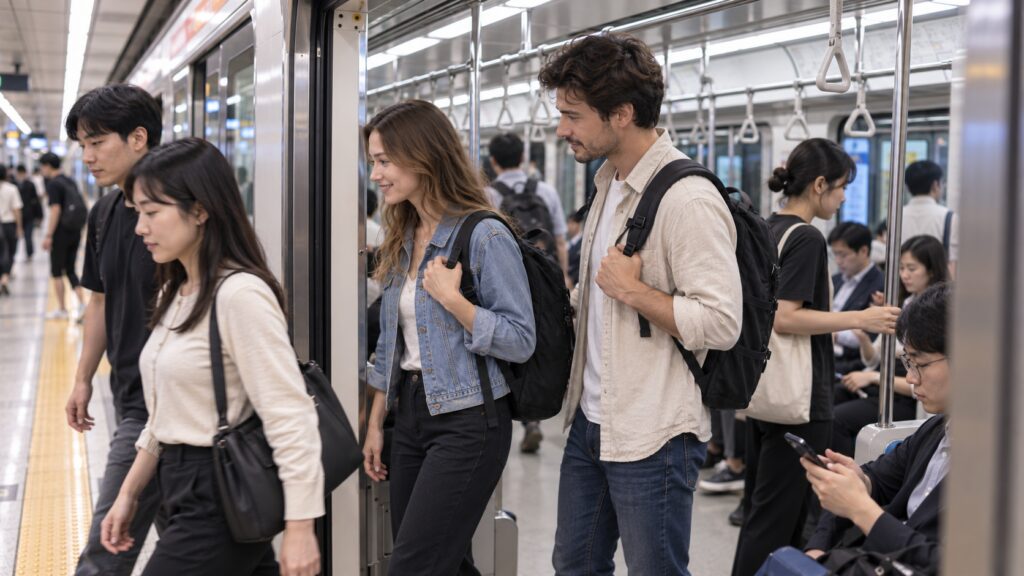
Let passengers leave the train before boarding. Avoid standing directly in front of the doors when people are trying to exit.
Keep conversations and phone audio at a reasonable volume.
Priority seating is clearly marked. Some seating is designated for older adults, people with disabilities, pregnant passengers and others who may need it.
During rush hour, backpacks can take up surprising amounts of space. Holding a large bag in front of you or placing it where it will not hit other passengers makes crowded trains easier for everyone.
And on long escalators or crowded station passages, pay attention to the flow around you rather than stopping suddenly to check your phone.
The goal is not to worry about making a cultural mistake. It is simply to move with the same awareness you would use on any busy urban transit system.
Useful Seoul Subway Tips for First-Time Visitors
Use station numbers as well as names. They can make similar-looking station names easier to distinguish.
Check the exit number before leaving the station. Large stations may have many exits, and choosing the wrong one can add a significant walk.
This matters especially when visiting walkable historic neighborhoods such as Bukchon Hanok Village, where choosing the right subway exit can make the start of your visit much simpler.
The same is true when visiting Gyeongbokgung Palace, where choosing the right station and exit can make it easier to start your palace visit without unnecessary walking.
Allow time for transfers. A transfer shown as one stop on an app can still involve several minutes of walking inside a large station.
Keep some Korean cash available. International card acceptance has improved, but standard T-money purchase and top-up options are not universally cashless.
Check the Climate Card service area before a day trip. The metropolitan rail network extends well beyond Seoul.
If you are planning a DMZ tour from Seoul, check the tour’s meeting point and transportation arrangements separately, since many controlled DMZ sites are not places you can simply reach with a regular Seoul transit pass.
Separate airport transportation from city transportation when planning. AREX Express, AREX All-Stop and Seoul subway services have different fare and pass rules.
Once those details make sense, Seoul’s subway becomes much less complicated than the map initially suggests.
For most visitors, the real decision is simply whether the flexibility of T-money or the unlimited rides of a Climate Card short-term pass better matches the itinerary.
After that, exploring Seoul is largely a matter of choosing a station, checking the direction and tapping in.
FAQ
Is T-money better than the Climate Card for tourists?
It depends on your itinerary. T-money is flexible and widely useful if you are making fewer journeys or traveling beyond Seoul. A Climate Card short-term pass can be attractive if you expect to use eligible Seoul public transportation frequently during a 1-, 2-, 3-, 5- or 7-day period.
Can I buy a T-money card at the airport?
T-money cards are widely sold through convenience stores and transportation-related locations, including places used by travelers. Availability can vary, so check the current transportation facilities in your arrival terminal.
Can I recharge T-money with a foreign credit card?
Do not assume you can. Current Korea Tourism Organization guidance says standard prepaid T-money purchases and top-ups at common convenience-store and station locations generally require cash. Seoul’s newer international-card machines primarily improve payment for Climate Card short-term passes and single-journey tickets.
Can tourists buy the Seoul Climate Card?
Yes. Seoul continues to offer short-term Climate Card passes specifically useful for visitors, with 1-, 2-, 3-, 5- and 7-day options.
Do I need to tap my card when leaving the subway?
Yes. Tap when entering and exiting. The system uses your journey information to calculate the appropriate fare. Tapping correctly is also important when using integrated public transportation transfers.
Does the Climate Card work on trains to Incheon Airport?
Only under specific conditions. Current Climate Card coverage includes AREX between Gimpo International Airport and Seoul Station, and eligible passengers boarding within the service area may exit at Incheon Airport Terminals 1 or 2. You cannot currently use the Climate Card to board AREX at Incheon Airport for the trip into Seoul. Check the latest rules before traveling because the short-term pass service area is changing from October 1, 2026.
Sources & Further Reading
Seoul Metropolitan Government — Public Transportation
Official guidance on Seoul subway, buses, transportation cards, transfers and single-journey tickets.
Seoul Metropolitan Government — Subway
Official subway fare and transfer information.
Seoul Metropolitan Government — Climate Card
Official Climate Card prices, service area, purchase, charging and usage information.
Seoul Metropolitan Government — International Credit Card Payments for Transit Tickets
Official March 17, 2026 announcement on international card payments at new Seoul subway ticket machines.
Seoul Metropolitan Government — Climate Pass Transition
Official 2026 guidance on the transition of the resident program and changes to the Climate Card short-term pass service area.
VISITKOREA — Korea Transportation Guide
Korea Tourism Organization guidance for international visitors on T-money, Climate Card and transportation payment options.